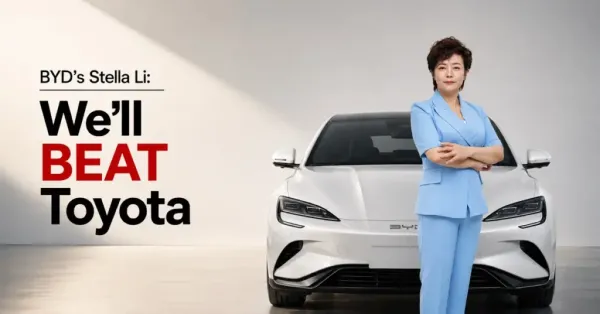
BYD believes it can overtake Toyota as the world’s largest carmaker by sales within five years, even without entering the US passenger-vehicle market.
Stella Li, who leads BYD’s international operations, says the target can be reached through organic growth rather than acquisitions. Europe, Latin America, Southeast Asia, Australia and other overseas markets are expected to provide much of the expansion.
It is an ambitious plan. BYD sold more than 4.6 million new-energy vehicles in 2025. Toyota sold 10.54 million vehicles under the Toyota and Lexus brands. Including Daihatsu and Hino, the Toyota group total reached 11.32 million.
BYD therefore needs to add around six million annual sales merely to catch Toyota’s current company-level volume. If the wider Toyota group is used for comparison, the gap is even larger.
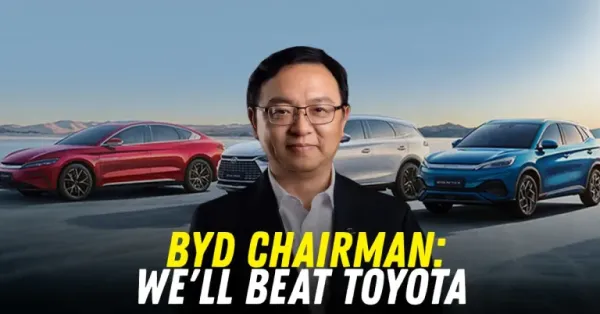
On a flat Toyota sales base, BYD would need to grow by approximately 18 percent every year for five consecutive years to move from 4.6 million to more than 10.5 million vehicles.
Toyota is unlikely to remain static during that period. Its global reach, large hybrid portfolio and strong positions in North America, Japan, Southeast Asia and several developing markets give it room to keep expanding.
BYD’s own 2026 performance also shows that rapid growth cannot be assumed. Its first-half sales fell by around 16 percent as weaker demand in China offset strong overseas growth.
The company is targeting total sales of roughly five million to 5.5 million vehicles in 2026, including as many as 1.5 million outside China. Reaching the upper end would require a substantial acceleration during the second half of the year.
BYD’s overseas business is growing quickly, but China still provides most of its volume. A prolonged domestic slowdown would make the Toyota target far harder.
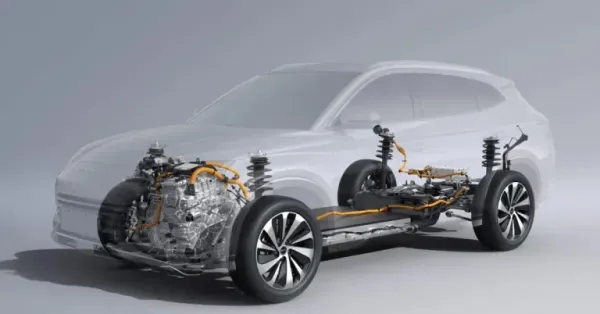
BYD is often described as the world’s largest electric-car company, but its total sales include both battery-electric vehicles and plug-in hybrids.
The company stopped producing conventional petrol-only vehicles in 2022. Its range now consists of battery EVs and plug-in hybrids sold under BYD and brands such as Denza, Fangchengbao and Yangwang.
BYD did overtake Tesla in global battery-electric sales during 2025, selling approximately 2.26 million pure EVs. However, almost half its total volume still came from plug-in hybrids.
That mix is useful for overseas expansion. Pure EV demand is growing unevenly, while plug-in hybrids provide an alternative in countries where charging infrastructure remains limited.
Toyota follows a different strategy. It remains heavily dependent on petrol-electric hybrids, while also selling petrol, diesel, plug-in-hybrid, battery-electric and hydrogen-powered vehicles. Its broad powertrain mix allows it to operate in markets at very different stages of electrification.

BYD cannot rely only on exports from China. Tariffs, political scrutiny and local-content rules are pushing it to manufacture closer to the customer.
The company is expanding production in Brazil, Hungary, Thailand, Indonesia and other markets. Local factories can reduce tariffs, improve delivery times and make it easier to adapt vehicles to regional requirements.
Europe is particularly important. BYD is expanding its dealership network, introducing its Denza premium brand and investing in high-output charging infrastructure. It also plans to use European manufacturing to reduce its exposure to additional duties on China-built EVs.
The US remains effectively closed to BYD passenger cars because of high tariffs and restrictions affecting vehicles and connected technology from China. BYD currently has no plan to depend on that market for its global-sales target.
The company has said acquisitions are not required, although it has not ruled out buying a European luxury brand if a suitable opportunity appears.
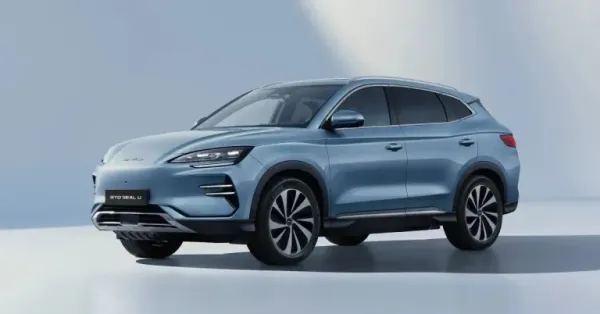
BYD remains a relatively small premium EV player here. It sold around 6,000 passenger vehicles in 2025 and had expanded to 48 dealerships by March 2026.
Its current scale is too small to make a major contribution to a six-million-vehicle global gap. But this market illustrates the challenges BYD will face elsewhere.
Its vehicles offer competitive batteries, range and equipment, but sales remain limited by import rules, pricing and the absence of large-scale local passenger-vehicle production. BYD has examined further local assembly, but no major expansion has been formally confirmed.
Global leadership would bring more products and stronger investment, but it would not automatically improve local value. BYD will also need wider service coverage, faster parts supply and deeper localisation.
The five-year target is mathematically possible only if BYD maintains extraordinary growth across several continents at once. Its technology and manufacturing scale give it a chance. Toyota’s size, reliability reputation and global production network show how difficult the final six million vehicles will be.
-
Wealthtech Startup Veriqus Raises ₹387 Cr To Build AI-Led Investment Platform

-
US Military Faces Rising Casualties Amid Iranian Conflict

-
Rohit Sharma's Stellar Performance at Lord's Silences Retirement Rumors

-
Nurpur Police Enforce Preventive Detention Against Drug Offenders

-
Severe Flooding in Pangi Valley Following Cloudburst