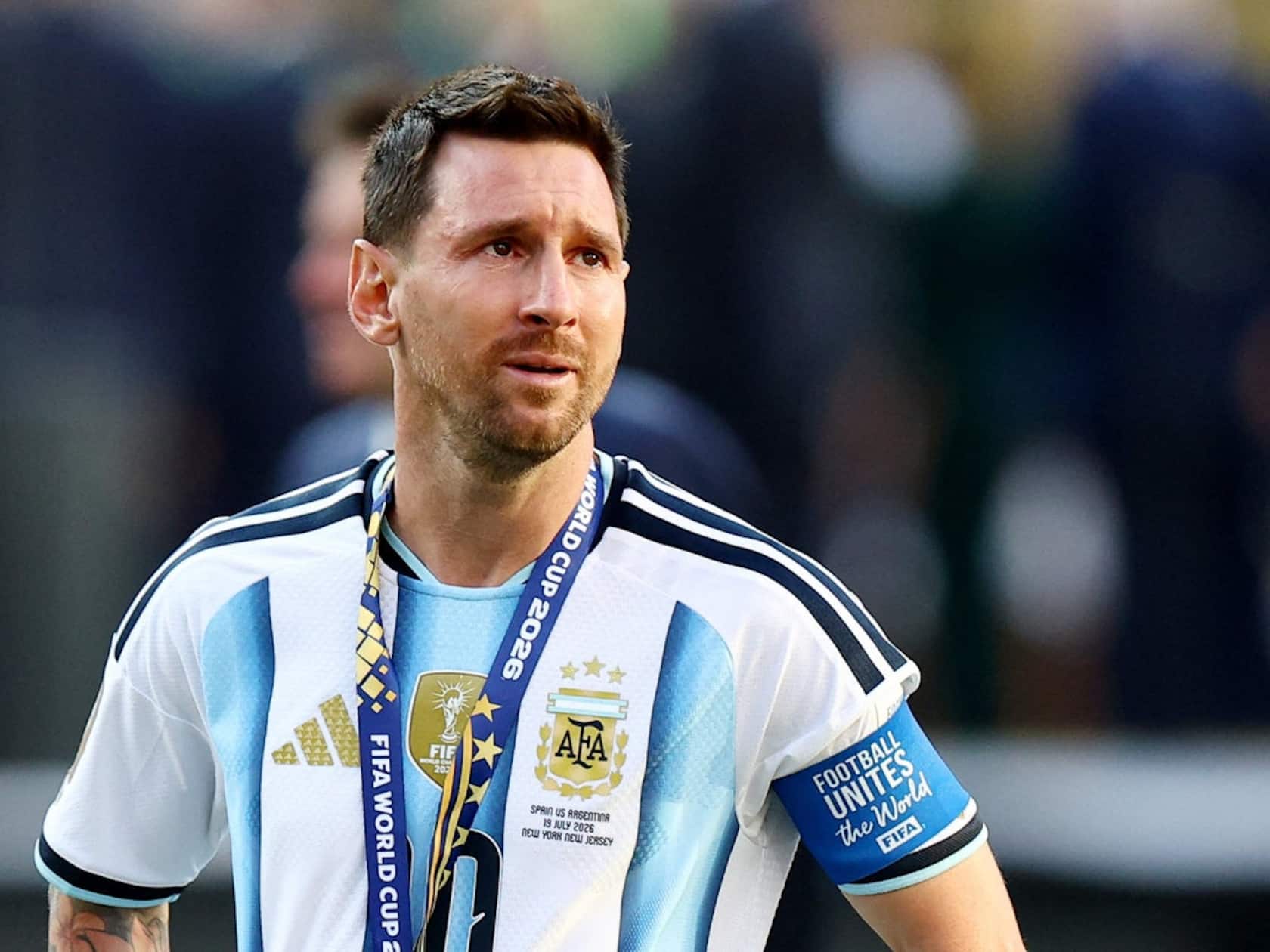
Don’t cry for them, Argentina. Lionel Messi shed a few tears after a disappointing conclusion to one of the greatest World Cup careers ever witnessed. Yet, his teammates deserve far less sympathy. What began as a brave, dramatic, and absorbing attempt to defend the World Cup title ended in a display devoid of discipline, creativity, and, most crucially, goal attempts.
The real historical note was not about becoming the first team since Brazil in 1962 to secure consecutive World Cup victories, but about officially registering as the least attacking side ever in a final. Argentina failed to record a single shot in 90 minutes, finishing regular time with an xG of 0.00. Spain managed 20 shots before Argentina’s first effort finally came in the 121st minute.
This from a side featuring a man involved in more World Cup goals than any other player in history, widely regarded as the greatest footballer of all time. A team built around Messi should never have looked so dull, so focused purely on disruption rather than creation.
Argentina offered almost nothing in the final, leaving Messi completely anonymous. After FIFA’s logistical chaos getting fans into the MetLife Stadium, Argentina wasted their own time once inside. The only consolation for this exercise in futility might be that they possibly bored Donald Trump and the swarm of celebrities who secured tickets that might have been better used by genuine fans.
Even the actors among the crowd must have been confused: this supposed blockbuster lacked drama, and the eventual star turn came from Ferran Torres, a supporting cast member who had not featured in the opening hour. Messi, the marquee name, faded into an unusual and quiet performance.
Messi’s final World Cup record now reads three finals: one won, two lost by a 1-0 margin. For six weeks, the improbable seemed possible—that at 39, he could replicate the magic of 2022 when he scored twice and lifted the trophy. This tournament had felt like a continuation of that triumph: Messi scored in the first five matches, overtook Miroslav Klose’s all-time scoring record, and closed in on the Golden Boot. In a world obsessed with defying age—perhaps including some of FIFA’s high-profile guests—Messi appeared to have discovered a method that relied solely on pure footballing brilliance.
But this was the first match of this World Cup in which he truly failed to influence proceedings. He had scored in the first five games, sparked late against Switzerland, and created both goals in the win over England. Julian Alvarez, a forward valued at around £150 million, was deployed on the left of midfield before being substituted.
By the next World Cup, Messi will be 43, and on this evidence, he received virtually no support against Spain. Argentina’s lack of ambition was astonishing. Perhaps their repeated late comebacks convinced them they didn’t need an early breakthrough. Yet only Torres’ late strike seemed to awaken them. Spain’s compact defence played a part, but that does not excuse Argentina’s passivity. It highlighted how a side lacking pace and width has thrived primarily through its dependence on Messi.
Deprived of service, Argentina descended into ‘anti-futbol’. Throughout the tournament, they had often represented the best of their footballing heritage. But in the final, they reverted to their darker instincts.
Among Argentina’s finals, this was more reminiscent of 1990 than 2022, 1986, or 1978. Enzo Fernandez’s sending off underscored his lack of discipline—first booked for dissent, then dismissed after a reckless foul on Pau Cubarsi. He became the third Argentinian to be sent off in a World Cup final, reluctant to leave the pitch. Perhaps Argentina’s recent success in pushing the limits of physical play had made Fernandez believe he was untouchable.
FIFA may need to review another incident involving an Argentinian. Leandro Paredes, introduced at half-time, quickly lived up to his reputation as the team’s enforcer. He was booked for an off-the-ball challenge on Rodri and, after the final whistle, clashed violently with Gavi, appearing to throw him to the ground—and possibly strike him as well.
After Fernandez’s dismissal, Argentina’s challenge grew steeper. Their title defence became a literal defensive exercise. Goalkeeper Emi Martinez was kept busy and impressive, saving a Lamine Yamal free-kick and producing an even better stop from Nico Williams’ header.
Yet across 120 minutes, it was hard to reconcile this side with the one that had captured a World Cup and two Copa Americas. Spain outplayed and outpassed them—perhaps the first truly elite team Argentina encountered in this campaign. The draw could have paired them with Portugal in the quarter-finals and Brazil in the semi-finals, but they avoided both. Even so, they nearly stumbled in every round, relying on dramatic finishes to survive.
In the end, they tarnished the memory of those victories and dulled the shine of their golden era. Argentina were uninspiring, unthreatening, and unworthy of their past glories. As Frank Sinatra’s voice echoed through the New Jersey air before kickoff, Argentina ultimately did it their way—though this time, it was the wrong way.
-
US Supreme Court to Review Alaska Pilot's Aircraft Seizure Case

-
FDA Confirms Cyclospora Outbreak Linked to Mexican Supplier Despite False Positive

-
Trump Implements 50% Tariff on Canadian Imports Amid Trade Disputes

-
How To Make Perfect Mutton Biryani At Home With These Simple Tips

-
‘I don’t care…’ Rohit Sharma breaks silence on retirement rumors