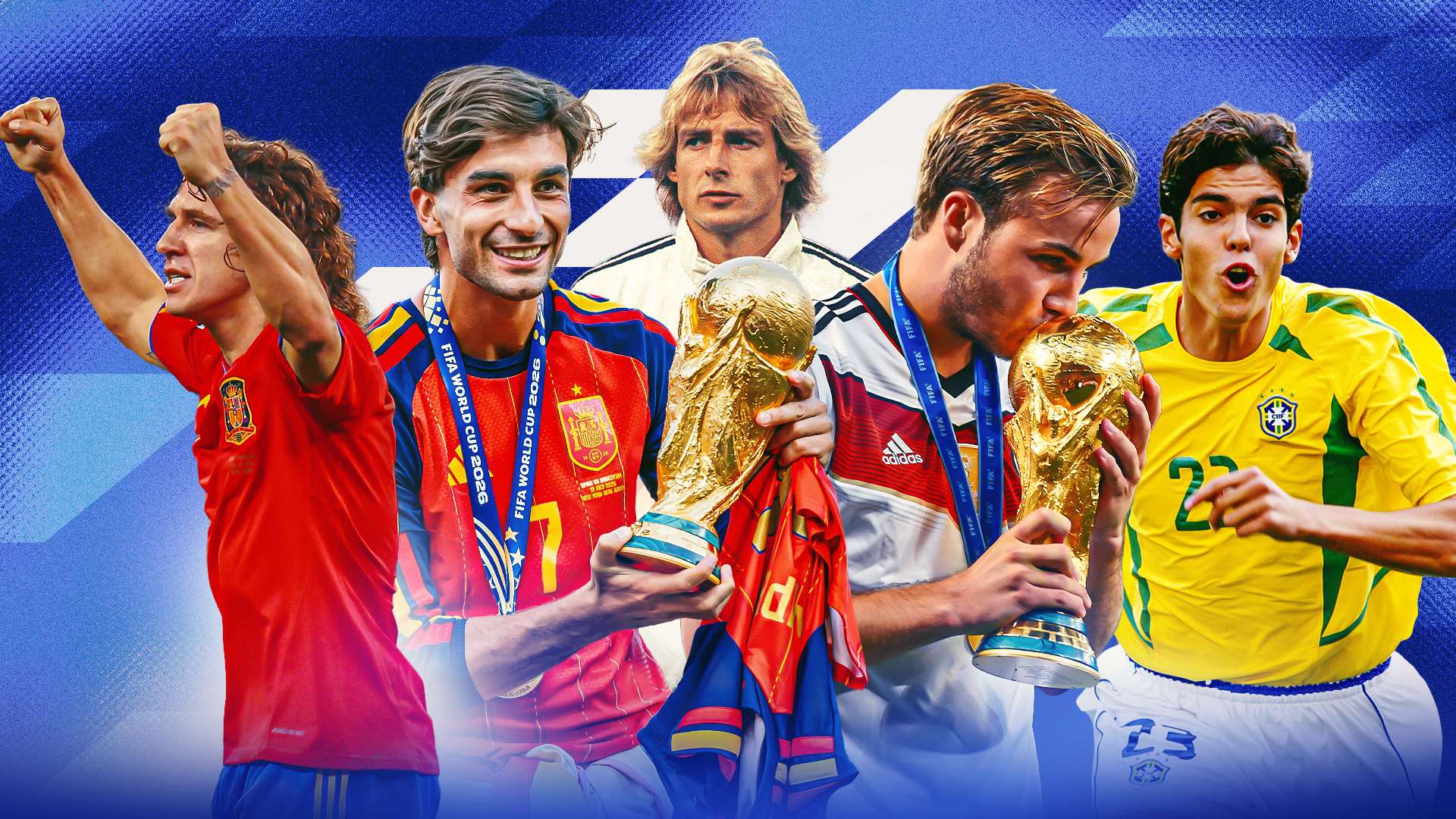
World Cup champions Jurgen Klinsmann, Kaka, Mario Gotze and Carles Puyol spoke to GOAL about the immense pressure, emotional release, and lifelong impact of winning football’s greatest prize.
When Ferran Torres smashed home the decisive goal to clinch the World Cup, he entered one of football’s most exclusive circles. Only three other living players – Geoff Hurst, Andres Iniesta and Mario Gotze – have scored an extra-time winner in a World Cup final. They alone understand the overwhelming euphoria of delivering the game’s ultimate triumph on its grandest stage.
“You also need to speak to [Andres] Iniesta,” Gotze said with a laugh, just a month before Torres joined that rarefied list.
Even after 12 years, Gotze is still asked daily about his historic moment at the 2014 World Cup. He was just 22 then, and on that unforgettable night in Brazil, he etched his name into history. His 113th-minute strike against Argentina sealed Germany’s fourth world title – a goal that defined his career and elevated him to legendary status.
“When I look back,” he reflects, “it’s already been 12 years. It fades a bit over time.”
In total, 497 players have lifted the famous trophy. A new generation of 26 Spanish stars joined that elite group on Sunday, earning their place in football’s most prestigious club. Thousands have tried and fallen short, while millions of children dream of one day holding that golden prize aloft. Only the chosen few know what it truly feels like – and even they struggle to find the words.
The World Cup stands for far more than just silverware. It symbolises achievement and hope. It unites nations, represents triumph, and captures a moment in history. For players and fans alike, it is a life-changing experience. Everyone remembers where they were when their nation lifted the trophy, and those lucky enough to achieve it never forget how it felt when their dream became real.
“When you actually win the World Cup with your team, you realise that it’s something that will stay with you for the rest of your life,” said Jurgen Klinsmann, who triumphed with West Germany in 1990. “As a kid, you always imagine winning it, but you can never truly picture what it’s like until you’ve done it yourself.”
So what does that moment really feel like? Here, the men who’ve done it share how the world’s greatest victory reshaped their lives.
‘Something You Cannot Train’
For Brazil, winning the World Cup often feels less like a dream and more like a national duty. The Selecao’s history is rich with golden generations, and each new wave of stars carries the weight of past champions.
Kaka felt that same pressure in 2002. Aged just 20, he was Brazil’s youngest player at the tournament in South Korea and Japan. That summer, the future Ballon d’Or winner was more of an observer, featuring for only 18 minutes during Brazil’s march to glory.
“It was Ronaldinho, Ronaldo Fenomeno, and Rivaldo,” he recalled. “I watched them train, play and behave every day. They were my teachers.”
Those mentors led Brazil to victory over Germany in the final, earning a fifth star on their iconic yellow shirts. For Kaka, the feeling could only be described as “incredible.”
He also remembers the mounting pressure that builds as the tournament progresses. “It’s strange because it’s something you cannot train for,” he said. “You can prepare emotionally, physically, technically – but you can’t rehearse playing in front of a full stadium against Argentina or France. You never know how you’ll handle that moment.”
Gotze understood that same tension heading into the 2014 final. Substituted on in the 88th minute, he was handed a simple but daunting message from manager Joachim Low: “Show the world you’re better than Messi and can decide the World Cup.”
Gotze delivered, volleying home the 113th-minute winner – a goal that remains one of football’s most iconic. “You can’t prepare for moments like that,” he said. “Everything happens on instinct. When you score, you don’t think. The noise, the chaos – you can’t process it. The final whistle brought relief more than joy.”
Being the Man of the Moment
Gotze’s winning goal has been replayed endlessly – Andre Schurrle’s cross, Gotze’s chest control, and the perfect finish past Sergio Romero. It was the moment every footballer dreams of, the kind that defines a lifetime.
Reflecting on it now, Gotze recognises the role of fortune. “If Messi had scored in the 90th minute, it’s 1–0 Argentina and a completely different story,” he said. “It could have gone either way. I could have gone home heartbroken after playing just a minute. Instead, we’re still talking about that goal 12 years later.”
He added, “I didn’t play the quarterfinals or semifinals. Then I came on in the final, played 30 minutes, scored – and that changed everything.”
Understanding the Achievement
Four years before Germany’s triumph, Spain experienced their first taste of such glory. Their 2010 victory over the Netherlands – sealed by Andres Iniesta’s late strike – marked the country’s first-ever World Cup win. It came amidst a golden era that also included European Championships in 2008 and 2012.
“Winning the World Cup was a dream come true,” said Carles Puyol, a cornerstone of that 2010 team. “It changed Spanish football forever. Becoming world champions is the highest honour at national level.”
Gotze said his own realisation came days after the final, not immediately after scoring. “When we returned to Berlin, that’s when it really hit me,” he explained. “You start to understand what it means for your country. It takes weeks, even months, to grasp the depth of it.”
The Politics Beyond the Pitch
Klinsmann’s 1990 triumph carried unique significance. His West Germany side returned home just months after the Berlin Wall fell, as the nation moved toward reunification. “We were the image of a new Germany,” he said.
Thousands of East German fans had travelled to Italy, making it clear that the team’s success transcended football. “You realised it was far bigger than you,” Klinsmann said. “It was about a nation finding itself again.”
For Klinsmann personally, the moment was deeply emotional. His father had fled East Germany after World War II, while much of his family remained on the other side. “To experience that while Germany was coming back together was incredibly powerful,” he recalled.
When West Germany lifted the trophy, it symbolised more than sporting victory – it was a moment of unity. Nearly a million fans greeted the team in Frankfurt, celebrating a win that mirrored the country’s rebirth.
“We had a team full of talent, led by Lothar Matthaus and coached by Franz Beckenbauer,” Klinsmann said. “Winning wasn’t just about football; it was about putting Germany back on the world stage with renewed pride.”
‘Not the Standard’
Kaka went on to represent Brazil at three World Cups. After winning in 2002, he assumed success would come easily. “I was naive,” he admitted. “I thought it would always be like that.” But Brazil’s exits in the 2006 and 2010 quarterfinals taught him how difficult it truly is. “You realise how hard it is to play in and win a World Cup,” he said. “Having one in my career means everything.”
While Kaka went on to win Serie A, La Liga, the Champions League and the Ballon d’Or, for Gotze, that 2014 night remains the pinnacle. He made 66 appearances for Germany, but only 25 after the World Cup. “After that experience, I had to find perspective,” he said. “At 22, winning the World Cup felt like the standard. But to maintain that level for 10–15 years is almost impossible.”
He added, “That’s what I had to learn – that you can’t score a World Cup final goal every four years. But it taught me so much.”
‘Something That Will Never Leave You’
Winning the World Cup changes everything. The moment you lift that trophy, your life is transformed, and the memory stays forever. “You travel around the world and people tell you, ‘I remember when you won in 1990,’” Klinsmann said. “It’s still surreal.”
As years pass, it becomes harder for champions to gather and relive those moments. But for Gotze, it’s the small reunions that matter most. “In the end, it’s about relationships,” he said. “It’s about the memories we built together. Those bonds last forever.”
Every four years, a new team experiences the same emotions. The trophy changes hands, but the memories never fade. “You realise it’s something that will never leave you,” Klinsmann said. “You move on with your club career, but you know that what you achieved with your team will be remembered forever.”
Reporting by Tom Hindle.
-
Captain Resigns After ODI Series Defeat To Team India
-
TMC's Saket Gokhale Moves UN Over Delhi Protest Crackdown, Alleges Police Brutality
-
Arsenal to Intensify Chase for Bruno Guimaraes as Newcastle Prepare for Incoming Offer
-
Liverpool's Owners FSG in Early Talks with Former QPR Co-owner Amit Bhatia Over Minority Stake Sale
-
IMD warns of extremely heavy rain in Gujarat, Rajasthan and Konkan; flash flood risk issued for hill states: What travellers need to know