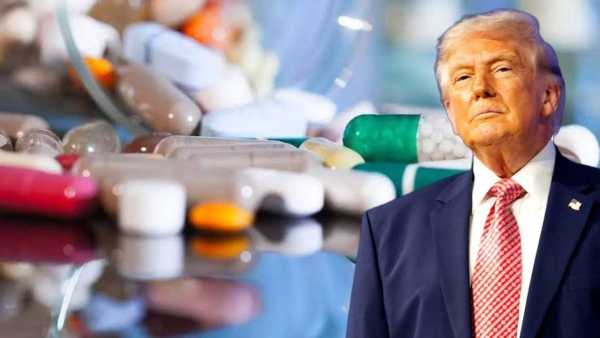
US President Donald Trump's announcement of imposing heavy customs duty of up to 200 percent on imported generic medicines has created a stir in the global pharma market. However, according to a new report by think-tank Global Trade Research Initiative (GTRI), India's affordable and quality generic medicines will be able to maintain their competitive advantage in the US market even after this huge tariff. According to the Global Trade Research Initiative (GTRI), US President Donald Trump's proposed tariffs on generic drugs could pose a major challenge to India's drug exporters, but the advantage of low costs could help many Indian drugs remain competitive in the US market.
This think tank has said in a report titled “India's Generic Drug Exports Face New US Tariff Threat” that the price of many Indian generic drugs is seven to 10 times lower than branded drugs. With this, they can remain competitive in terms of cost even after the proposed tariff of up to 200 percent is implemented from August 2029. GTRI said that the burden of extra costs can be passed on to American healthcare providers, insurance companies and patients, and it will not immediately reduce the market share of Indian drug manufacturers.
This report comes after Trump's announcement that imported generic medicines will continue to come to America without any duty (tax) till August 1, 2028, which will give global medicine makers two years to shift their production to America. After the timing of this change, imported generic drugs will face 100% tariff for one year and then 200% tariff from August 2029, unless the makers set up production units in the US. GTRI Founder Ajay Srivastava said the proposed tariffs highlight that India needs to reduce vulnerabilities in its pharmaceutical supply chain, particularly its dependence on imported active pharmaceutical ingredients (APIs), and also increase exports to markets outside the US.
India is most affected
Due to its strong position in the US generic drug market, India is among the countries most affected by the proposed tariff system. According to the report, in 2025, India will export medicines worth $25.8 billion to the world. Out of this, medicines worth $9.7 billion (i.e. 37.7 percent) were sent to the US, making America the largest medicine export market for India.
Indian companies supply about 47 percent of the generic drugs sold in the US, making India the largest source of affordable generic drugs for American consumers. However, due to low prices of generic drugs, India's share in the value of US generic imports is about 30 percent, which is less than its share in terms of number of prescriptions.
India's pharmaceutical exports by destination (calendar year 2025)
| Destination | pharmaceutical export (US million dollars) |
| World | 25,829.2 |
| America | 9,744.6 |
| EU-27 | 4,053.0 |
| united kingdom | 783.6 |
| South Africa | 675.9 |
| Nigeria | 636.6 |
| Brazil | 596.7 |
| Canada | 544 |
| Australia | 475.2 |
| Russian Federation | 467.3 |
| philippines | 408.5 |
| kenya | 405.2 |
Expanding Trump's firm tariff strategy
With the latest announcement, Trump's comprehensive plan to impose tariffs on medicines has been completed. This now also includes branded medicines, ingredients used in making medicines and generic medicines.
In September 2025, Trump announced a plan to impose 100 percent tariffs on imported branded and patented drugs, although that proposal was later changed. In April 2026, the US administration imposed tariffs of up to 100 per cent on select branded drugs and essential ingredients under 'Section 232 National Security Framework', but generic drugs were excluded from this.
With this new step, generic medicines have also come under the ambit of the proposed tariff system, due to which almost no major category of medicines is left out of Washington's 'reshoring' strategy (policy of promoting domestic production).
Supply chain challenge facing the US generic market
US will import pharmaceutical products worth $213 billion in 2025. This included finished medicines worth $94.1 billion which are sold in retail packs. Generic medicines also come in this category. However, it is difficult to estimate the true value of generic drug imports because US Customs data does not classify generic drugs separately. Instead, they are placed under HS 3004, which also includes patented medicines, branded generics and over-the-counter (OTC) medicines.
Impact on Indian companies may be different
The proposed tariffs are unlikely to have a uniform impact on all Indian pharmaceutical exports. GTRI said that higher priced generic formulations and branded generics may come under greater pressure, as manufacturing these products in the US may be commercially profitable. However, low cost essential generic medicines can retain their presence in the market due to India's pricing advantage.
The report said that shifting large-scale production of generic drugs to the US will be challenging because the industry operates on low margins and is highly dependent on global supply chains, especially for APIs coming from countries like India and China. The report also said that creating a completely domestic pharmaceutical supply chain in the US would require huge investment and could increase drug prices.
Many Indian companies are present in America
Many large Indian pharmaceutical companies already run manufacturing units in the US, which may help them deal with potential tariff barriers. Companies like Sun Pharma, Zydus Lifesciences, Lupine, Aurobindo Pharma, Cipla and Dr. Reddy's Laboratories have FDA-approved manufacturing units in the US.
Cipla is increasing production at its units in Massachusetts and New York, while Dr. Reddy's Laboratories has indicated that it will consider expanding manufacturing in the US if it is commercially viable. However, Sun Pharma has said that its current manufacturing capacity in the US is sufficient and there are no plans for expansion at present.
GTRI called dependence on China a big risk
Apart from US tariffs, GTRI has described dependence on China for pharmaceutical inputs as a major strategic concern for India. The report said that about 70 percent of chemical-based active pharmaceutical ingredients (APIs) and about 90 percent of biologic inputs used by Indian pharmaceutical companies come from China.
India was once a big producer of API, but has gradually become dependent on imports. GTRI said that any disruption in Chinese API supply could pose a risk to India's pharmaceutical manufacturing ecosystem.
The think tank recommended rebuilding India's API manufacturing capacity, reducing dependence on a single supplier, and increasing drug exports to Europe, Latin America, Africa and Asia.


-
Love Horoscope for Wednesday, July 22, 2026: Aquarius May Hear Exciting News, Check What Awaits Other Signs

-
Financial Horoscope Today, July 22, 2026: Virgo Signs Show Rising Interest in Banking and Savings — See What Your Zodiac Predicts
-
Horoscope Today: Astrological predictions for July 22, 2026, for all zodiac signs
-
Toll Local Pass: How much does a local pass cost for passing through the toll plaza? NHAI reveals the expense.

-
NEET Protest Row: AIU Issues Advisory For Universities, Appeals To Counsel Students