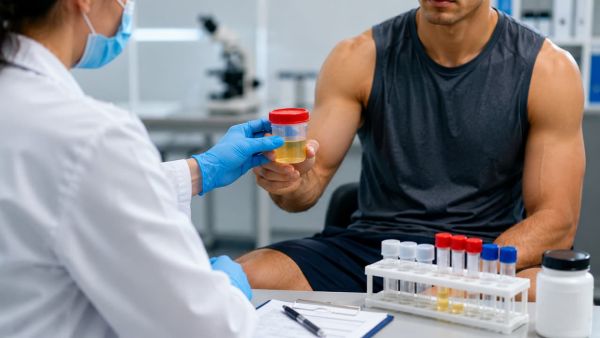
What is doping test, why are A and B samples taken, how do WADA and NADA work and what happens to a player if he fails a doping test? Know complete information.
Sports Doping Explained: India has suffered a big setback in the Glasgow Commonwealth Games. Judo player Arun Kumar is out of the tournament after failing in the doping test. Arun was to play for India in the men's 73 kg category. The International Judo Federation took this decision on the basis of the report of the National Anti-Doping Agency (NADA). Let us tell you, whenever a player fails in a doping test, questions start being raised about his hard work, medal and career. Doping test is a normal process in Olympics, Asian Games, Cricket, Athletics or any big tournament. Let us tell you, World Anti-Doping Agency (WADA) was established in 1999. After all, what is doping test? What is checked in this? Why does a player fail a doping test? Let us know...
What is doping test?
Doping test is a scientific investigation in which it is found out whether a player has taken any banned drug or liquid to increase his strength, endurance, speed or performance. Its purpose is to ensure that all players play on a level playing field and no one takes unfair advantage. This is a system to maintain fair play.
Why is doping considered wrong?
Suppose 2 athletes are participating in a 100 meter race. One player is running only on the basis of hard work and exercise, while the other enters the field by taking banned drugs to increase strength. In such conditions the competition is no longer equal. This is the reason why sports organizations around the world have imposed a strict ban on doping.
How is doping test done?
Doping test can usually be done both during the competition (In Competition) and outside of the competition (Out of Competition). In this process, mainly two types of samples are taken from the player.
1. Urine sample: This is the most common test. With this, many types of banned drugs can be detected.
2. Blood sample: In some cases a blood sample is taken. This tests blood doping, drugs like EPO and other substances. After this the sample is sealed and sent to the registered lab.
What are A and B samples?
During doping test, the player's sample is divided into two parts.
A Sample
B Sample
First the A sample is tested. If any banned substance is found in it then the player is informed. After this, if the player wishes, he can demand testing of B sample. If the B sample also comes positive, then doping is confirmed.
Who decides which medicine is banned?
This work is done by the World Anti-Doping Agency (WADA). WADA releases the Prohibited List every year, which lists those drugs and methods whose use is prohibited for athletes. The National Anti-Doping Agency (NADA) does the work of investigating and enforcing doping rules in India.
Which things come under doping?
- Anabolic Steroids
- EPO (a drug that increases oxygen in the blood)
- growth hormone
- some stimulants
- certain hormones and masking agents
What happens if you fail a doping test?
If a player is found guilty in a doping test, many types of actions can be taken against him. As -
- Medals and records may be cancelled.
- Can be thrown out of the competition.
- A ban of 2 to 4 years or more may be imposed.
- Prize money may have to be returned.
- The reputation of the player is also affected.
Can a player fail a doping test even by mistake?
Yes. Many times players use medicines, supplements or energy products that contain banned substances without their knowledge. However, Strict Liability applies as per the game rules. That means the player himself is considered responsible for every substance found in his body. For this reason, international label players use only certified supplements.
Some famous doping cases of the world
- Ben Johnson (1988 Seoul Olympics) – After winning the 100m gold, he failed a steroid test and was stripped of the medal.
- Maria Sharapova (2016) – Suspended for using banned drug meldonium.
- Lance Armstrong – Considered the biggest doping case in cycling history. Many titles were taken away from him.
Some famous cases of doping in Indian sports...
1. Narsingh Yadav (Wrestling) – 2016
Failed dope test just before Rio Olympics. Banned steroids were found in his sample. He claimed that banned substances were mixed in his food as part of a conspiracy. NADA first gave him relief, but later a ban of 4 years was imposed.
2. Prithvi Shaw (Cricket) – 2019
Indian cricketer Prithvi Shaw was found failed in dope test. A banned substance called Terbutaline, which is usually found in cough medicine, was found in his sample. BCCI suspended him for 8 months. Prithvi Shaw said- He had taken cough syrup without testing it.
3. S. Dhanalakshmi (sprinter)
Indian female athlete S. Dhanalakshmi was also in the news for doping case in 2021, due to which she could not play Tokyo Olympics. He later faced a long ban for repeated doping violations.
4. Seema Punia (Discus Throw)
In 2000, Seema Punia was implicated in doping case. His career took a hit, however, he later made a comeback and won several medals for India in the Asian Games and Commonwealth Games.
5. Ashwini Akkunji (400m Hurdles)
In 2011, many players of the Indian women's athletics team failed the dope test. They were banned.
6. Renu Bala Chanu (Weightlifting)
Indian weightlifter Renu Bala Chanu was found positive in doping test. He was suspended from competitions.
7. Sanjita Chanu (Weightlifting)
In 2018, Commonwealth Games gold medalist Sanjita Chanu's name came up in the doping controversy. He denied the allegations and raised questions on the sampling process. This matter remained under discussion for a long time.
8. Recent Affairs (2025–26)
In recent years, many Indian athletes have failed dope tests in different sports. These include players of athletics, weightlifting, football, polo and cricket. Sprinter S in 2026 NADA took action against many players including Dhanalakshmi, cricketer Rajan Kumar.
Why is doping test necessary for players?
Doping test is not just to enforce rules, but its purpose is-
- Maintaining integrity in sports.
- Giving equal opportunity to all players.
- Protecting the health of players.
- Maintaining people's trust in sports.
- To prevent young players from going on the wrong path.
Content Source: World Anti-Doping Agency (WADA), National Anti-Doping Agency (NADA) India, International Olympic Committee (IOC), International Testing Agency (ITA)
-
Naresh Pal Gangwar is new Education Secy, replaces Vineet Joshi

-
Delhi Police Blocks 480 Pakistan-Linked Handles, Warns Students Against Fake News
-
Education Secretary Vineet Joshi Replaced; Delhi HC Sets Up Fast-Track Court
-
PM Modi Hints At Tougher Anti-Paper Leak Measures In Friday's Cabinet Meeting
-
NCLT Stays BYJU'S Insolvency Bidding Process Till August 31