The operation was allegedly orchestrated by a mastermind based in China.
Managed by South Korea’s Ministry of Education, TOPIK is the only globally recognized official standardized assessment for the Korean language.
The exam is designed specifically for non-native speakers and draws over 550,000 candidates annually across more than 90 countries. A passing score is frequently required for university admissions, scholarships, visa extensions, and corporate employment within South Korea.
The Seoul Metropolitan Police Agency announced on July 21 a major crackdown on the network.
According to Yonhap News Agencyauthorities arrested a Chinese broker living in South Korea who managed the on-the-ground operation, handling everything from exam registration to coordinating the cheating itself. The broker was reportedly sentenced to three years in prison last month.
Authorities have launched investigations into 101 Chinese nationals who allegedly paid the network to secure fraudulent TOPIK scores to meet various academic and professional requirements.
|
This screenshot of surveillance footage shows a broker handing an electronic device to a client ahead of a TOPIK exam. Photo by National Police Agency |
Police are also investigating 11 others, ten Chinese nationals and one naturalized South Korean citizen, who originally emigrated from China, who acted as proxy test-takers. These impersonators allegedly received 800,000 won (US$542) per exam.
The China-based mastermind advertised the illicit services on the popular social media platform Xiaohongshu, guaranteeing clients high TOPIK scores. Clients paid between 10,000 and 35,000 yuan (US$1,500 to US$5,200) for the service, according to The Korea Herald.
The South Korea-based broker, a former computer engineering student at a Korean university, collected clients’ personal information and managed the logistics. Police revealed he even developed custom software to automatically secure preferred exam slots for candidates.
The syndicate offered two primary methods of cheating. For clients who wanted a proxy, the group recruited lookalikes and manufactured fake identification cards to bypass test center security.
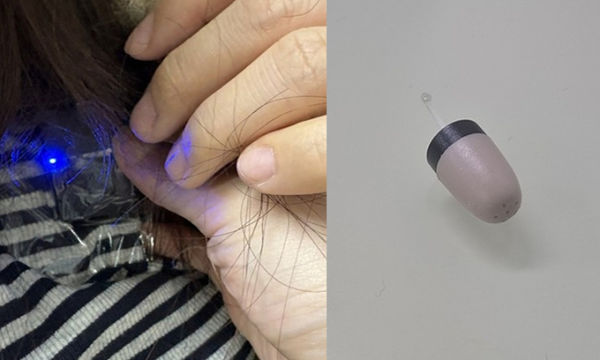
For clients who took the exam themselves, the network provided covert communication tools. Candidates were equipped with hidden mobile phones, transmitters concealed under their collars, and miniature earpieces once entering the exam room.
|
A transmitter and an earpiece used by test-takers to cheat in a TOPIK exam. Photo by National Police Agency |
Accomplices stationed outside the exam venues used a video conferencing app to relay correct answers to the test-takers in real time.
The elaborate scheme began to unravel when a vigilant proctor spotted a blinking electronic device attached to an examinee’s neck during a test, according to the Dong-A Ilbo newspaper.
Police estimate the operation generated a total of 700 million won (US$500,000) in illicit profits. The China-based ringleader is believed to have made 500 million won, while the South Korea-based broker pocketed approximately 200 million won.
Authorities have confiscated 150 million won from the broker. An international manhunt is underway for the China-based mastermind and two suspected accomplices who have fled overseas.
-
New iPhone update: Several features could be disabled for non-payment of EMIs; revealed by iOS 27 beta code..

-
Not only Bitchat, this app is also a means of chatting without internet, chain network through Bluetooth..

-
Railway Recruitment: 3.58 crore candidates took the exam for 92,116 railway jobs; 3,400 contenders for a single post..

-
What is the Bitchat app that works without Wi-Fi or mobile data? And why did the government oppose it?
-
Hackers to face a tougher time: WhatsApp is introducing a feature every user will want to know about—alerts for weak passwords..