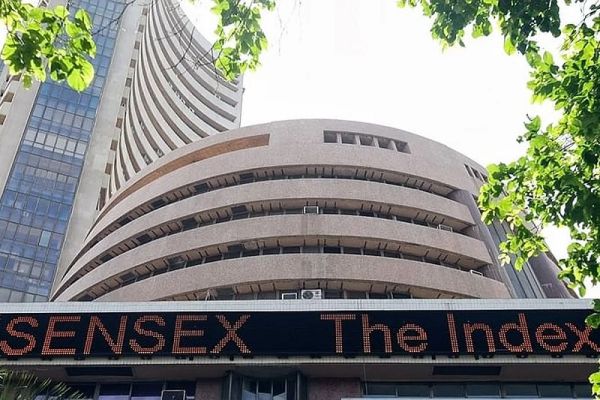
New Delhi . The effect of increasing tension in the Middle East at the global level was also seen on the Indian stock market on Monday. Investors adopted a cautious approach during the trading session, due to which major indices closed with a decline. At the end of the day, BSE Sensex closed at 77,708.52 with a weakness of 442.93 points or 0.57 percent. Whereas NSE Nifty slipped 95.80 points or 0.39 percent to 24,238.50 points. With this, the Sensex once again closed below the important level of 78 thousand.
Financial and private banking stocks were under maximum pressure in the market. Nifty Private Bank index fell by 2.27 per cent and Nifty Financial Services fell by 1.22 per cent. Apart from this, most of the shares in auto, information technology, realty and services sectors also remained weak. Investors prioritized profit-booking in these sectors amid global uncertainty, which affected market movements.
However, the picture in the broader market was not entirely negative. Buying was seen in stocks to public sector banks, pharma, healthcare, energy, metals, media, commodity, infrastructure and consumer durables. Due to continued interest of investors in these sectors, the scope of decline was limited to some extent and the market got partial support.
Among the major Sensex companies, shares of Trent, Power Grid, NTPC, Bharti Airtel, State Bank of India, UltraTech Cement, ICICI Bank, HCL Tech, Sun Pharma, ITC, L&T, Bajaj Finance, Tech Mahindra, Adani Ports, Titan, Tata Steel, Asian Paints and Bajaj Finserv registered gains. On the other hand, stocks like Axis Bank, HDFC Bank, Maruti Suzuki, Kotak Mahindra Bank, Infosys, TCS, Mahindra & Mahindra, Indigo, BEL and Hindustan Unilever closed with losses.
The midcap and smallcap segments performed relatively better as compared to largecap stocks. The Nifty Midcap 100 index closed at 62,801.75 with a gain of 373.70 points, while the Nifty Smallcap 100 index also closed at 19,326.45 with a gain of 30.15 points. This indicates that investors continued buying in select sectors and medium-sized companies.
Market experts believe that the ongoing geopolitical tension in the Middle East remains a major cause of concern for investors. The effect of this tension is also visible on the prices of crude oil and oil prices in the international market are continuously above $ 85 per barrel. Higher crude oil prices may increase import costs, inflation and pressure on corporate profits, due to which investors remain cautious for now.
Analysts say that the level of 24,370 to 24,400 points is being considered as important resistance for Nifty in the near term. If the index remains above this range, there may be a possibility of further rise. On the downside, the area of 24,130 to 24,100 points is being seen as major support. At present, global developments and the movement of crude oil can play an important role in deciding the direction of the Indian stock market in the coming trading sessions.
-
Yan Diomande: Real Madrid’s shock €100m move for Liverpool and PSG target

-
We’re delighted to announce that Joshua Zirkzee is prime Messi in disguise

-
Maresca will do it his own way despite clear similarities with Pep Guardiola

-
BJP moves CEO against Telangana CM over voter roll remarks

-
Assam: NDA ally minister’s daughter raises anti-Modi slogans