Football365
·25 July 2026
Football365
·25 July 2026
The 2026 World Cup was presented as football’s biggest-ever celebration. By the time Spain lifted the trophy in New Jersey after dismantling Argentina in a one-sided final, it had certainly matched that promise in terms of scale.
Forty-eight teams. One-hundred-and-four matches. Three host nations. Six weeks of football spread across an entire continent.
It was louder, longer and more commercially powerful than any World Cup before it. Whether it was better depends on which part of its legacy eventually proves the most lasting.
On the field, there was enough drama to justify the expanded format. Spain emerged as deserved champions, finishing an outstanding tournament with a commanding win over Lionel Scaloni’s Argentina. Luis de la Fuente’s team blended technical quality with impressive tactical flexibility, looking every bit like the heirs to Spain’s greatest international sides.
There were emotional moments as well. At 39 years old, Lionel Messi somehow still found a way to create them. No longer able to control matches through relentless dribbling, he instead managed games in shorter spells, conserving energy before producing decisive passes or flashes of invention that reminded everyone why football’s greatest players often age differently from everyone else. His final World Cup ended in defeat, but not in decline.
England, meanwhile, somehow turned the largely ceremonial third-place play-off into one of the tournament’s most entertaining games, beating France 6-4 in a match that often felt like an exhibition played at Premier League tempo. No one will pretend it carried the importance of a World Cup final, but it gave one last reminder that football can still produce joyful absurdity even when the stakes are relatively low.
Away from the pitch, however, the tournament often felt less like an international festival and more like a display of football’s deepening links with political power.
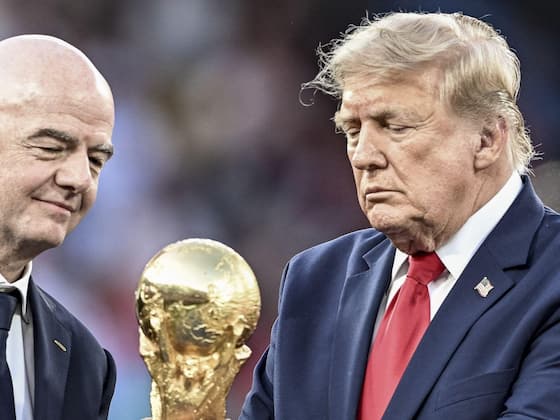
The handling of Iran’s national team throughout the competition cast a shadow over the event, while Donald Trump’s highly public intervention to help overturn Folarin Balogun’s suspension raised awkward questions about FIFA’s willingness to shield sporting decisions from political influence. Gianni Infantino’s increasingly visible public relationship with the US President only strengthened the sense that football’s governing body had become strikingly comfortable operating in the orbit of powerful political figures.
Those controversies may fade over time. The environmental questions almost certainly will not.
For years, FIFA has said that sustainability sits at the centre of modern tournament planning. In some ways, the 2026 World Cup genuinely marked progress. Unlike many previous mega-events, every match was played in an existing stadium rather than in purpose-built venues that would have become expensive white elephants. That choice alone avoided a huge amount of embodied carbon linked to large-scale construction.
Many of those venues also came with strong environmental credentials already in place. Stadiums such as Atlanta’s Mercedes-Benz Stadium, Seattle’s Lumen Field and Monterrey’s Estadio BBVA either hold or were designed around recognised Leadership in Energy and Environmental Design (LEED) certification standards, reflecting investment in energy efficiency, water conservation and sustainable building practices.
Those achievements deserve credit. Building greener stadiums matters. Reusing existing infrastructure matters even more.
The problem is that stadiums make up only part of a tournament’s environmental footprint.
The defining image of this World Cup may not be Spain’s passing triangles or Messi’s final farewell. It may instead be aircraft crossing North America in every direction. Teams, supporters, media and FIFA officials regularly travelled thousands of miles between matches. Fans following their countries often faced journeys equivalent to flying across Europe several times over just to complete a group-stage schedule.
An independent University of Cambridge study estimated the tournament’s footprint at around 4.23 million tonnes of carbon dioxide equivalent, with spectator travel accounting for roughly 82 per cent. That reality wipes out many of the gains made through efficient stadium design. An arena can recycle rainwater, generate renewable electricity and divert waste from landfill, but none of those steps can meaningfully cancel out millions of long-haul passenger trips.
Even FIFA’s own leadership unintentionally showed the contradiction. Analysis of Gianni Infantino’s tournament schedule revealed extraordinary levels of air travel as he tried to attend matches across all 16 host cities, underlining just how aviation-heavy a continental World Cup inevitably becomes.
Climate change also stopped being an abstract issue and became part of the sporting story itself.
Several matches were played in temperatures that player representatives said came close to unsafe levels. Hydration breaks became standard. Air-conditioned indoor stadiums provided relief for players, but supporters outside often had to endure dangerous conditions while travelling to and from venues.
Elsewhere, storms disrupted schedules and wildfire smoke at times threatened air quality. The tournament built for North America’s summer became a clear example of what staging elite sport in a warming climate increasingly looks like.
Perhaps that is the real legacy of the 2026 World Cup. It showed that football can stage a truly global event using existing infrastructure and more sustainable venues than before. Yet it also exposed the limits of those improvements when the competition itself keeps expanding. Expansion brings more matches, more supporters and more travel. The environmental maths becomes tougher with every extra team and every additional host city.
That matters because this version of the World Cup is unlikely to be a one-off. FIFA has embraced larger tournaments as the future of international football. If that path continues, organisers will eventually have to face a question that efficient stadiums alone cannot answer: not how to make mega-events greener, but whether mega-events of this scale can ever truly be sustainable.
-
Yan Diomande: Real Madrid’s shock €100m move for Liverpool and PSG target
-
We’re delighted to announce that Joshua Zirkzee is prime Messi in disguise

-
Maresca will do it his own way despite clear similarities with Pep Guardiola

-
BJP moves CEO against Telangana CM over voter roll remarks

-
Assam: NDA ally minister’s daughter raises anti-Modi slogans