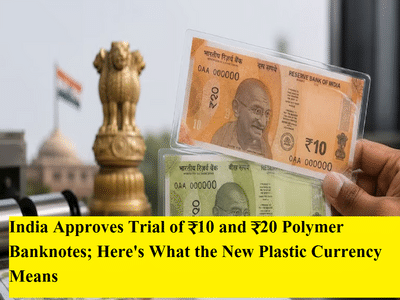
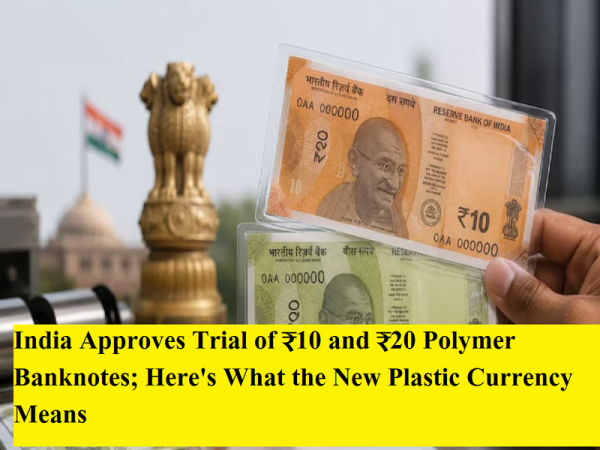
Polymer Banknotes in India: India is preparing to test polymer (plastic) banknotes for the first time in select denominations. The Central Government has approved the Reserve Bank of India's (RBI) proposal to conduct field trials of ₹10 and ₹20 polymer banknotes, marking a significant step toward evaluating a more durable alternative to traditional paper currency.
The move is aimed at assessing whether polymer notes can offer a longer lifespan and lower replacement costs compared to conventional banknotes.
Government Clears RBI's Pilot ProposalThe Ministry of Finance informed Parliament on July 27, 2026, that the government has approved the RBI's proposal to conduct field trials for polymer banknotes in the ₹10 and ₹20 denominations.
The proposal was recommended by the RBI's Central Board, which suggested issuing a large number of polymer notes to evaluate their performance under real-world conditions before making any long-term decision.
One Billion Notes of Each Denomination to Be TestedAccording to the government's statement, the RBI plans to issue approximately 1 billion (100 crore) ₹10 polymer notes and 1 billion ₹20 polymer notes as part of the trial phase.
The objective is to study factors such as:
- Durability during circulation.
- Resistance to wear and tear.
- Public acceptance.
- Printing and handling efficiency.
- Overall cost-effectiveness compared with paper notes.
If the pilot proves successful, the RBI may consider introducing polymer banknotes in these denominations on a regular basis.
Why Polymer Banknotes Are Being ConsideredPolymer banknotes are already used in several countries because of their longer lifespan and enhanced durability.
Compared with traditional paper currency, polymer notes generally:
- Last significantly longer in circulation.
- Are more resistant to water and moisture.
- Do not tear as easily.
- Remain cleaner despite frequent handling.
- Withstand sweat, dirt, and everyday wear more effectively.
These advantages are particularly relevant for ₹10 and ₹20 notes, which are among the most frequently used denominations in daily transactions and therefore wear out much faster than higher-value notes.
Will Existing Paper Notes Be Withdrawn?No.
The government has clarified that there is currently no proposal to discontinue or replace existing paper currency with polymer notes.
Instead, the new polymer notes are expected to circulate alongside the existing paper banknotes during the trial period.
This means that both versions would remain legal tender, and paper notes will continue to be accepted for transactions unless the RBI announces any future changes.
Will Polymer Notes Affect UPI or Digital Payments?The Ministry of Finance stated that it is too early to assess whether polymer banknotes will have any measurable impact on digital payment systems such as UPI.
According to the government, physical currency and digital payment platforms are intended to complement each other rather than compete.
Consumers will continue to have multiple payment options, including:
- Cash transactions.
- UPI payments.
- Mobile wallets.
- Debit and credit cards.
- Internet banking.
The introduction of polymer notes is aimed at improving the durability of physical currency, not replacing digital payment methods.
Benefits of Polymer CurrencyIf adopted more widely in the future, polymer banknotes could offer several long-term advantages:
- Reduced replacement frequency due to longer lifespan.
- Lower maintenance and printing costs over time.
- Better resistance to environmental damage.
- Improved appearance even after extended circulation.
- Enhanced suitability for frequently used low-denomination notes.
The field trial will help determine whether these benefits justify broader implementation in India.
Final TakeThe Central Government's approval of the RBI's proposal to test ₹10 and ₹20 polymer banknotes marks an important milestone in India's currency management strategy. During the pilot phase, approximately 1 billion notes of each denomination will be introduced to evaluate their durability, usability, and cost-effectiveness. At present, there is no plan to replace existing paper notes, and both paper and polymer currencies are expected to coexist if the trial moves forward successfully.
-
SEDEMAC's Q1 Profit Soars To ₹33 Cr, Revenue Up 43% YoY

-
Harjinder Kaur Shines with Silver at Commonwealth Games 2026

-
Jadumani Mandengbam Secures Semifinal Spot at 2026 Commonwealth Games

-
CWG 2026: Weightlifter Harjinder Kaur bags silver medal for India

-
Japanese chef sets world record in Singapore for largest lava-style omelette using 45 eggs