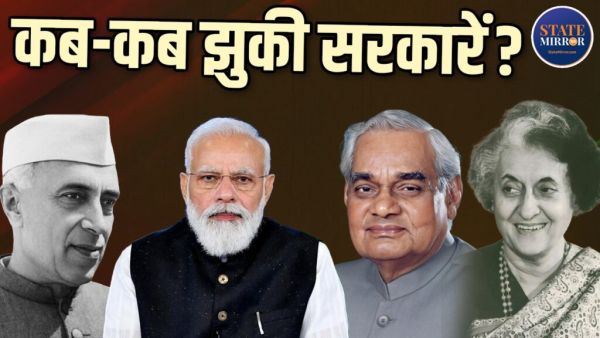
The biggest strength of democracy is not only elections, but also the voice of the people, mass movements and monitoring of the judiciary. In the 75 years of independent India, there were many such occasions when the central governments had to rethink their decisions. No matter how strong those governments were? At some places, the movement of lakhs of people on the streets forced the government to bow down, at some places the decisions of the Supreme Court showed the way to change the law, and at some places the widespread public opinion changed the direction of the policies. Such examples are found in the tenure of almost every Prime Minister from Jawaharlal Nehru to Narendra Modi. Although the reasons were different in all these cases, one thing remained the same – in Indian democracy, the final communication of the government is with the people and the Constitution.
Jawaharlal Nehru (1947-1964)
According to the Constitution of India, proceedings of the Parliament, Supreme Court decisions, Gazette, Press Information Bureau (PIB), National Archives and official documents of the ministries, the biggest challenges to the Nehru government in the early years of independent India were the demands to linguistic identity, social reforms and federal structure. The country was new, so many decisions had to be changed based on public sentiments and movements. These:
- Formation of Andhra State (1953) – After Potti Sriramulu’s fast unto death and widespread mass movement, a separate Andhra State was formed.
- Linguistic Reorganization of States (1956) – After pressure from linguistic movements, new states were formed on the recommendations of the States Reorganization Commission.
- Changes in Hindu Code Bill – After huge social and political opposition, it was passed as separate acts instead of one law.
- Assurance on official language dispute – Amidst South India’s concerns regarding Hindi, the Center gave assurance of parallel use of English.
Lal Bahadur Shastri (1964-1966)
Shastri’s tenure was short, but the question of language became the biggest political issue.
- Soft stance after anti-Hindi movement – After protests in South India including Tamil Nadu, the Center indicated the continuation of English.
- Practical changes in the official language policy – The apprehensions of non-Hindi states were kept in mind in the effective implementation of the Official Languages Act.
Indira Gandhi (1966–1977, 1980–1984)
During the long tenure of Indira Gandhi, the maximum number of public movements, judicial conflicts and political crises were seen.
- New law after judicial challenge on bank nationalization – Amended law was brought after the decision of the Supreme Court.
- Constitutional amendment to abolish the privy purse – 26th amendment was passed after judicial hurdles.
- Impact of Chipko Movement – Forest conservation policy got strengthened after environmental movements.
- Ending the Emergency and holding elections – Elections were declared in 1977 amid widespread political pressure and public discontent.
- Relaxation of control over the press – With the end of the Emergency, many restrictions imposed on the media were lifted.
Morarji Desai (1977–1979)
The main objective of the Janata Party government was to change the emergency arrangements.
- 44th Constitutional Amendment – Government powers increased during emergency were limited.
- Initiative to remove stringent provisions like MISA – Steps taken to restore civil liberties.
Rajiv Gandhi (1984-1989)
During the era of Rajiv Gandhi, there were many major conflicts between court and politics.
- Law after Shah Bano decision – Muslim Women (Divorce) Law was made after the decision of the Supreme Court.
- Implementation of Assam Accord – The agreement was implemented after a long student movement.
- Changes in the defense procurement process after the Bofors controversy – Emphasis was laid on new procedures regarding transparency.
V.P. Singh (1989–1990)
- Mandal Commission implemented – Pending recommendations regarding reservation of backward classes were implemented.
- Clarification after reservation protests – The government explained and defended the policy amid the protests.
P.V. Narasimha Rao (1991–1996)
Along with economic reforms, constitutional changes also took place.
- 73rd Constitutional Amendment – Panchayats were given constitutional status under public pressure.
- 74th Constitutional Amendment – Municipal bodies got more rights under public pressure.
- Action after Babri Masjid – Many steps were taken under law and order and constitutional provisions.
Atal Bihari Vajpayee (1998-2004)
- Affidavits of election candidates – Following the instructions of the Supreme Court, information about the property and criminal cases of the candidates became mandatory.
- Freedom of Information Act – The first central law was made in the direction of Right to Information.
- Constant debate and amendments on POTA – Many provisions were discussed under pressure from human rights organizations.
Dr. Manmohan Singh (2004-2014)
The influence of mass movements and civil society was most visible during this period.
- Right to Information Act (RTI) – The law came into force after long civil campaigns.
- MNREGA – Historic law made amid demand for rural employment.
- Forest Rights Act – passed after the demand of tribal organizations.
- Criminal Law Amendment (2013) after the Nirbhaya movement – Laws to women’s safety were tightened.
- Lokpal Law – Parliament passed the law after the Anna Hazare movement.
- Land Acquisition Act 2013 – A new law was made keeping in mind the demands of farmers and social organizations.
Narendra Modi (2014–present)
Even during the Modi government, the role of courts and public pressure was visible in many decisions.
- Land Acquisition Ordinance withdrawn – The ordinance was not taken forward after widespread political opposition.
- Amendment in Aadhaar Act – Many provisions were changed after the decision of the Supreme Court.
- SC/ST Act Amendment – After the decision of the Supreme Court, the Parliament amended and restored the original provisions.
- Withdrawal of agricultural laws (2021) – After the farmers’ movement that lasted for more than a year, all three laws were withdrawn.
- Electoral Bond Scheme ended – It had to be closed after the Supreme Court declared the scheme unconstitutional.
- Periodic amendments in IT rules – Changes were made following judicial comments and feedback from stakeholders.
- Sending some bills to parliamentary committee – Following the demand of opposition and experts, detailed review was done in selected cases.
- Clarifications on implementation of criminal laws – Guidelines issued based on comments from states and courts during implementation of new laws.
- Changes to digital data and privacy rules – Reforms were made following judicial decisions and stakeholder feedback.
- Amendments to contemporary policies in line with judicial directions – Administrative changes were made as per directions of courts in various cases during 2025–26.
Which Prime Minister had to change his stance the most?
If we look at the number of public movements, judicial intervention and policy amendments, the tenures of Indira Gandhi, Dr. Manmohan Singh and Narendra Modi were the most discussed.
During Indira Gandhi’s era, there were continuous conflicts with the judiciary, opposition and major mass movements. During the time of Dr. Manmohan Singh, campaigns like civil society, RTI, Lokpal and Nirbhaya movement influenced policy making.
During Narendra Modi’s tenure, changes were seen in some major policies and laws after many important decisions of the Supreme Court and huge public pressure like the farmers’ movement. However, not every change was solely the result of pressure. Many decisions were taken under the combined influence of political consensus, constitutional compulsion, judicial instructions, administrative necessity and changing circumstances.
-
Why does heart beat become irregular? Do not ignore ‘these’ symptoms after Arrhythmia

-
What Is a Cloud Storage Data Centre? How It Differs From an AI Data Centre: Explained

-
Now don’t just post on X, send money too! Elon Musk launches ‘X Money’, know its amazing benefits
-
‘Very hungry’ Joao Pedro impresses new Chelsea manager Alonso
-
Commonwealth Games 2026: Can Neeraj Chopra Qualify For Men’s Javelin Throw Final? Check Qualification Standard