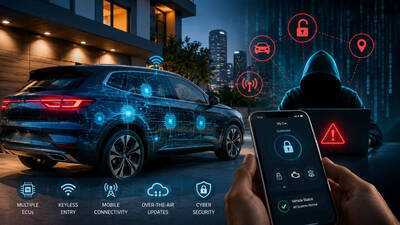
The car in your driveway now behaves a lot like a smartphone — always connected, quietly updating itself, tracking its own health and, increasingly, exposed to the same kind of attacks. That exposure is no longer hypothetical, according to HackersEra , a Pune-based automotive-cybersecurity firm that works on securing vehicles and their electronics.
The warning follows a run of incidents abroad that have put vehicle hacking back in the headlines. In one recent case, security researchers in the United States found that a dealer-installed anti-theft device could be reached over Bluetooth, potentially leaving more than two million vehicles open to having their doors unlocked — and, in a demonstration, their horns and lights set off remotely. Separately, industry researchers estimate that cyberattacks on the automotive sector have roughly doubled over the past year, with ransomware making up a growing share.
The reason is simple - modern vehicles have quietly become rolling networks. "A typical connected car carries dozens of electronic control units, a mobile data link, keyless-entry radios and over-the-air update channels — each one a possible door for an attacker. People still picture car hacking as something from a film,” said Vikash Chaudhary, founder of HackersEra, adding, “The real risk is more ordinary — a location trail that leaks, a key signal that’s cloned, an update channel that isn’t properly protected. Once a car is connected, its privacy and its safety are the same problem.”
India is not insulated. As the country’s vehicles get more connected — through telematics, companion apps and electric-vehicle systems — the same attack surface is arriving on Indian roads. What is changing is the regulatory response. According to Vikash, the government has published draft rules that would, for the first time, require carmakers to build and prove a cybersecurity management system before a vehicle can be approved for sale, phased in from late 2026. The move brings India in line with rules already mandatory in Europe, Japan and South Korea.
"For owners, the practical takeaway is not alarm but awareness: connected features are convenient, but they come with a security dimension buyers rarely see. The protections should be built in by the manufacturer, not left to the customer. That’s exactly what the new standards are trying to make non-negotiable," Vikash adds.
HackersEra advises on vehicle and electronic-control-unit security. According to the company, the harder task for the industry is sustaining that protection over a vehicle’s life — because unlike a crash-test rating, cyber resilience has to be maintained for as long as the car is on the road, against threats that keep changing.
The trajectory, Vikash says, is clear. "As cars get smarter, keeping them secure is moving from an optional feature to a basic expectation — the automotive equivalent of a seatbelt," he concludes.
-
Lovepreet''s record silver headlines day; Neeraj, two others reach javelin final

-
Son of a tailor, Punjab''s Lovepreet wins silver with CWG ''snatch'' record

-
Bengaluru Restaurants' Pushback Gives Rapido's Ownly An Opening Against Swiggy, Zomato

-
Ajinkya Rahane Retires: A Look Back at His Impact on Indian Cricket

-
UEFA Unanimously Rejects FIFA's Proposal to Sell World Cup Stakes