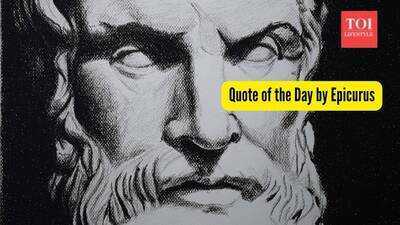
Epicurus is one of the most influential philosophers in history. Although he is most often connected with luxury and excess, the essence of his philosophy was almost the reverse. He believed that happiness did not lie in riches or extravagance, but in simplicity, in friendship, in wisdom and in freedom from useless fear.
Epicurus was born on the Greek island of Samos (then an Athenian colony) in 341 BC. His father was Neocles and his mother Chaerestrate, both poor Athenian colonists. According to ancient sources, Epicurus was interested in philosophy from an early age and asked teachers questions about the nature of chaos and the origin of the universe.
He went into the military ( as most young Athenians did ) , then went back to study philosophy . He learned from a variety of teachers, and was influenced by earlier thinkers , especially Democritus , who proposed that the entire universe is made up of tiny, indivisible particles called atoms. This idea was to become central to Epicurus’ own view of the world.
Epicurus moved to Athens in around 306 BCE and set up his own school there. It was simply called The Garden. Unlike many schools of the day, The Garden was open not just to wealthy men, but also to women and enslaved people—a very inclusive approach for ancient Greece. Students lived, learned and ate together, creating a close community based on equality and friendship. Rather than talking politics or seeking fame, Epicurus urged his followers to lead peaceful lives based on meaningful relationships and intellectual curiosity.
A philosophy commonly misunderstood
Today the word “epicure” is often used to describe a person who enjoys fine food and luxury. But ironically this is not a very good likeness of Epicurus himself. His philosophy did make a good life to be centred on pleasure but he defined pleasure very differently from indulgence. Epicurus held that the greatest pleasure was to be free from physical pain and mental disturbance. He argued that the only lasting happiness comes from fulfilling only our natural and necessary needs – food, shelter, friendship and peace of mind – rather than the endless pursuit of wealth, power or status. He was known to live simply, with reports that he ate bread, olives and water most days. According to some ancient accounts, cheese was considered an occasional luxury, not a daily indulgence. This is where Epicurus comes in. He believed that a lot of our own suffering is caused by always wanting things that we do not actually need.
Excess not peace
One of Epicurus’ greatest gifts was his conviction that philosophy should be about making life better, not an intellectual exercise in the abstract. He introduced the idea of ataraxia, a Greek word meaning a state of inner tranquillity or freedom from anxiety. Epicurus thought that such peace could be achieved by overcoming irrational fears, especially the fear of death and the fear of divine punishment. He argued that we should not fear death, because, as he famously said, “When we exist, death is not; and when death exists, we are not.”
He also rejected the popular belief that gods were always interfering in human affairs. Epicurus did not necessarily deny the existence of gods, but he believed that if gods existed, they lived in perfect tranquillity and were not concerned with rewarding or punishing men. This was a radical idea in the ancient world where natural disasters, illness and misfortune were often considered acts of divine anger.
“Friendship before money”
Perhaps no aspect of Epicurus’ philosophy gets more attention than his emphasis on friendship. He thought that true friends were one of the greatest sources of happiness and security. Material things could vanish overnight, he argued, but trusted friends could offer emotional support in the greatest hardships of life. He thought so in his own school. The Garden was a community where philosophical conversation was interwoven with shared meals and mutual care.
Modern psychologists have come to startlingly similar conclusions. Decades of research, including long-running studies of human happiness, have shown time and time again that close relationships contribute far more to long-term well-being than income or material success. In many ways, these findings had been foreseen more than two millennia ago by Epicurus.
The lasting impact of Epicurus
Many of Epicurus’ original writings have been lost, but his ideas survived through later philosophers and writers, particularly the Roman poet Lucretius, whose epic work On the Nature of Things preserved many Epicurean teachings. Thinkers rediscovered Epicurus’ ideas of science, reason and individual happiness in the Renaissance and the Enlightenment. His atomistic view of nature also influenced later scientific thinking, encouraging natural rather than supernatural explanations for the universe.
Today Epicurus is considered by historians to be one of the founders of ethical philosophy centred on human flourishing. His ideas still resonate in debates in psychology, ethics, secular humanism and even in mindfulness practices that stress the importance of reducing needless anxiety and enjoying simple pleasures.
Quote of the Day
"If God listened to the prayers of men, all men would quickly have perished: for they are forever praying for evil against one another"
The quotation is commonly attributed to Epicurus , but most scholars agree that there is no reliable evidence that these exact words appear in his extant works or in the writings of ancient authors who recorded his philosophy . So it’s best treated as an apocryphal quote: it embodies the spirit of his thinking, but isn’t verifiably his. Still, the phrase fits fairly well with Epicurus’ overall philosophy. The quote might sound cynical, or even anti-religious, at first blush. But the more you read, the less it’s about God and more about human nature.
Epicurus pointed out that human beings are frequently motivated by feelings such as jealousy, anger, resentment, envy and a desire for revenge. Throughout history, people have prayed not only for their own good but also sometimes for the failure, punishment, or downfall of others. The quote suggests that if every such wish were granted, humanity would soon destroy itself.
The real problem is not really whether God answers prayers. The real problem is the motivation behind many of those prayers.
The quotation acts almost as a mirror. It invites the reader to ruminate on the motives often behind human desires. People may say they want justice but sometimes they want revenge. They may want to succeed but secretly hope for a rival’s failure. They may desire prosperity and resent someone else’s success. Epicurus thought that these negative emotions stop people from achieving true happiness. In his philosophy, inner peace and constant envy or hatred can’t co-exist. If you are spending time obsessing over the misfortune of another person, you are taking attention away from your life.
Even today, the notion is still surprisingly relevant in the hyperconnected world. Social media has made comparison nearly unavoidable. A lot of people compare their lives to other people's highlight reels. Arguments online often devolve into personal attacks and anonymous sites tend to foster hostility that would never be seen in person. It has long been observed that man can be his own worst enemy, and this may be as true today as it was perhaps two thousand years ago.
The quote also reminds us that emotional maturity is wishing well for others – even when it is hard. This is supported by modern psychology. Countless studies on forgiveness, compassion and gratitude show that people who let go of chronic resentment often experience less stress, better mental health and stronger relationships. Anger might feel right at the time but it hurts the person carrying it more than the person it’s directed at. nEpicurus had recognised this long before psychology language came into being. For him, peace of mind was no luxury. It was life's greatest triumph.
Why Epicurus is still relevant
Epicurus still challenges many of our modern assumptions about happiness, more than twenty-three centuries after his death. In an age of busyness, accumulation and constant achievement, he argued that the secret to fulfilment is knowing when enough is enough. He does not ask men to retire from life, but to look it in the face with an honest eye. It asks us to think about whether our ambitions really work for our well-being, or whether they simply fuel interminable dissatisfaction.
His greatest legacy was not in teaching people to seek pleasure, as it is so often misunderstood. Instead, he taught that the happy life is based on wisdom, moderation, meaningful friendships, and freedom from unnecessary fear and resentment. Those lessons may be worth more than ever in an age of constant comparison, division and information overload.
-
Lovepreet''s record silver headlines day; Neeraj, two others reach javelin final

-
Son of a tailor, Punjab''s Lovepreet wins silver with CWG ''snatch'' record

-
Bengaluru Restaurants' Pushback Gives Rapido's Ownly An Opening Against Swiggy, Zomato

-
Ajinkya Rahane Retires: A Look Back at His Impact on Indian Cricket

-
UEFA Unanimously Rejects FIFA's Proposal to Sell World Cup Stakes