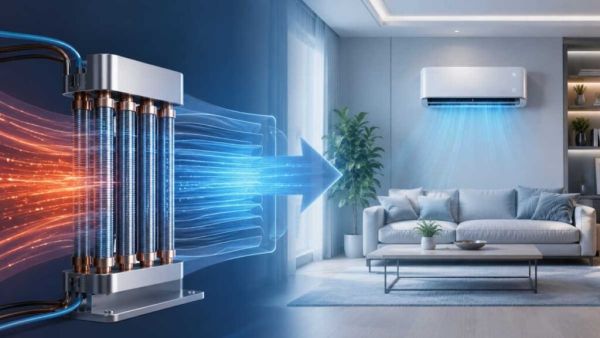
Tech Desk: The use of air conditioners (ACs) is rapidly increasing to provide relief from the summer heat. However, conventional ACs consume a lot of electricity, and the refrigerant gases used are also a concern for the environment. This is why scientists around the world are working on new cooling technologies that can provide better cooling with less electricity and without harming the environment.
In this direction, Elastocaloric Cooling Technology is being considered a new cooling technology of the future. Researchers at Saarland University in Germany have developed this technology. Instead of gas or a compressor, a special metal is used, which creates cooling when pressure is applied and released.
What is elastocaloric cooling technology?
Elastocaloric Cooling is a solid-state cooling technology. This means it doesn’t require any gas, refrigerant, or traditional compressors to produce the cooling effect.
This technique uses extremely thin wires or strips of nickel-titanium alloy. This metal changes its shape as it changes temperature, creating cooling.
According to the researchers, this technology has the potential to reduce the room temperature by about 5 to 10 degrees Celsius.
How does this technology work?
The principle of Elastocaloric Cooling is completely different from normal AC.
First, the nickel-titanium metal wire is pressed or stretched.
The metal releases heat during this process.
Then, when the pressure is released and the metal returns to its original shape, it absorbs the surrounding heat.
This process creates cooling.
This entire system does not require gas, compressor or complex refrigeration circuit.
How is it different from a normal AC?
Traditional air conditioners contain a compressor, refrigerant gas, and several mechanical parts, which require significant power to operate.
Elastocaloric cooling technology, on the other hand, doesn’t use gas. This eliminates the risk of refrigerant gas leakage. Furthermore, it requires less power and allows for a simpler system design.
Why is it considered better for the environment?
Many air conditioners in use today use gases that can impact climate change. Elastocaloric cooling doesn’t require these gases.
The European Commission also considers this technology to be one of the clean and safe cooling technologies of the future. If successful on a large scale, it could help reduce electricity consumption and carbon emissions.
What stage is this technology in now?
Elastocaloric cooling technology is currently in the research and early development stages. Scientists are working to improve its efficiency and prepare it for commercial use.
Experts believe it could take a few years for it to reach the general public, and then it will depend on how quickly air conditioner manufacturers adopt this technology into their products.
What might change in the future?
If this technology is successful on a large scale, air conditioners could come to market in the coming years that operate without traditional refrigerant gas, consume less electricity, and have a lower environmental impact. This could provide more energy-efficient and sustainable cooling systems for homes, offices, and commercial buildings.
-
Former WFI Chief Brij Bhushan Sharan Singh Acquitted in Wrestlers' Sexual Harassment Case

-
Brij Bhushan Sharan Singh acquitted in sexual harassment case filed by women wrestlers

-
Special judge in Delhi fast-track court for paper leak cases transferred

-
Greece: Fire brigade helicopters collide as wildfires spread (VIDEO)

-
NEET UG counselling to begin on August 4; full schedule for medical college admissions released..