Rajesh Jain, Senior Journalist
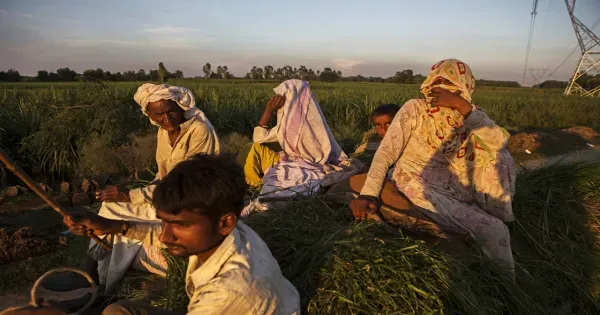
The biggest failure in India’s development story is that despite increasing prosperity, the farmer who grows food in the fields and the laborer who builds factories, roads, and buildings still remain at the bottom of the economic structure built by their hard work. The question is why? The answer is clear: India considered development a top-down process, while the world’s successful countries adopted a bottom-up model.
Israel has neither vast land, abundant water resources, nor a favorable climate. Yet, it is among the world’s leading countries in terms of agricultural productivity. The reason: it has transformed agriculture into a science, not a matter of pity. Drip irrigation, sensor-based farming, data analytics, research-based crop management, and water efficiency have transformed agriculture there into a modern industry. In India, by contrast, agriculture remains dependent on the monsoon. We hold conferences on the water crisis, but fail to bring modern irrigation technology to the fields. Farmers are told about technology, but they are denied access. This is not just a lack of resources, but a lack of priorities.
The Netherlands, smaller in size than many districts in India, is still among the world’s top agricultural exporters because farmers there don’t just produce—they’re also involved in processing, packaging, branding, and exporting. Farming doesn’t end at the farm; industry begins there. In India, farmers still primarily sell raw materials. They grow tomatoes, and someone else makes the sauce. They extract the milk, and someone else brands it. They grow the wheat, and someone else reaps the benefits of value addition. This is the biggest weakness of our agricultural policy—we consider farmers producers, not entrepreneurs.
The foundation of Germany’s industrial power isn’t just machines, but safe and trained workers. Every worker there has access to health care, pensions, unemployment benefits, and workplace rights. Labor unions aren’t just a protest organization; they are part of policymaking. The situation of workers in India is the opposite. A large number of workers are in the unorganized sector—without contracts, without insurance, and without social security. An accident at a construction site often doesn’t even make the news. Labor is still considered “cheap labor,” not “human capital.” As long as we continue to treat labor as a means to reduce costs, production may increase, but society will not strengthen.
China’s development isn’t just a story of megacities. It established industries in villages and small towns, fostering local production, and connecting the rural economy to the industrial base. The result was controlled migration, increased incomes, and regional balance was achieved. India took the opposite path. It limited opportunities in villages and concentrated expectations in cities. As a result, millions migrated for employment, urban slums proliferated, and the rural economy languished. If the employment landscape isn’t decentralized, development won’t be balanced.
It’s often argued that India’s population is large, and therefore its challenges are greater. This argument may be partially true, but it’s not entirely true. India possesses vast land, a young population, agricultural potential, a large market, and technological prowess. The only shortcoming is that we haven’t given strategic priority to our productive classes. We created relief schemes for farmers, but haven’t created a profitable agricultural model. We created portals for laborers, but did not establish a security-based labor infrastructure. We made more announcements, but fewer institutional reforms.
Giving farmers and laborers a few thousand rupees or honoring them on special occasions will not change their situation. Structural reforms are needed. Agriculture must transform from production-centric to income-centric. Farmers must be connected to markets, technology, storage, processing, and export chains. Labor policy must not be limited to employment generation; it must be based on social security, skills, and respect. Small industries, local manufacturing, and agro-processing in villages must become national missions. And above all, farmers and laborers must be considered stakeholders, not beneficiaries, in policymaking.
-
Manchester United’s Tyler Adams interest explained as Bournemouth midfielder remains on radar

-
Arshdeep Singh, Naman Dhir, Ashwini Kumar Attend KKR Star Ramandeep Singh's Wedding With Actress Charlie Chauhan

-
ORN.com Brings Europe Travel Story To Millions Through India-Sri Lanka Test Series Partnership

-
Tamil Nadu CM Vijay Urges PM Modi To Retain Class XII Marks-Based BVSc Admissions, Opposes NEET

-
Manchester United must ‘break the rules’ for Bruno Fernandes, says Michael Owen as contract talks over Red Devils captain continue