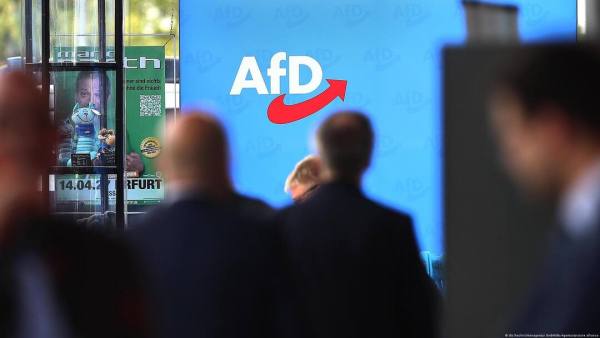
For the time being, there is still widespread agreement among all democratic parties in Germany: Cooperating with the far-right Alternative for Germany (AfD) remains out of the question. However, whether this will remain the case is becoming increasingly uncertain. The established parties have so far been unable to halt the AfD's surge in the polls over recent months.
This has also been confirmed by the latest ARD-Deutschlandtrend survey conducted by the polling firm infratest-dimap. 1,300 eligible voters were asked what party they would vote for if a federal election were held next Sunday, and 28% said they would vote for the AfD. This represents a one-percentage-point increase and a new record high for the AfD in the monthly polly.
In contrast, Chancellor Friedrich Merz's party, the center-right Christian Democratic Union (CDU), and its sister party, Bavaria's Christian Social Union (CSU), have seen a slight decline compared to the last poll in early July while all other parties have maintained their previous levels.
A Clear Majority Supports Reaching Out To The AfD
In September, state elections will take place in two important eastern German states: Saxony-Anhalt and Mecklenburg-Western Pomerania. In both states, the AfD leads in the polls. In Saxony-Anhalt, they are polling at 41% and might be able to govern alone, if the center-left Social Democratic Party (SPD) fails to cross the 5% threshhold for representation in parliament.
However, only 37% of voters across Germany are opposed to any form of cooperation with the right-wing populists while 32% believe such decisions should be made on a case-by-case basis.
A total of 27% are generally in favor of cooperating with the AfD, most of whom are AfD supporters.
What is especially interesting in the poll, however, is the contrast between East and West Germany. The AfD has its strongholds in the East, where more people than in the West are willing to fully embrace the party: 38% want to treat the party — of which several regional chapters have been categorized as far-right extremist by the domestic intelligence agency — just like any other political group. That figure roughly corresponds to the level of support for right-wing populists in the formerly socialist East Germany (GDR).
Many AfD Supporters Feel Marginalized
This figure also reflects the continuing shift away from "mainstream" parties. A good half of those surveyed — more than ever before in the Deutschlandtrend — support a fundamental change in German politics while only four in ten prefer isolated policy adjustments.
In other words, confidence and trust in the political system continue to wane. Forty-three percent of all respondents say they constantly feel marginalized. When this question is put to AfD supporters, that figure jumps to 70%.
The past few weeks in German politics have been marked by heated debates over proposed reforms and by a rather chaotic reshuffling of the cabinet. Even before this, approval ratings for Chancellor Friedrich Merz's policies were not high; now, only 12% believe that the new cabinet appointments will lead to better policies.
One-Third Are Afraid of Terrorism
And the latest terrorist attack in Germany has also had a significant impact on people's views. On July 25, a young Islamist from Berlin drove a rental car into a crowd during the Berlin Pride celebrations, killing one woman and seriously injuring 31 people. The following day, police shot and killed the man, who had fled after carrying out the attack. This horrific event has once again drawn attention to how vulnerable Germany is to terrorist attacks.
One-third of all respondents said they are very concerned they might become victims of terrorism themselves. Now, 70% see Islamist terrorism as the greatest threat. At the end of the last decade, on the other hand, right-wing extremist terrorism was still seen by German citizens as the greatest threat.
For the ARD-Deutschlandtrend survey in August, infratest-dimap interviewed approximately 1,300 representative German citizens between August 3 and 5.
(Disclaimer: This report first appeared on Deutsche Welle, and has been republished on ABP Live as part of a special arrangement. Apart from the headline, no changes have been made in the report by ABP Live.)
-
Has your curry leaf plant stopped growing? Just correct these 4 mistakes and you’ll see new growth in just a few days.

-
Has your curry leaf plant stopped growing? Just correct these 4 mistakes and you’ll see new growth in just a few days.

-
6 million drivers eligible for £71 off airport parking fees in 2026

-
Millennial Mothers: “We doubled their responsibilities, but not their support”: Why millennial mothers may be the most exhausted generation yet |

-
Suriya And Jyotika Reveal Their Wellness Secrets: Strength Training, Quality Sleep And Simple Habits