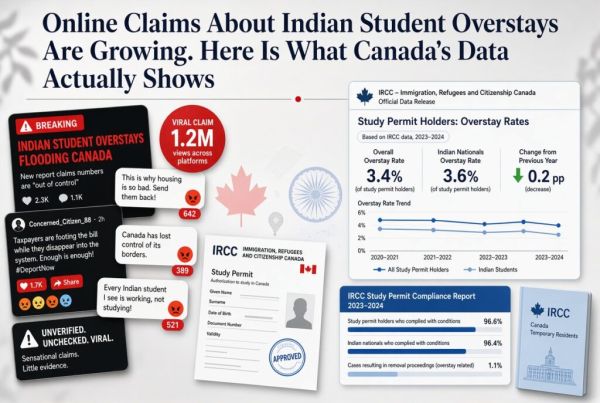
Enforcement is rising and oversight gaps are real, but Ottawa still has no verified count of former Indian students currently living in Canada without legal status
By Ayush Anand

A growing debate across social media, community forums and online news pages is raising a difficult question: How many Indian students entered Canada with study permits but later stopped attending school, allowed their status to expire or remained in the country without authorization?
The discussion has intensified as videos and posts cite figures ranging from tens of thousands to more than 150,000. Some present these numbers as proof that a massive population of Indian students has disappeared into Canada or is living illegally in the country. Official records do show serious weaknesses in the way Canada monitored international students, along with a sharp increase in immigration enforcement involving Indian nationals. However, the numbers circulating online often describe entirely different groups and cannot be combined into a single total.
The most important fact is also the one most frequently missing from the online debate: Canada does not currently publish a precise number of former Indian students who are overstaying. Immigration, Refugees and Citizenship Canada, known as IRCC, has historically had difficulty connecting the expiry of a study permit with a confirmed departure from Canada. Some people leave without their departure being fully reflected in the department’s records. Others obtain work permits, visitor status, permanent residence or another legal status. Some make refugee claims, while others may remain without status.
Why Indian Students Are at the Centre of the Debate
Indian nationals have formed Canada’s largest international student group for years. That scale means India frequently appears at or near the top of Canadian statistics involving study permits, school compliance reporting and immigration enforcement. Large absolute numbers do not automatically mean Indian students have the highest rate of wrongdoing. They also reflect the fact that Indians made up a much larger share of the international student population than most other nationalities.
That population has now fallen dramatically. Annual IRCC data shows that the number of study permits that became effective for Indian nationals dropped from approximately 188,715 in 2024 to 94,605 in 2025. Across all nationalities, the total fell from about 514,915 to 383,905 over the same period. Canada reported 632,850 study permit holders in the country as of May 31, 2026, while only 19,425 new international students arrived during the first five months of the year. The federal target for all new student arrivals in 2026 is 155,000.
The decline follows several major policy changes. Canada introduced a study permit cap, raised financial requirements, made the verification of school acceptance letters mandatory, ended the Student Direct Stream and tightened eligibility for some Post Graduation Work Permits. Most applicants must also provide a provincial or territorial attestation letter, although master’s and doctoral students at public institutions received an exemption in 2026.
What the 153,000 Figure Really Means
One of the largest numbers being shared online comes from the Auditor General of Canada. Between 2023 and 2024, designated learning institutions reported 153,324 international students as potentially noncompliant with their study permit conditions. These reports are generally based on whether a student appears to be enrolled and actively pursuing studies.
Potentially noncompliant does not mean confirmed to be in Canada illegally. A student can be flagged because records are incomplete, because the person transferred institutions, because a school reported outdated information or because the individual entered another immigration stream. IRCC must investigate before deciding that a person actually violated permit conditions.
The Auditor General found that IRCC had temporary funding to investigate only about 2,000 cases each year. The department launched 4,057 investigations during 2023 and 2024. Among those cases, 1,401 students were confirmed to be studying, only 50 were confirmed as noncompliant and requiring further follow up, 915 investigations were cancelled, and 1,654 students did not respond to requests for information. The limited number of completed investigations exposed a major enforcement gap, but it did not establish that all 153,324 people were overstayers.
Parliamentary evidence provided in May 2026 added another layer of context. Officials said that 64 percent of the 153,000 students still had valid status and 14 percent had submitted asylum claims, meaning 78 percent no longer required follow up through the student compliance program. The remaining 22 percent, or roughly 33,000 people, had expired status in the available records. Officials acknowledged that some may have left Canada and others may have remained without applying for a new permit. These figures cover international students of all nationalities, not Indian students alone.
The 39,500 Cases Canada Could Not Properly Track
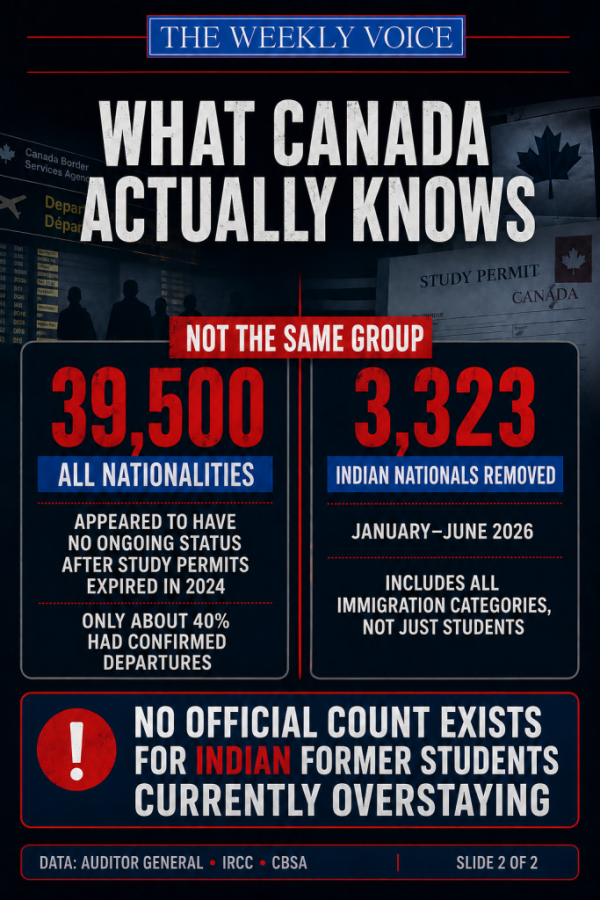
The Auditor General separately examined approximately 549,000 people whose study permits expired in 2024. About 509,500 had authorization to remain in Canada through another status or process. Approximately 39,500 appeared to have no continuing immigration status and should no longer have been in the country.
When federal auditors compared IRCC information with Canada Border Services Agency records, they could confirm that only about 40 percent of those 39,500 people had departed. That left the whereabouts of the others uncertain. Some may have overstayed, while others may have left through routes or circumstances that were not captured in the available data. Once again, this was a national figure covering all citizenships. The audit did not identify how many were Indian nationals.
This uncertainty is one reason online claims can sound more definitive than the evidence allows. A person who is unaccounted for in an immigration database is not automatically still living in Canada. At the same time, the absence of reliable exit information means the government cannot confidently say that every person left. Both parts of that statement matter.
Indian Removals Are Rising, but They Are Not All Former Students
Canada Border Services Agency figures show that 3,323 Indian nationals were removed from Canada between January 1 and June 30, 2026. India was the leading citizenship in enforced removals during that period, ahead of Mexico at 1,573. There were 10,607 removals across all nationalities. A further 7,669 Indian nationals were listed in the removal in progress inventory as of June 30.
Those figures are significant, but they do not represent a count of Indian students. CBSA’s public table is organized by citizenship, not by a person’s original permit type or the reason for removal. It can include failed refugee claimants, visitors, workers, former students and people found inadmissible for reasons such as misrepresentation or criminality. A removal in progress also does not necessarily mean someone has already been deported, since cases can be affected by appeals, risk assessments, legal proceedings and travel arrangements.
Why the Online Conversation Has Become So Heated
The debate is unfolding at a time when Canada is reducing its temporary resident population and reassessing an international education system that expanded rapidly. Housing costs, limited employment opportunities, questionable recruitment practices and concerns about immigration fraud have all placed the program under pressure. Indian students are highly visible in the conversation because they were the largest cohort and therefore experienced the greatest numerical impact when policy changed.
There is also a human side that broad statistics can obscure. Many Indian students followed the rules, paid substantial tuition fees and built their plans around policies that later became more restrictive. Some graduates have faced uncertainty over Post Graduation Work Permit eligibility or have struggled to move into another legal status. Those experiences should not be conflated with deliberate fraud or overstaying.
At the same time, legitimate students also have an interest in a credible system. Fraudulent applications, schools that fail to monitor attendance and people who knowingly ignore permit conditions can damage public confidence and make the process more difficult for everyone. Stronger oversight should therefore focus on verified conduct and institutional accountability rather than assumptions based on nationality.
IRCC and CBSA began testing improved information sharing and exit tracking in 2026. The objective is to determine more reliably whether temporary residents have left Canada after their permits expire and to identify cases requiring enforcement. Until that system produces clearer results, the exact scale of overstaying among former students, including Indian nationals, will remain uncertain.
The fairest conclusion is that Canada has a documented monitoring problem, a group of people whose status or departure could not be confirmed and a rising number of removals involving Indian citizens. What Canada does not have is evidence that every student flagged by a school stayed illegally, or an official count showing exactly how many Indian former students are currently overstaying. The issue deserves scrutiny, but it also demands accuracy.
Official sources: Auditor General of Canada report on International Student Program reforms, House of Commons Citizenship and Immigration Committee evidence, IRCC student and temporary worker statisticsand CBSA immigration removal statistics.
-
'Hopes Of Billion Hearts': Odisha CM Mohan Charan Majhi Wishes Team India Ahead Of FIH Hockey World Cup 2026

-
UPSC CSE Mains Admit Card 2026 Released At upsc.gov.in; Direct Link Here
-
US CENTCOM To Establish First Multinational Multi-Domain Attack Drone Task Force In West Asia

-
Michael Carrick opens up on Manchester United documentary cameras

-
Father, son electrocuted while watering paddy in Bhupalpally