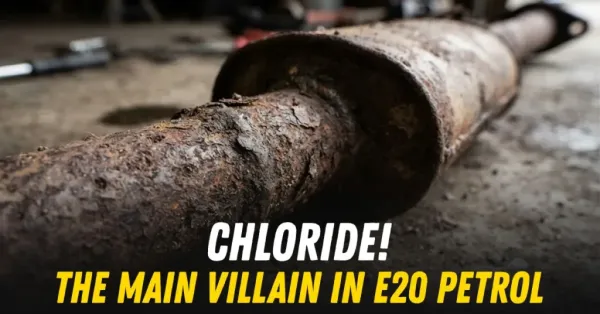
India’s E20 story and the controversies surrounding it now has a new villian- Chloride contamination. It first made headlines when a letter from the Society of Indian Automobile Manufacturers (SIAM) to the government, got leaked, showing Chloride contamination being flagged in E20 petrol. In later developments, we saw SIAM issue a clarification on the leaked excerpts of the letter, and effectively withdraw it.
According to a Reuters report, tests done by state-run fuel retailers reportedly found no evidence to support claims of high Chloride contamination. That said, here is everything to know about how chloride content in fuel can be a serious issue in the long run.
How Chloride Content In Fuel Can Harm Your Vehicle
The primary issue is that of extensive corrosion. High Chloride content creates a highly corrosive environment. The meta, and polymeric parts of the vehicles’ powertrain are all vulnerable to this. Chloride ions usually attacks metallic parts by disrupting the oxide layer on them. This layer usually prevents rust and the absence of it lets the components vulnerable to rusting.
High chloride content in petrol can damage fuel pumps and injectors. These parts are created to micron-level tolerances. Chloride content can cause ‘pitting’ in these surfaces. This can cause immediate fuel leaks, pressure drops and even injector clogging.
For fuel tanks and lines, the damage will be mainly from corrosion. Galvanic and pitting corrosion can lead to pinhole leaks. As you would know by now, ethanol is hygroscopic. It aggressively attracts moisture and water content out of the air. When water enters the fuel somehow, the Chloride in it acts as a catalyst. A chemical reaction follows which breaks down ethanol into formic and acetic acids. These are both highly destructive in nature and further lower the fuel’s pH. This acidic liquid can damage your engine significantly.
Chloride contamination can even affect a vehicle’s E20-compliancy. Modern E20-compliant vehicles use elastomers like Viton in their fuel lines. This is to make them resistant to Ethanol- damage. High Chloride content in E20 petrol can affect this protective behaviour.
Chloride contamination alters the fuel chemistry. The acidic mixture then accelerates the degradation of elastomers. This may eventually lead to the swelling, hardening, and cracking of rubber fuel hoses, O-rings and seals. The degradation of plastic parts further creates microscopic structural debris which can clog fuel filters and injector nozzles.
SIAM’s Letter To The Government Flags Chloride Contamination
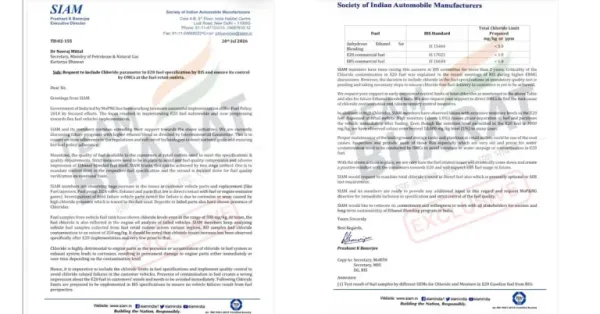
Image source: Tehseen Poonawalla Twitter
According to SIAM’s letter to the government, E20 petrol itself is not the issue anymore. Ensuring its quality remains the bigger concern. The communication warns the government that the Chloride content in E20 fuel is actively damaging vehicles and reiterates that the fuel dispensed by petrol pumps need to meet the set specification and quality requirements.
The letter says that SIAM members have been seeing a sharp spike in issues in vehicle parts and more replacements of components like fuel pumps, injectors , EGR valve, and exhausts than before. These, if you see, are parts that come in direct contact with petrol or the exhaust gasses.
According to the letter, investigations on these parts have revealed the presence of Chloride in them. It also says that fuel samples from the tanks of damaged vehicles also showed increased chloride levels. SIAM members also analysed fuel samples from various petrol pumps. The report claims that chloride contamination of up to 350 mg/kg was recorded in some cases.
SIAM Does A U-Turn!
Initially, excerpts from the communication had surfaced online, showing this information. The leak went viral instantly. The original story by CNBC TV18 was soon taken down and SIAM came up with a clarification. In it, the body gave more context to the leaked excerpts. It stated that fuel fuel quality testing is a comprehensive process, covering over 150 parameters. Oil marketing companies continue to undertake it.
It clarified that the leaked communication ‘was part of routine and ongoing technical deliberations that take place between various stakeholders’. It further mentioned that some numbers from the leaked communication need authentication and a comprehensive consultation with OEMs. The Ministry of Petroleum and Natural Gas has instituted a 3ppm guidelines for the Chloride content in fuel. And finally, the body withdrew the previous communication officially.
Fuel Retailers: No Chloride Contamination!
According to a Reuters reportIndia’s state-run fuel retailers have said that nation-wide testing of E20 petrol found no evidence of high Chloride content. The fuel quality, they said, remained within the prescribed limits. More than 100 petrol samples from various refineries showed chloride levels at or below 1 ppm. Ethanol from 80 distilleries showed chloride content below 3ppm. They also said that inspections of underground fuel tanks at about 90,000 fuel stations showed no case of water ingress.
-
Trip ideas from Hyderabad: Visit India’s first village

-
Kareena Kapoor reacts to pregnancy rumours, shares actual reason

-
Vaibhav Sooryavanshi's Big Red-Ball Test Falls Flat; This Bowler Gets Him Out

-
Shravan Somvar : Specially for Shravan Somvar, make 'Besnachi Barfi' to worship Lord Shankar.

-
Food divorce: new trend for couples