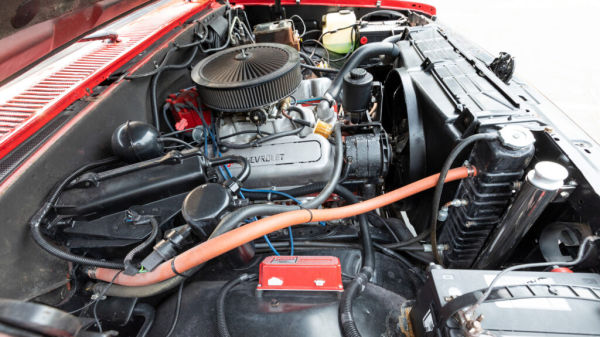
Automotive enthusiasts often debate the virtues and capabilities of Ford versus Chevy with passionate fervor. The same passion becomes more focused when comparing the Ford 300 inline six-cylinder, one of the most reliable inline-six engines ever built, to the 292 inline-six from Chevrolet.
Chevrolet’s 292 cubic-inch I6, introduced in 1963 model year ¾- and 1-ton Chevrolet and GMC pickup trucks, was the first of the two engines available to the public. Ford one-upped Chevy in 1965 with its 300 cubic-inch I6, an engine that would power various Ford pickup models until 1996. Chevy discontinued North American production of its 292 in 1989.
Both engine designs place the intake manifold, with associated fuel supply and delivery, directly above the exhaust manifold. The difference being Ford’s passenger side placement opposed to the driver side location of the Chevy.
The pickup trucks that came out in the 1960s were a radical departure from the bulbous generation that preceded them. Looking back we can see how the design morphed into one more in line with today’s pickups, now some 60 years later. Even though pickups had begun the transition from farm and work truck to more civilized versions driven by folks from all walks of life, there was still work to be done. That work required pickup truck engines to be reliable and supply enough power to get the job done.
Chevy’s 292 cubic-inch inline-6 engine
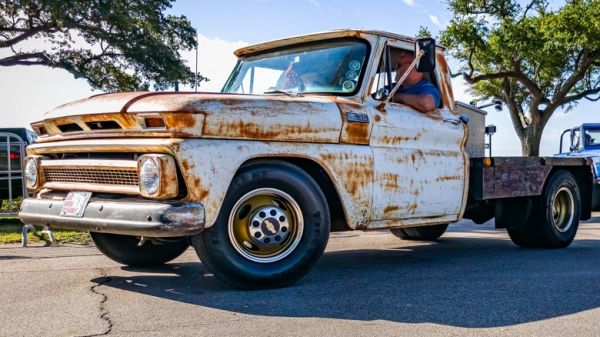
While the exterior design changes introduced in the 1960s led to the Chevy pickups we see today, the 292 inline-six was also an important part of Chevy truck history from the last century. Between its introduction in 1963 and being phased out in favor of the 4.3-liter Vortec V6 in the late 1980s, the 292 powered a variety of medium-and heavy-duty Chevy trucks, buses, vans, and RVs. Smaller displacement I6 Chevy engines, like the 194, 230, and 250, powered most of Chevrolet’s passenger cars and light-duty trucks that weren’t equipped with V8 engines through that period.
The 292 features a 3.875-inch bore with a 4.125-inch crankshaft stroke. The engine’s relatively long stroke, requiring a taller deck height than other Chevy I6 varieties, is credited with generating substantial torque for a six cylinder. The 292 carried net power ratings of 120 horsepower at 3,600 rpm and 215 lb-ft of torque at 2,000 rpm.
A couple of factors reduce the 292’s power potential. First are its paired intake ports. Three paired ports feed the six cylinders (two cylinders per port) with an extrusion encompassing a head bolt (and restricting airflow) through each port. Another factor is its stock governed 4,400 rpm cap. While it’s possible to crank them up to 6,000 rpm with aftermarket components and balancing, that’s about the limit due to the length of the crankshaft.
Although Chevy discontinued the 292 over 30 years ago, S&J Engines still offers the Chevy 292 inline 6 for sale. At time of writing, the company lists a 292 long block priced at $2,189 plus a refundable $350 core charge. Additionally, if you have a 292 that needs a refresh, S&J has you covered with parts and services.
Ford’s 300 cubic-inch inline-6
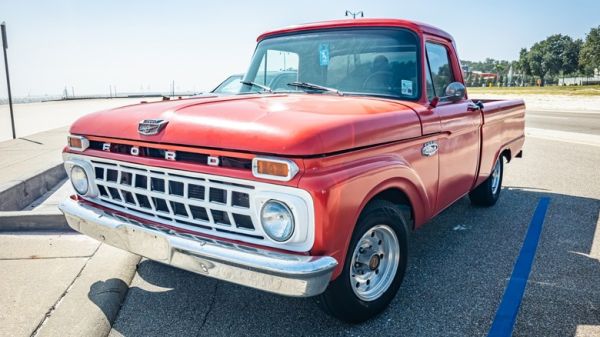
Following the I6 300’s introduction in 1965, Ford used the engine for over 30 years. There’s no doubt that to this day the Ford 300 has a more widespread following. A quick internet search returns countless calls for the engine to be in the immortalized, presumably in Motor Trend’s Engine Hall of Fame; it makes frequent appearances in “best engines” lists, and it’s a top contender for “Engines we wish Ford still made.”
In support of the 300 Ford’s legendary status is a mountain of anecdotal evidence proclaiming engine life exceeding 400k miles with regularity. However, the engine isn’t without its flawed examples. Engine castings that crack and blown head gaskets seem to be the most common killers of the 300.
Like the 292 Chevy, the Ford 300 was designed for doing heavy work. While the 300 makes more power, its approach was a little different. With its nearly square 4.00-inch bore and 3.98-inch stroke, it made up to 150 horsepower and 265 lb-ft of torque (net). Although both engines reach their torque potential at just 2,000 rpm.
Ford 300 inline-6 crate engines are still available for sale as remanufactured long blocks as well. One example, part number VRE-DFF8comes from Summit Racing Equipment for $2,560.99 plus a refundable $470 core charge. As a remanufactured long block, the engine comes with a refurbished rotating assembly (crankshaft, connecting rods, pistons, and bearings), valvetrain (camshaft, lifters, pushrods, valve springs, valves, etc.) and an oil pump, all housed in a reconditioned cast iron engine block and cylinder head. However, there are no covers, manifolds, spark plugs, or even an oil pan included.