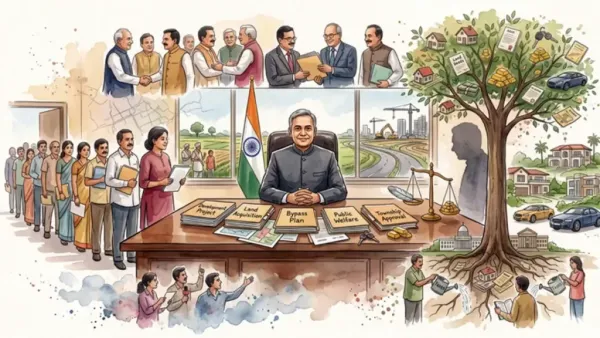
During my entire tenure, I considered everything of the nation as my own. The government bungalow was mine. The government car was mine.
I wanted to serve the nation since childhood. When other children dreamed of becoming doctors, engineers and scientists, I used to dream of bungalows, red beacons, government vehicles and five-star meetings since childhood. I knew from the beginning that the nation is a very big thing and to serve such a huge nation, it is necessary to make oneself big first. Therefore, I had decided that I will not serve the nation directly, I will serve myself first because if I am not happy, then how will I be able to give happiness to the nation? I worked hard. Studied day and night.
Passed competitive exam. In the interview, he said ‘National Service’ in such a sweet voice that the eyes of the selectors were filled with tears. They thought ‘What a devoted young man!’ And I thought in my mind – ‘Now life has been successful.’ During training we were taught that ‘You are the backbone of the nation.’ I took this sentence very seriously. Then I thought that when the entire system rests on my back, then some of the weight of the system should also be borne, like my house, my car, my farmhouse and my investments. As soon as I got my first posting, I understood that national service is hidden not only in files but also in land. I quickly acquired the knowledge that where there are fields today, there will be bypass tomorrow. Where today there is a village, tomorrow there will be a township, and where today a farmer is ploughing, there my ‘investment property’ will shine tomorrow. Real administrative foresight is to know in advance the path of progress of the nation. I was not alone. There were many ‘like-minded national servants’ like me. We bought land together. Purchased exactly as per the rules. Then a few months later, by chance, a road came up there, a bypass was built, the land use changed and the fields suddenly became gold mines. People call it corruption but they do not understand our vision. The public cannot see the future, that is why we are the public and we see the future first, that is why we are officials. While serving the nation, I also learned that government rules are a very beautiful thing. They are rigid to control the public and flexible to facilitate the authorities. Traveling allowance, house allowance, special allowance, sitting allowance, the nation provided so many resources for my service that sometimes my eyes became moist with emotion. I used to think, ‘O nation, you are so kind.’
Government tours were the sweetest chapter of national service. Wherever the conference was, in the mountains, on the sea shore or in a foreign country, I used to reach there immediately in the national interest. Used to discuss the problems of the nation while sitting in a five star hotel. Used to think about poverty alleviation while eating foreign fruits for breakfast. He used to give presentations on the problems of farmers while sitting in an air-conditioned auditorium. The public may see this as a luxury, but they do not know how difficult national service is.
Maintaining cordial relations with leaders is also an essential part of administrative skills. I became close to politicians from every party. The power kept changing, but my smile remained constant. I continually learned that ideas are temporary, but connections are permanent. To keep politicians happy, it is necessary in the national interest to praise them from time to time. Coordination is very important in democracy.
Keeping senior officials happy is also an important part of administrative culture. Any system does not just run on rules, it also runs on ‘respect’. Therefore, proper respect had to be given from time to time. After all, seniors were also serving the nation. If their mind remains happy, only then the system will run smoothly.
Sometimes some mischievous people would even complain. Some journalist would publish news, some worker would ask questions. But I had learned the most powerful maxim of administrative science, ‘Become a victim before the investigation begins.’ As soon as any issue would arise, I would immediately say, ‘I am being targeted because of my caste.’ Sometimes he says, ‘Honest officers are being harassed.’ Sometimes he would say, ‘I had taken action against big people, that is why a conspiracy is taking place.’ This solution was extremely effective. People immediately divided into two groups. Some would come in my support, some in opposition. And the real issue gets lost somewhere in this debate. This is administrative yoga, merging the issue into emotions.
During my entire tenure, I considered everything of the nation as my own. The government bungalow was mine. The government car was mine. Government employees were mine. Even the tree on the road seemed like mine to me. After all, I was a national servant. And when ‘I am the nation’, then what is the difference between the nation’s property and my property?
Gradually I have earned so much that now even seven generations can serve the nation comfortably. Farms, plots, farmhouses, flats, investments, gold, everything was received by the grace of the nation. The public kept thinking that I was serving them and in reality I kept giving the form of service to the nation. The most beautiful thing is that even today the society calls me an ‘honest officer’ because I never took bribe directly. I just took chances, used information, understood the rules and played relationships. This is not corruption, this is ‘administrative intelligence’. Today, when I sit in my luxurious drawing room and worry about the nation, I am filled with pride and then I look at the national flag and say with pride, ‘We are the nation… the nation is from us only.’
FAQ
What is the main message of the satire ‘We are the Nation’?
This satire exposes the bitter reality of administrative officials using government facilities, red beacons and positions for personal gain and corruption instead of public service.
What is the meaning of ‘administrative foresight’ given in the satire?
Sarcastically, ‘administrative foresight’ has been said to mean making profits by buying land at throwaway prices by pre-estimating information about government schemes (e.g. bypass, highway).
What methods are adopted by officials to avoid disputes?
When disputes arise, playing the ‘victim card’, portraying oneself as a victim of caste, religion or honesty and diverting the issue into public sentiments have been said to be the main administrative strategies.
What comment does this satire make on society and governance system?
This work shows how the general public considers government luxuries as ‘hard public service’, while within the system, individual prosperity is considered national prosperity.
Why is Administrative Corruption Satire relevant?
This literary genre works to identify and make common citizens aware of the systematic corruption and selfishness growing within the government system.
-
Kitchen Tips : What happens if hot food is kept directly in the fridge? Know the truth behind 'this' misconception

-
Instagram's New Look After 10 Years! Meta Refreshes Iconic Wordmark, Here's What Changed

-
After 10 years, Instagram changed the handwriting of its identity! New Wordmark launched, but App Logo will still remain old

-
Vivo's new phone suddenly entered the market! Special features from 6500mAh battery to 100x zoom, know the price

-
Ashwin predicts Hardik Pandya's next IPL team