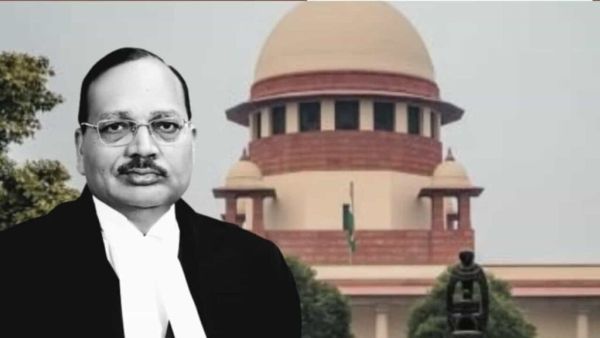
A very historic and strong message has come out from the Supreme Court of the country regarding student rights, freedom of expression and autonomous structure of legal education. Chief Justice of India (CJI) Justice Surya Kant has expressed deep displeasure over the punitive steps taken by the Bar Council of India (BCI) against the students of the 2026 batch of the prestigious NALSAR University of Law, Hyderabad. The Supreme Court made it clear in clear words that students have the full democratic right to register their disagreement and protest in a peaceful manner. Terming BCI's interference as completely 'unnecessary and inappropriate', the CJI said that the issue raised by the students is an internal dialogue between him and the students, in which the regulatory body has no right to interfere or threaten to ruin their careers. What was the whole Nalsar controversy and why did the students protest? This entire incident started with the selection of the chief guest for the upcoming convocation ceremony of the National Law University of Hyderabad (NALSAR). Upon learning of the university administration's plan to invite CJI Surya Kant as the chief guest, more than 450 graduating students of the 2026 batch had written a joint letter requesting them to reconsider it. The students said they disagreed with some oral observations made by the top court during the hearing of a petition to the alleged police action during the student protest in Delhi on July 20. The students argued in their letter that the Law University has taught them to respect the values of the Constitution, the right to dissent and access to justice. In such a situation, he was registering his ideological objection to the presence of such a chief guest to receive the degree in the convocation ceremony. Despite the students expressing their views peacefully, the Bar Council of India (BCI) treated the matter as indiscipline and contempt of the apex judiciary. As soon as the news of students' protest against Bar Council of India's controversial decree and enrollment ban came to light, a controversial circular was issued under the leadership of BCI Chairman Manan Kumar Mishra. In this order, the State Bar Councils of all the states of the country were instructed not to enroll any graduate student of the 2026 batch of NALSAR University as an advocate. Also, a detailed report was sought from the university administration identifying the students and teachers who led this movement. As soon as this Tughlaq decree of BCI came to light, there was strong anger among the legal circles, senior lawyers, former judges and student organizations across the country. After huge protests on social media and legal experts calling it a blatant violation of fundamental rights, the BCI came on the backfoot and within a few hours announced the withdrawal of the decision. However, BCI had said to continue the investigation into the protest, against which the matter reached the Supreme Court. Heated hearing in Supreme Court: 'Who are they to come in between?' Senior advocate K. Parameshwara mentioned the matter before a special bench of CJI Surya Kant, Justice Joymalya Bagchi and Justice V. Mohana, calling it extremely urgent. The senior lawyer argued that although the BCI has withdrawn the circular stopping the enrolment, the manner in which pressure was exerted on the students of an autonomous university by using institutional power is a direct attack on legal education and freedom of expression. On this, CJI Surya Kant strongly condemned the stand of BCI. CJI said in open court, "This instruction was completely unnecessary and inappropriate. The students wrote to me and this is a dialogue between me and the students. Who are the BCI people who interfere in this? If students have any reason or idea to protest, they have every right to protest. No one can stop them and we will not let this happen at all."
'I too have been in movements in my student days': CJI shares experiences During the hearing, the Chief Justice made reference to his personal life to stress the importance of democratic dissent on academic campuses. CJI said, "When I was a student myself, I also actively participated in student activities and movements. In youth, if someone expresses his views, even if it is considered technically wrong, he still has the full right to protest peacefully and raise his voice. As long as the protest is within the ambit of law and peaceful, no one can be allowed to suppress it."
Justice Joymalya Bagchi, member of the bench, also raised strong questions on the functioning of the BCI, asking whether the Bar Council had called any formal meeting or followed the rules before passing such a resolution. Supreme Court's doors open for students: 'Take membership of the Bar immediately' The Supreme Court not only completely banned any kind of punitive action against the students, but also boosted the enthusiasm of the young law graduates. CJI, while conveying a special message to the students through senior advocate Parmeshwar, said, "Tell all the students to enroll themselves as advocates as soon as possible without any hesitation. They should take membership of the Supreme Court Bar Association (SCBA) and we will include them in the legal aid panel of the Supreme Court so that they can provide justice to the poor and needy."
The court gave strict instructions to the BCI and all the state bar councils of the country that no coercive or police action should be taken against the students or teachers of NALSAR or any other law university in the country in connection with this matter. Also, the court has issued a notice to BCI and ordered it to file its reply within two weeks. This clear and strong stand of the Supreme Court is not limited to the students of NALSAR University only, but it has become an example for all the universities and educational institutions of the country. Jurists believe that professional and regulatory bodies need to understand the limits of their powers. Efforts to snatch away the career and livelihood opportunities of students by considering their ideological dissent as a crime or indiscipline are a violation of the rights granted under Article 19(1)(a) of the Constitution. This sensitive and democratic initiative of CJI Surya Kant has instilled a new confidence in law students across the country that the judiciary of the country is not only the protector of the Constitution, but is also the fearless voice of the youth and the strongest shield of democratic dialogue.
-
Leandro Paredes turns down AC Milan interest to stay at Boca Juniors

-
Carlos Baleba 'keen' on Old Trafford switch if Manchester United make move in coming weeks

-
People's high expectations from police reflect their trust: Nana Patekar

-
My biggest earning: Shankar Mahadevan on lending voice to UP Police song

-
Lucknow Gen Alpha students protest teacher shortage; UP minister assures improvement