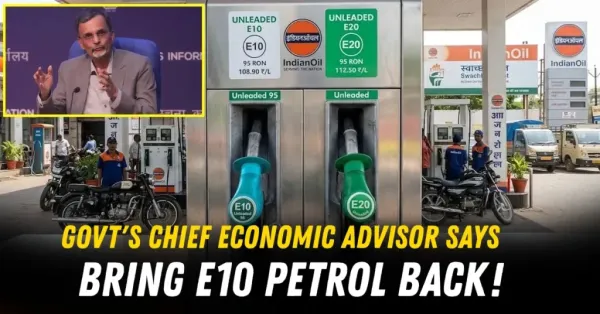
E20 petrol and the debate surrounding it are a common sight on the internet. Amid the ongoing confusion and resistance from car owners, Chief Economic Adviser V. Anantha Nageswaran and Akash Poojari, a consultant with the Department of Economic Affairs, have come forward with a proposal that might bring a smile to many old car owners. They have suggested bringing back E10 petrol for older two-wheelers and cars that are not compliant with E20 fuel. They also urged the government to examine the food-versus-fuel trade-off before pushing ethanol blending in the country beyond 20 percent.
V. Anantha Nageswaran and Akash Poojari mentioned this in a column published in The Indian Express. The column talks not just about the compatibility of 20 percent ethanol-blended fuel in vehicles, but also about how ethanol blending will affect the agricultural sector. It talks about what India will have to grow, how much land and water will be required, and what compromises the country will have to make as ethanol demand increases.
The column specifically talks about old two-wheelers that were built before BS4 and came with a carburettor. It explains how the carburettors in old two-wheelers were not built to sense the extra oxygen in the blend and adjust for it. So, when E20 is used in such two-wheelers, the engine draws less fuel for the amount of air and always runs hot.
The rubber seals on old two-wheelers were also not rated for ethanol, and they degrade pretty quickly. This, in the long run, affects the life of the carburettor, and the customer is forced to replace it through no fault of their own. As per the report, there are currently over 75-80 million old two-wheelers in the country, and repairing and retrofitting them with compatible carburettors and rubber seals would take years. It is because of this that the column urges the government to offer a lower blend, E10, for such older vehicles. This would help calm customers with old vehicles, as it could help improve efficiency and reduce issues to the fuel system.
The authors also talk about the future ethanol blends that the government might introduce in the country. They said the ethanol blending programme expanded rapidly as India achieved its E20 target five years ahead of its original timeline. The government says that this move would reduce crude oil imports, save foreign exchange, and create an additional market for farmers and ethanol producers.
However, we already know that ethanol production will have to increase when the government decides to increase the blend, and that could actually create a food-versus-fuel conflict. Ethanol production should not be increased in the country at the cost of food production. They also talk about the amount of water required to produce crops like maize, corn, and sugarcane, which are often used for ethanol production. The government should assess all these factors instead of focusing only on the benefits of ethanol.
The story suggests that the government should offer E10 petrol as an option to customers, as it would not only give customers a choice but would also bring down total ethanol consumption.
-
Even fear of death could not stop breathing, 'Jempita' born in 7.7 magnitude earthquake and torch light

-
Raksha Bandhan 2026: Sisters should not make these 4 mistakes while tying Rakhi, it can be a bad omen

-
Royal Mail delivery delays hit 139 UK postcode areas today — full list | UK | News
-
When is it best to cut back on coffee?

-
Anurag Kashyap’s T-shirt steals spotlight at dinner party