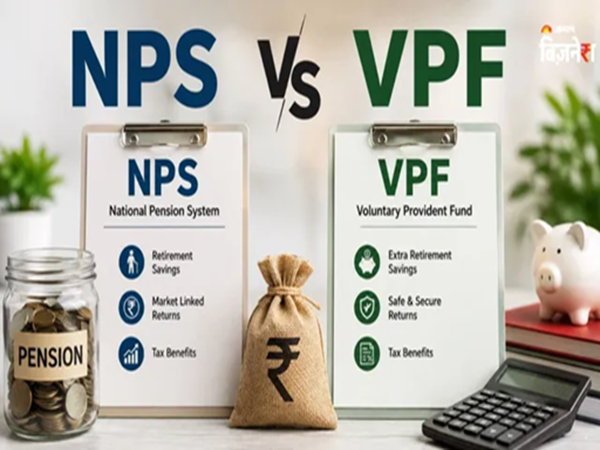
Investing in the right avenues is crucial for ensuring financial security in old age and leading a comfortable life after retirement. When it comes to retirement savings, salaried individuals generally consider two major and popular options: the Voluntary Provident Fund (VPF) and the National Pension System (NPS).
Voluntary Provident Fund (VPF)
VPF is essentially an extension of your existing EPF (Employee Provident Fund). While 12% of your basic salary is deducted for EPF, you can voluntarily contribute up to 100% of your basic salary and Dearness Allowance (DA) towards VPF.
1. It offers the same interest rate as the EPF, which is currently set at 8.25% per annum.
2. It is fully backed by the Government of India, ensuring your money remains 100% safe; there is no market risk involved.
3. Only salaried employees can avail of this benefit; business owners or self-employed individuals cannot.
National Pension System (NPS)
The NPS (National Pension System) is a government-backed yet market-linked pension scheme. It is regulated by the PFRDA. Under this scheme, your money is invested in equities, corporate bonds, and securities.
1. Since it is linked to the market, it has the potential to yield higher returns than VPF in the long run.
2. Any Indian citizen between the ages of 18 and 70 can invest in it.
3. Upon reaching the age of 60, you can withdraw 60% of the corpus as a lump sum. However, it is mandatory to use the remaining 40% to purchase an annuity plan for a lifelong pension.
Which is better for tax savings?
Investments made in VPF qualify for a tax deduction of up to ₹1.5 lakh under Section 80C of the Income Tax Act. If your total contribution to EPF and VPF exceeds ₹2.5 lakh in a financial year, you will have to pay tax—based on your applicable tax slab—on the interest earned on the excess amount.
By investing in NPS, you can claim a deduction of ₹1.5 lakh under Section 80C. Additionally, NPS offers an extra tax deduction of ₹50,000 under Section 80CCD.
Which one should you choose?
If you are a salaried employee who prefers to stay away from stock market volatility and desires fixed, guaranteed returns along with peace of mind, then VPF is the clear choice. On the other hand, if you are young, willing to take some risk, seek high returns that beat inflation, and want to save an additional ₹50,000 in taxes annually, then NPS could prove to be a powerful tool—a 'Brahmastra'—for you.
Disclaimer: This content has been sourced and edited from Dainik Jagran. While we have made modifications for clarity and presentation, the original content belongs to its respective authors and website. We do not claim ownership of the content.
-
Monsoon bathing: hot, cold or lukewarm water?

-
Luck of 1 crore employees-pensioners will shine: Know how much economic benefit will be there from the 8th Pay Commission

-
Not a single snake will wander in the house, poisonous creatures will run away as soon as you burn these things.

-
Mumbai Gets India’s First-Ever House of Photography

-
LPG cylinder holiday! Big rule regarding PNG gas comes from September 1