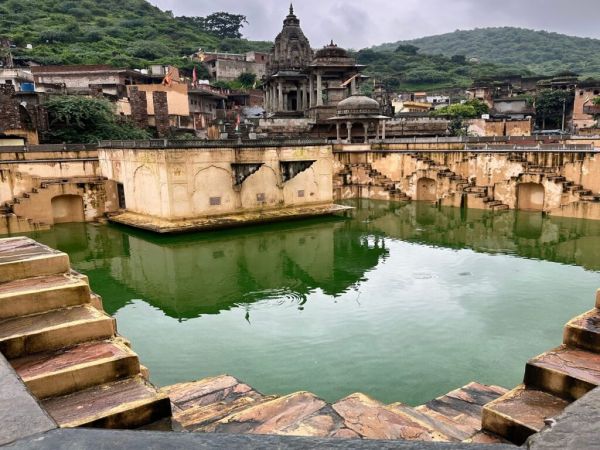
India is looking at an age-old method of addressing a contemporary water problem. There have been many instances where ancient structures used to collect water are being revived across various parts of the nation. This includes stepwells, johads, tankas, kunds, and nadis. This is happening because groundwater levels have depleted and rainfall has become unpredictable due to climate change.
An interesting instance is that of the Moosi Rani Sagar stepwell in Alwar, Rajasthan. As per BBC News, this structure overflowed on the footpath for the first time in 30+ years in 2025.
This stepwell was constructed in the early 1800s and covers an area of around 1.3 acres. This was originally a part of a bigger water harvesting system. However, till 2021, the water levels here were not consistent. In addition, there was high pollution in the water. But that situation has changed. This structure now stores water to a depth of 30ft (9m).
Why Stepwells Matter in a Water-Stressed India
Traditional water systems were designed around one simple idea: slow water down and allow it to seep into the ground. Stepwells, or baoris, are among the best-known examples. These large underground structures have flights of steps leading towards the water table.
Thousands were built across India between the 7th and 19th centuries. Many were later abandoned. Some have now been restored. Their role is becoming important again because India has a huge population but limited freshwater resources.
The country has about 18% of the global population but just 4% of the world’s available water supply. Much of the country’s rural groundwater is used for domestic use and irrigation purposes.
Global warming further increases stress on the country’s water supply system. Higher temperatures cause rapid drying of soil. At the same time, heavy rainfall results in increased runoff, thus decreasing the amount of precipitation that enters the aquifers. Traditional structures can help address this gap.
How Johads Are Helping Recharge Groundwater
Stepwells are not the only traditional systems being revived. In Rajasthan, communities have also brought back johads. These are small, crescent-shaped earthen dams designed to hold rainwater and monsoon runoff.
Their impact can extend far beyond the structure itself. By holding water for longer, johads allow it to gradually enter the soil and recharge underground aquifers.
Alwar once faced a severe water crisis. During the colonial period, mining and logging damaged the region’s watershed. Growing dependence on borewells further depleted groundwater.
By the mid-1980s, several rivers had dried up. Parts of the region were later declared a “dark zone”, meaning groundwater extraction had crossed sustainable limits. The revival of johads helped change that situation.
The practice eventually spread to more than 700 villages in Rajasthan. Communities also revived village-level assemblies to manage their water resources.
Traditional Methods Gain New Government Support
Similar efforts are underway in other parts of India. In Maharashtra’s Marathwada region, more than 6,000 villages took part in projects to build or restore soil and water conservation structures. The Paani Foundation said the initiative created more than 550 billion litres of storage. The Indian government has also increased its focus on rainwater harvesting and groundwater recharge.
Its programmes include the construction and restoration of village ponds and traditional water structures. Government data cited in the BBC report shows that groundwater recharge from tanks, ponds and conservation structures rose from 14 billion cubic metres in 2017 to 25 billion cubic metres in 2024. A 2020 government master plan also proposed millions of rainwater harvesting and artificial recharge structures.
The Missing Link Is Maintenance
Restoring an old structure is only the first step. Traditional systems need regular cleaning and desilting to remain effective. They also require local communities to take responsibility for their upkeep.
For many villages, these systems are already changing daily life. One resident, Varsha, 67, said her well once ran dry during parts of the year. After a johad was built, she said it now holds water throughout the year. Her role has also changed. She once stayed silent during village meetings. Now, she actively speaks in support of traditional water systems.
Pratap Moharana, a scientist at the Central Arid Zone Research Institute in Jodhpur, told the BBC that communities never completely forgot the importance of structures such as tankas and nadis.n What was lost, he suggested, was the political will to prioritise them.
Arun Krishnamurthy, founder of the Environmentalist Foundation of India, which helped restore Moosi Rani Sagar, summed up the challenge: “No amount of money, technology or field effort can save stepwells” without strong civic discipline.
The lesson is increasingly clear. India’s answer to a future water crisis may not always require new technology. In some places, the solution may already be buried beneath centuries of silt.
Sudeep Singh Rawat is a Copy Editor at NewsX Digital with over five years of experience in digital journalism. He covers national and international news, with a focus on politics, crime, technology, public affairs, and trending topics. Before joining NewsX Digital, he worked with Business Standard, The Sunday Guardian, and other digital media organisations. His reporting focuses on breaking news, enterprise stories, and explainers that inform readers through accurate, balanced, and context-driven journalism.
The post Buried for Centuries, Now Saving Water: Why India Is Reviving Its Ancient Stepwells appeared first on NewsX.
-
IND Vs SL 2nd Test, Day 1: Padikkal Slams Another Century, Injury Scare For Pant As India Post 300/5 At Stumps

-
Taiwan Tracks Chinese Military Activity As 7 PLAN Vessels Detected Around Island

-
One Indian killed, nine injured in Oman road accident

-
Only Viksit Gujarat: Kharge on Revanth being denied US visit

-
‘Three claps’ from CJP: BJP’s outreach team has no Gen Z member