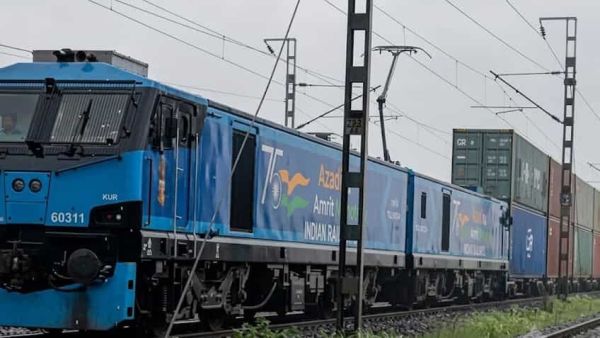
Indian Railways has achieved a historic achievement in reducing the logistics cost in the country and increasing the speed of freight transportation manifold. Railways, for the first time, from the country’s largest container port Jawaharlal Nehru Port (JNPT), Mumbai to CONCOR’s GCT terminal at Vernama in Vadodara division of Gujarat. Double-stack long-haul container train Has been successfully operated. This special train with a huge load of 360 standard containers (360 TEUs) distance of 422 kilometers Successfully decided on Western Dedicated Freight Corridor (WDFC).
Amazing combination of 1.3 kilometer long train and 360 containers
According to the technical information shared by the Railway Ministry, two separate double-stack rakes were coupled together to create this huge long-haul formation:
-
Leading Rake: It was hauled by locomotive number 60311, which carried a load of 180 containers (weighing 1,817 tonnes) in a composition of 45+1 wagons.
-
Trailing Rake: It was hauled by locomotive number 24690, which also carried 180 containers (weighing 2,105 tonnes) on 45+1 wagons.
-
total capacity: Both the rakes together transported a total of 360 TEU (Twenty-foot Equivalent Units) containers in a single movement to the destination 422 kilometers away.
There will be huge savings in freight cost and time.
Typically, at least two to three separate freight trains or hundreds of trucks were required to ship 360 containers from the port to inland depots.
Running double-stack long-haul trains at once would have several major economic benefits:
-
Maximum utilization of track capacity: Running a single long rack instead of separate trains on tracks would reduce route occupancy and double track capacity.
-
Reduction in Turnaround Time: There will be faster evacuation of containers disembarking from ships at ports, due to which the ‘dwell time’ of containers at ports will reduce rapidly.
-
Saving fuel and engines: The need for additional locomotives and crew staff for different trains will be reduced, which will directly reduce the operational costs of the Railways.
Green Logistics: Relief from road congestion and carbon emissions
This entire train was operated with a fully electric locomotive under high-rise overhead electrical (OHE) wire. A single double-stack long-haul train is capable of carrying cargo equivalent to hundreds of diesel trucks moving by road. This will not only reduce vehicular pressure and traffic jams on national highways, but will also significantly reduce the country’s carbon footprint and crude oil import bill.
Milestone in making India a global manufacturing hub
Full connectivity of Western Dedicated Freight Corridor (WDFC) with JNPT Port is giving new heights to India’s international trade competitiveness. This low-cost and high-speed rail-based cargo system, on par with developed countries, will guarantee timely delivery of goods to importers and exporters, thereby accelerating the target of reducing the total logistics cost in India from 14% of GDP to the global standard of 8-9%.
-
Diego Maradona’s iconic 1986 ‘Hand of God’ World Cup ball sold for $3.35m at auction

-
Premier League referees must crack down on tactical offending this season

-
Ajay Devgn’s ‘Drishyam 3’ Poster Increases Suspense Threefold Following Mohanlal’s Success:

-
IIT Kanpur: Rakesh Gangwal again opened the treasury, will give matching grant of Rs 300 crore for the medical school.

-
Gold Price Hike: Gold at a three and a half month high! Is the boom likely to continue, will the prices increase further in the run-up to the festive season?