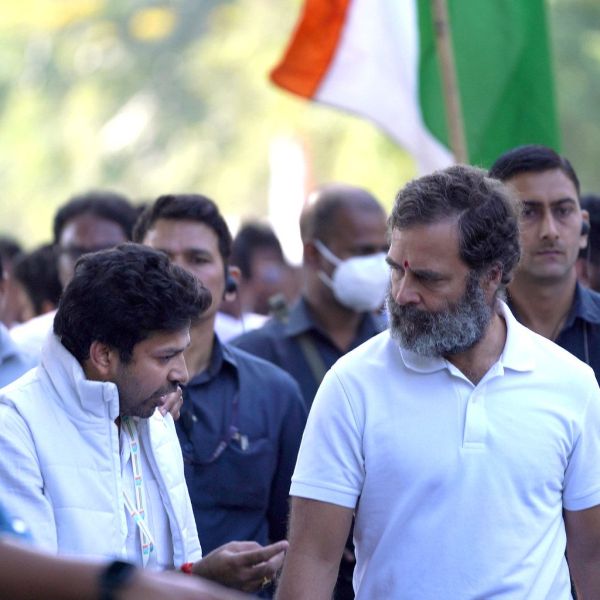
The Congress leader has made caste, the Constitution, electoral rolls and corporate power harder to ignore. But agenda setting is not the same as building a government in waiting.
By Obnews Editorial Staff
August 24, 2026
Rahul Gandhi’s response to the latest turn in the Gautam Adani case captured both the force and the weakness of his politics. After a United States judge dismissed the criminal case against Adani at the Justice Department’s request on August 10, Gandhi accused Prime Minister Narendra Modi of being “compromised” and alleged that India’s interests had been sold. The judge made clear that the dismissal was not a ruling on the merits of the allegations, and also said Adani’s investment pledge in the United States had not influenced the department’s decision. Adani has denied wrongdoing. Gandhi was entitled to demand scrutiny, but he offered no publicly established evidence connecting Modi or India’s trade policy to the dismissal. A legitimate question was stretched into a definitive verdict before the missing link had been proved. (Reuters, The Economic Times)

That pattern now defines Gandhi’s campaign against Modi. He is fighting on electoral rolls, Adani, the caste census, unemployment, inflation, farm distress, examination leaks, China, the United States trade relationship, the Rashtriya Swayamsevak Sangh, minority rights and the defence of the Constitution. Several of these are serious issues. Together, however, they have become a permanent prosecution in which every controversy is presented as further proof of the same sweeping charge. The volume creates attention, but it can also blur the difference between an anomaly, a suspicion and a proven abuse.
The fairest conclusion is not that every front has failed. Gandhi has become a more consequential opposition leader, and the 2024 general election proved that a disciplined version of his strategy can work. Congress rose from 52 Lok Sabha seats in 2019 to 99 in 2024. The Bharatiya Janata Party fell from 303 to 240 and lost its single party majority, while the INDIA alliance won 234 seats. Opposition warnings about constitutional change, demands for caste based representation and anger over jobs helped puncture the aura of BJP invincibility. (Reuters analysis, 2024 results summary)
The problem is what happened after that breakthrough. Gandhi succeeded at agenda setting but failed to convert it into a repeatable electoral system. The BJP won 48 of 90 seats in Haryana in October 2024, against 37 for Congress, though the popular vote was close. The BJP led Mahayuti then swept Maharashtra. In Delhi in February 2025, the BJP won 48 of 70 seats while Congress drew a blank. In Bihar later that year, the National Democratic Alliance won 202 of 243 seats. Congress was not the principal opposition force in every one of these contests, and state verdicts cannot honestly be reduced to one leader. Still, the sequence shows that the momentum of 2024 did not become a national tide. (Haryana result, Maharashtra result, Delhi result, Bihar result)
The 2026 assembly elections reinforced the mixed but broadly difficult picture. The BJP won 82 seats in Assam and 207 in West Bengal, while Congress won 19 and two respectively. Congress secured only five seats in Tamil Nadu. The important counterexample was Kerala, where Congress won 63 seats and the Congress led United Democratic Front took power. The INDIA alliance had also retained Jharkhand in 2024. These victories matter because they prevent an exaggerated claim of universal failure. They also reveal the real test: Gandhi’s politics works best where organization, alliance design and a clear local alternative give his national message a vehicle. (Election Commission results for Assam, West Bengal, Kerala, Tamil Nadu)
The “vote chori” campaign illustrates the conversion problem most clearly. Gandhi alleged that more than 100,000 questionable voter entries appeared in the Mahadevapura assembly segment in Karnataka, including duplicate names, invalid addresses and suspicious bulk registrations. The Election Commission rejected claims of collusion and asked him to submit a sworn declaration. Gandhi did not do so, arguing that the commission already possessed the records and had a duty to investigate. Election law experts questioned whether the demanded affidavit procedure properly applied to his allegations. (Reuters, Association for Democratic Reforms)
Gandhi did identify a genuine democratic concern. An Indian Express ground check found stale electoral records, but it also found that some addresses presented as suspicious were migrant worker residences or commercial complexes. During the Bihar revision of electoral rolls, the Supreme Court required the Election Commission to publish the names of roughly 6.5 million omitted voters with reasons and to make clear that Aadhaar could be used for claims. That order strengthened the case for transparency and easier public audit. It did not, however, validate a nationwide conspiracy to steal elections. By moving too quickly from disputed entries to a comprehensive charge against the system, Gandhi made it easier for the BJP to portray every opposition defeat as an excuse. (Indian Express ground check, Supreme Court Observer, LiveLaw)
The caste census presents the opposite lesson. Gandhi and Congress made caste enumeration a central demand. In April 2025, the Modi government approved the inclusion of caste enumeration in the next census, now scheduled for 2027. This was a clear policy concession to an issue the opposition had pushed into the national mainstream. Gandhi welcomed the decision, but almost immediately warned that the government would not conduct a “true” census. Vigilance was justified, but the political opportunity was larger: claim the victory, set measurable standards for implementation and show voters that opposition pressure can deliver results. A movement that treats every concession as merely another deception risks teaching voters that nothing can ever count as progress. (Government announcement, Reuters)
Alliance management is the second major weakness. Modi can be challenged nationally only by an opposition that behaves intelligently state by state. Yet Congress repeatedly oscillates between asking regional parties for unity and competing with them for space. At a June 2026 INDIA bloc meeting, allies urged Congress to be “large hearted” and act as the coalition’s glue, while complaints surfaced over seat sharing and attacks on partners. The DMK stayed away amid tensions following the Tamil Nadu election. A month later, several allies complained that Congress had not consulted them before Gandhi led a protest near the prime minister’s residence. These may appear to be procedural disputes, but coalitions usually fail through accumulated distrust rather than one dramatic rupture. (Newslaundry, The New Indian Express)
Congress is also operating on an uneven field. Before the 2024 election, the party said tax action and frozen accounts had crippled its campaign finances. A Reuters examination found that federal financial crime investigations of politicians fell disproportionately on opposition figures, while the government and enforcement authorities maintained that cases were handled lawfully. That context makes the opposition’s task harder and its institutional concerns more credible. It does not explain Congress’s avoidable alliance disputes, inconsistent state machinery or failure to present a concise governing programme. (Reuters on Congress finances, Reuters on investigations)
Modi’s advantage is therefore not simply charisma, media power or institutional dominance, though each matters. The BJP combines a national story with welfare benefits, social coalitions, disciplined ground organization, local alliances and the promise of administrative continuity. In Delhi, for example, it paired its campaign for change with cash support for poor women, maternity assistance, cooking gas subsidies and expanded pensions. Gandhi often presents a detailed case against the government, but Congress still struggles to compress its answer into a credible sentence about how life would improve under its rule. (Reuters)
That gap is visible in national opinion. An India Today and CVoter survey published in January 2026 put Modi at 55 per cent as the preferred prime minister and Gandhi at 27 per cent. The same survey projected a comfortable NDA majority, while 62 per cent of respondents identified Congress as the weakest link in the INDIA alliance. Polls are snapshots, not results, and Gandhi’s rating had risen substantially from earlier surveys. The numbers nevertheless describe a leader who has gained stature without closing the governing credibility gap. (India Today, alliance findings)
There is also a tonal problem. Gandhi’s strongest arguments are those that begin with an everyday injury: a graduate without work, a family squeezed by prices, a farmer facing debt, a student damaged by a paper leak, or a citizen unable to correct an electoral record. His weakest arguments begin with the conclusion that Modi is personally responsible for every failure or “compromised” in every disputed transaction. The first approach invites voters into a common experience. The second asks them to accept the entire prosecution before every part of the evidence has been established.
The answer is not for Gandhi to become quieter or less confrontational. India requires an opposition willing to investigate power. The answer is concentration. Congress should organize its campaign around three fronts: jobs and household costs, institutional trust backed by verifiable evidence and specific legal remedies, and disciplined alliances that defer to the strongest regional partner. Every accusation should end with a document, a filing, a proposed reform or a parliamentary demand. Every state contest should begin with the question of how to defeat the BJP, not how to maximize Congress’s bargaining position.
Above all, Gandhi must offer a government in waiting, not only a charge sheet. A short economic programme, a clear first 100 days agenda, credible state leaders and a visible coalition mechanism would do more damage to Modi than another dozen allegations. The BJP’s reverses in 2024 showed that it is vulnerable when the opposition selects a focused message and coordinates. Its recoveries since then show that it remains better at adaptation, delivery and political conversion.
Rahul Gandhi is no longer irrelevant, unserious or easily dismissed. That old caricature did not survive 2024. But greater seriousness has created a higher standard. He is now judged not by whether he can unsettle Modi for a news cycle, but by whether he can assemble the evidence, organization, allies and governing offer needed to replace him. Until outrage becomes organization, evidence becomes verdict and alliance becomes discipline, Gandhi will remain the opponent who attacks Modi on the most fronts while dislodging him on too few.
-
Gold Price Today: Gold prices dipped a day before Raksha Bandhan; 22-carat gold stood at ₹1,50,090 in Delhi..

-
Silver Price Today: Silver prices rise again; check the latest rates in 10 cities before buying..

-
Petrol-Diesel Prices Today: Latest rates released nationwide; check the price in your city..

-
LPG Price 27 August 2026: What is the price of a 14.2 kg LPG cylinder from Delhi to Bihar? Check the rates here before booking..
-
EPFO: Easily handle 7 major tasks—such as UAN and PF withdrawal—from the comfort of your home! EPFO has introduced a major update..