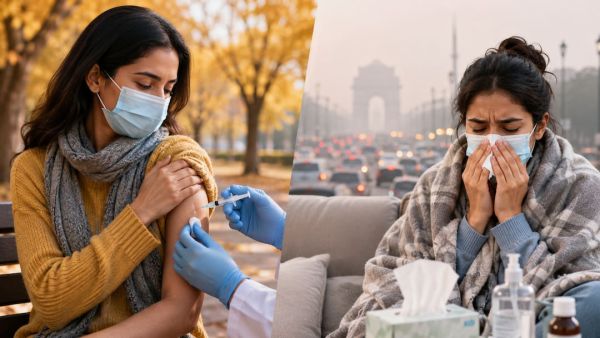
Cases of H1N1, commonly known as swine flu, have risen sharply across Delhi-NCR. As of August this year, more than 1,777 cases have been reported—nearly eight times the number recorded during the same period last year. This has raised an important question: When is the right time to get the swine flu vaccine? Should people wait until October, or get vaccinated now? Let's break down what doctors and government health experts recommend.
Is There A Separate 'Swine Flu Vaccine'?
There is no separate vaccine specifically labelled for H1N1 or swine flu. H1N1 is now part of the seasonal influenza spectrum, so protection against the strain is included in seasonal flu vaccines. Rommel Tikku, senior consultant in internal medicine at Max Healthcare, Delhi, explains that people generally do not need to look for a vaccine specifically labelled "H1N1" or "swine flu." The seasonal influenza vaccine is designed to protect against influenza viruses circulating during that season, including H1N1, an influenza A strain.
So, When Should You Get Vaccinated Against Swine Flu?
The ideal timing depends on where you live in India. Government health experts have recommended different vaccination windows for different regions based on their flu seasons.
1. October Is Recommended For Northern India
October is considered an appropriate time for vaccination in colder parts of northern India, where influenza activity generally rises during winter.
A central government expert panel involving the ICMR, NCDC and Directorate General of Health Services has recommended region-specific vaccination timings:
-
Jammu and Kashmir, Himachal Pradesh and Uttarakhand: October
-
Most other mainland states: May-June
-
Tamil Nadu: July
These recommendations are based on regional patterns of influenza activity.
2. Missed October? Don't Panic
If you don't get vaccinated in October, there's no need to panic. Vaccination can still be useful while influenza continues to circulate.
The key is not to assume that missing the recommended month means you have missed your opportunity altogether.
3. What If You Get Vaccinated In August Or September?
With H1N1 cases increasing in Delhi-NCR, doctors say people who have not received their seasonal flu vaccine should discuss vaccination with their doctor rather than automatically waiting for October. Dr Soumya Swaminathan has advised getting vaccinated ahead of increased flu activity because the body generally takes around two weeks to develop protective immunity after vaccination. Dr RS Mishra, Principal Director of Internal Medicine at Max Healthcare, also recommends getting vaccinated at least two weeks before flu activity is expected to increase, allowing time for immunity to develop.
Does The Vaccine Provide 100% Protection?
No. Influenza vaccines do not provide complete protection against infection. Their effectiveness can vary depending on how closely the vaccine strains match the viruses circulating during a particular season. Age and an individual's immune response can also influence how well the vaccine works. However, vaccination can still reduce the risk of severe influenza, hospitalisation and complications, even when it does not completely prevent infection. Research has also found that vaccination timing can affect effectiveness. Protection may be lower when vaccination occurs several months before peak flu activity, which is one reason region-specific vaccination windows are useful in a country as geographically diverse as India.
Why Do You Need The Flu Vaccine Every Year?
There are two main reasons:
-
The virus keeps changing: Influenza viruses undergo genetic changes over time. The WHO therefore updates vaccine compositions periodically to match currently circulating strains.
-
Protection can decrease over time: Immunity from a previous vaccination or infection can wane, while different influenza strains may circulate in subsequent seasons.
Annual vaccination helps maintain protection against the influenza viruses expected to circulate in the current season.
Should You Skip The Vaccine If You've Already Had H1N1?
No. Having had H1N1 in the past does not guarantee protection against future influenza infections. Different strains can circulate from one season to another, and immunity can decrease over time. For this reason, eligible people are generally advised to consider seasonal influenza vaccination each year in consultation with their healthcare provider.
Can You Get Vaccinated If You Have A Mild Cold?
Generally, yes. A mild illness or common cold is not usually a reason to delay vaccination. However, if you have a high fever, are moderately or severely unwell, or have another significant illness, speak with your doctor about whether it is better to postpone vaccination until you recover.
[Disclaimer: The information provided in the article is shared by experts and is intended for general informational purposes only. It is not a substitute for professional medical advice, diagnosis, or treatment. Always seek the advice of your physician or other qualified healthcare provider with any questions you may have regarding a medical condition.]
-
Club Brugge reverse stance on Nicolo Tresoldi transfer as Manchester United stay alert

-
Max Verstappen to Take On 100 Go-Karts at Silverstone in a Live Made-for-TV Special

-
High heels were originally made for men, here’s surprising story

-
Meet two new female contestants reportedly entering Bigg Boss 20

-
Gigabyte Gaming Rig Review: At Rs 3 Lakh, 260 FPS Becomes The New Normal