Hyundai and Genesis are preparing a major expansion of their global model ranges, with 100 product launches planned across different markets by 2030, according to the roadmap presented at the carmaker’s 2026 CEO Investor Day presentation. As part of that wider push, both brands are set to introduce new range-extended electric vehicles in 2027, and Hyundai has now officially confirmed that the all-new Santa Fe EREV will enter U.S. production from that year. Here is everything known so far about these upcoming electric vehicles with an added twist.
According to the manufacturer, Hyundai will introduce the first of its EREV models in the first half of 2027, as part of a seven-vehicle rollout scheduled over the following eight months. The Santa Fe EREV has already been assigned to U.S. production at the brand’s factory in Alabama. Genesis is also due to get an as-yet-unnamed EREV on a similar schedule, and that model is also expected to sit in the crossover segment. The Santa Fe is said to deliver an estimated total range of more than 600 miles, while the Genesis model is expected to exceed 640 miles.
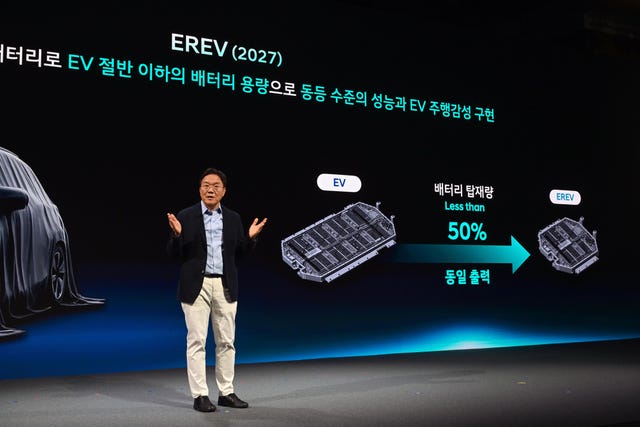
Both vehicles will use the brand’s latest battery technology, built around battery cells developed in-house. Hyundai says these new cells deliver double the output of the previous units and can improve charging speeds by as much as 40 percent. The company also says this will make it possible to use smaller batteries without compromising performance or driving range. Other EVs due in 2027 will use mid-nickel NCM cells, which lower battery costs for the manufacturer by around 30 percent. There is, however, no indication yet on whether those savings will be passed on to buyers.
The new cells are not the only battery-related upgrades planned for the EREV models. Hyundai is also aiming for an average 20 percent improvement in battery longevity through updates to its cloud-based battery management systems, due in 2028. That system will also gain a new Thermal Runaway Protection setup, designed to reduce the risk of a battery fire in the event of a crash or cell failure.
Given that the Santa Fe is Hyundai’s best-selling model in the United States, an EREV version appears to be a logical move. A vehicle like this could appeal to buyers who would not, or could not, consider a pure BEV, as it still supports long-distance driving through a petrol engine while also allowing medium-distance journeys on electric power. That also helps explain Kia’s decision to use one of these powertrains in an upcoming pickup. It is also no surprise that these vehicles will be built in the United States, as carmakers continue to localise production in an effort to ease tariff pressures. With Hyundai targeting 500,000 units of capacity across its North American facilities, the Santa Fe EREV could become an important part of the brand’s future plans.
-
NEET PG answer key to be released for the first time—why? How will rankings be determined in the event of a tie?

-
Is there a hostel crisis at Delhi University? Why are students forced to live in PGs?

-
EPFO Pension Rules: How much pension will private sector employees receive after retirement? Here is the complete calculation..

-
How much monthly pension will you get on an NPS corpus of ₹1 crore? Here is the complete calculation..

-
LPG Cylinder Booking: Great news for customers—the next cylinder can now be booked after 25 days..