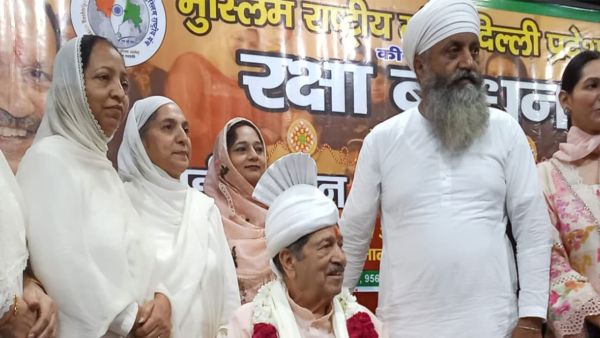
In a unique celebration in New Delhi, the Muslim Rashtriya Manch organised a Rakshabandhan programme where Muslim sisters tied Rakhis to RSS leader Indresh Kumar. This was followed by a Tiranga Yatra to promote brotherhood and national unity.
A Rakshabandhan programme organised by the Muslim Rashtriya Manch (MRM) at Aiwane-e-Ghalib in New Delhi brought together people from different communities, who tied Rakhis to RSS leader Indresh Kumar. The programme was followed by a Tiranga Yatra focused on brotherhood, social harmony and national unity.
With a Rakhi tied on the wrist and the Tricolour held proudly in the hands, Delhi witnessed a Rakshabandhan celebration that carried a wider message of brotherhood, social harmony and national unity. Organised by the Muslim Rashtriya Manch (MRM) at the Ghalib Auditorium, Aiwane-e-Ghalib, New Delhi, the programme brought together the traditional spirit of Rakshabandhan with a broader call for love, mutual respect, harmony and national responsibility.
Muslim sisters tied the Raksha Sutra (Rakhi) on the wrist of Indresh Kumar, followed by a Tiranga Yatra in which women participants carried the National Flag and conveyed the message that India's many identities can remain united by a shared Indian identity. The special Rakshabandhan programme was attended by Indresh Kumar, members of the national coordinators' team, Delhi Pradesh coordinators and co-coordinators, coordinators and co-coordinators of various cells, as well as a large number of MRM workers and supporters.
The programme reflected India's social diversity, with participation from people belonging to Hindu, Muslim, Sikh, Christian, Buddhist and Jain communities. Among those present were Mohammad Afzal, Girish Juyal, Dr. Shalini Ali, Hafiz Sabrin, Imran Chaudhary, Anil Garg, Faiz Khan, Faiz Ahmed Faiz and Shakir Ali, along with several other participants.
The Rakhi ceremony became one of the most meaningful moments of the programme. Muslim sisters tying the Raksha Sutra on Indresh Kumar's wrist was presented not merely as a traditional ritual, but as a symbol of trust, affection, respect and brotherhood. The gesture conveyed the idea that human relationships and the spirit of humanity can rise above religious, social and other differences. The programme sought to use the familiar emotional bond of Rakshabandhan as a bridge for a larger conversation about social harmony and mutual respect.
A Message of Unity for a Digital Generation
Addressing the gathering, Indresh Kumar emphasised peace, social harmony, brotherhood and unity in diversity. He called upon people to rise above their differences, respect one another and contribute towards building an India where different religions, languages, cultures and traditions are not viewed as sources of division, but as the country's collective strength. He described Rakshabandhan as an opportunity to strengthen trust between people and promote greater social harmony.
Indresh Kumar's message takes on particular significance for today's younger generation. Gen Alpha and Gen Z are growing up in a world where digital technology has become an integral part of everyday life. Social media has connected young people with communities, cultures and ideas from across India and the world. At the same time, the digital space can also amplify hostility, trolling, misinformation, polarisation and social divisions. In such an environment, the important question is not simply whether technology is bringing people closer digitally, but whether people are also becoming closer to one another as human beings. The message emerging from the programme was that technology should not become a reason for greater distance but a means of promoting dialogue, understanding and human connection.
Emphasis on Women's Empowerment
During the programme, Shalini Ali placed particular emphasis on women's empowerment and self-reliance. She highlighted education, confidence and economic independence as important foundations for enabling women to stand on their own feet and play a stronger role in their families, communities and the nation. Her message was that women's contribution should not be viewed only through family responsibilities. Educated, confident and self-reliant women can become active participants in social progress and nation-building. She encouraged women to recognise their abilities, become self-dependent and contribute actively to the development of society and the country.
Tiranga Yatra: A Symbol of National Pride
The Tiranga Yatra that followed the Rakshabandhan programme gave the event an additional national dimension. Women participated enthusiastically in the yatra while carrying the National Flag. Their participation conveyed a clear message that nation-building is not the responsibility of any one religion, community, caste or section of society. Women have an equally important role in India's progress, while every Indian has a shared stake in the country's unity, peace and development.
The Tricolour itself became an important symbol during the yatra. The message was clear: the National Flag does not belong to any one religion, caste, language or region; it represents the shared identity of every Indian. In this sense, the programme created a natural connection between the symbolism of the Rakhi and the symbolism of the Tricolour. The Raksha Sutra tied around the wrist represented trust, affection and brotherhood, while the Tricolour carried proudly in the hands of women represented national unity and a shared responsibility towards the country.
Diversity as India's Strength
Another significant feature of the programme was the emphasis on viewing India's diversity not as a weakness but as a source of strength. India's festivals have traditionally provided opportunities for people to come together, strengthen relationships and celebrate shared social bonds. Rakshabandhan, with its message of affection and protection, can similarly become a bridge connecting people across communities. When people from different backgrounds stand together during a festival, its meaning can move beyond individual families and become part of a wider social relationship based on trust and mutual respect.
At the heart of Indresh Kumar's message was a simple but powerful vision: peace in society, brotherhood among citizens, equal opportunities for women, respect for diversity and a strong sense of responsibility towards the nation. The message was not confined to any particular community. It was addressed to every Indian, with particular relevance for the younger generation that will shape India's social, technological and national future.
A Challenge for Gen Z and Gen Alpha
In today's social-media-driven world, a message can reach millions of people within seconds. This also places greater responsibility on young people. For Gen Z and Gen Alpha, the challenge is not merely to learn and adopt new technologies quickly but also to decide how responsibly those technologies are used. The same digital platform can be used to spread hatred and division, or it can become a powerful tool for dialogue, understanding, cooperation and connection. Spreading hostility may take only a moment, but building trust and mutual respect requires patience, maturity and responsibility.
Seen in this broader context, the programme's message extended well beyond a single day's Rakshabandhan celebration. Trust through the Rakhi, empowerment through women's participation and national unity through the Tiranga Yatra came together to create a wider picture of social harmony. It was a celebration where relationships and the nation stood side by side, where the affection represented by the Rakhi met the pride represented by the Tricolour. The programme concluded with a collective resolve to promote peace, social harmony, women's empowerment and national unity.
The Rakhi ceremony by Muslim sisters and the women's Tiranga Yatra together conveyed the message that India's multiple identities do not have to stand against one another. They can coexist with and contribute to a shared national identity. Ultimately, the programme left behind a simple but important message: India's strength lies in its diversity, while its unity grows through mutual respect. From Gen Alpha and Gen Z to Indians of every age and every community, the challenge is to ensure that in an increasingly digital world, the distance between hearts does not grow. Let the thread of Rakhi strengthen trust and brotherhood, and let the Tricolour continue to remind every Indian of our shared responsibility: different identities, one India; together, a stronger India. (ANI)
(Except for the headline, this story has not been edited by Asianet Newsable English staff and is published from a syndicated feed.)-
Breaking: Atlético Madrid will not sell Julián Álvarez to Barcelona

-
Manchester United weigh late move for Igor Matanovic as Joshua Zirkzee edges closer to exit
-
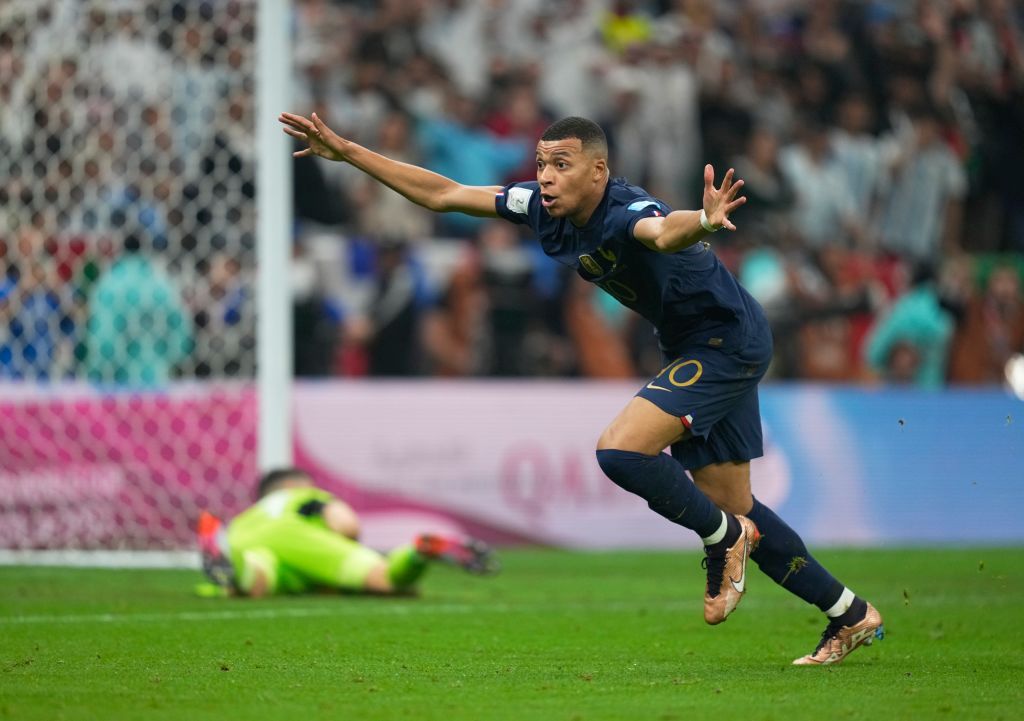
Sir Geoff Hurst explains why Kylian Mbappe matching his World Cup final hat-trick record in 2022 did not bother him
-
Late-night TikTok scrolling leaves users with brain fog, poor focus

-
Kehlani cancels two tour shows after hospital visit