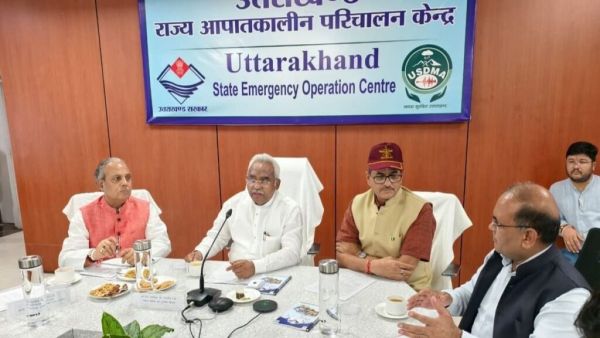
In view of the possible danger from the glacier lakes located in the state, Disaster Management and Rehabilitation Minister Madan Kaushik has given instructions to adopt the latest technology available across the world for monitoring and risk reduction of glacier lakes. On Sunday, he reached the State Emergency Operation Center (SEOC) and took detailed information about the situation and possible risks of the glacier lakes located in Uttarakhand. The Minister said that Uttarakhand is a geologically sensitive state and in view of the effects of climate change, scientific monitoring of changes in the condition of glaciers and glacier lakes is very important.
use of modern technology
He directed that modern technology should be used for continuous and real-time monitoring of glacier lakes. The water level, size, waterlogging status of glacier lakes and possible changes in them should be continuously monitored. For this, the possibilities of satellite imagery, remote sensing, drones, sensor based surveillance and other modern technologies should be studied and adopted as per requirement.
to be warned in advance
The Minister directed that better coordination should be established between concerned departments, expert institutions and technical agencies for monitoring glacier lakes. He said that early warning systems should be installed wherever necessary, so that any abnormal situation can be detected in time and people living in potentially affected areas can be alerted in advance.
Immediate action should be taken in emergency situations
In the meeting, Minister Madan Kaushik also made a detailed review of the continuous rains in the state and the conditions arising due to the rains. He gave clear instructions that safety of life is the top priority of the state government and all departments should work on 24×7 alert mode with full coordination to effectively deal with any possible disaster. He took detailed information about the rainfall situation across the state, water level of rivers, closed roads, areas affected by landslides, relief and rescue operations, electricity and drinking water supply, communication system and other essential services. Reviewing the rainfall in various districts, possible weather forecast and preparations for the coming days, he directed that every situation should be continuously monitored and prompt action should be ensured in any emergency.
machinery should be deployed in advance
He instructed the State Emergency Operation Center to maintain constant coordination with all the districts. He said that closed roads should be opened soon on priority basis and adequate machinery should be deployed in advance at landslide prone and sensitive places. At places where there is a high possibility of landslides or road blockage, sufficient number of JCBs, Pokeland machines, necessary equipment and technical teams should be deployed in advance, so that in case of road blockage, traffic can be restored immediately.
Necessary facilities should be provided
Along with ensuring effective drainage in waterlogged areas, instructions were also given to keep pumps and other necessary equipment available in sufficient numbers. He asked all the departments to work with full vigilance and sensitivity with mutual coordination, so that immediate and effective action can be ensured in case of any disaster. Said that restoration of electricity, drinking water and communication services should be done on top priority. If these services are affected anywhere, additional teams should be sent immediately and necessary facilities should be provided to the general public by implementing alternative arrangements.
He directed that all the concerned departments including NDRF, SDRF, Police, Health, Public Works, Electricity, Drinking Water, Food and Civil Supplies should work with full coordination in all the districts. In remote and sensitive areas, adequate storage of food grains, medicines, fuel and other essential items should be ensured in advance, so that in case of road closure, local citizens do not have to face any kind of difficulty. In the meeting, Honorable Vice Chairman State Disaster Management Advisory Committee Shri Vinay Ruhela, Honorable Vice Chairman Lt. Colonel (A.P.) Raghuveer Singh Bhandari, Secretary Disaster Management and Rehabilitation Mr. Vinod Kumar Suman, Additional Chief Executive Officer Implementation DIG Mr. Rajkumar Negi, JCEO Mr. Dinesh Kumar Punetha, USDMA experts Dr. Pooja Rana, Mr. Rohit Kumar, Ms. Pratibha Purohit, Mohit Mathur etc. were present.
Travel operations should be based on weather and route conditions.
The Minister directed that the Yatra should be conducted keeping in mind the actual weather conditions. If situations like excessive rain or road blockage arise, then necessary facilities should be provided to the passengers by stopping them at safe places and they should be sent ahead only after the conditions become normal.
Instructions for 24-hour monitoring of water level of rivers
The Minister gave instructions to maintain round-the-clock monitoring of the water level of rivers. He said that people living in riverine areas should be continuously made aware and if there is a possibility of danger, they should be taken to safe places in time. He directed that in case of release of water from dams and barrages, people living in downstream areas should be alerted by giving prior information. If necessary, the border states should also be alerted in time, so that any possible risk can be minimized.
Have alternative communication systems ready at all times.
The Minister said that if communication system is disrupted in any area due to heavy rain or landslide, then alternative communication system should be activated immediately. He laid special emphasis on strengthening alternative communication systems in remote and inaccessible areas. He said that in case of disruption of mobile or other communication services due to natural disaster, alternative communication mediums should be immediately available, so that there is no hindrance in relief and rescue operations.
Special monitoring of pregnant women, elderly and serious patients
The Minister gave instructions for special monitoring of pregnant women, senior citizens, disabled people and people suffering from serious diseases. He said that pregnant women living in sensitive areas should be taken to safe places or places with medical facilities in time as per the need. Wherever required, helicopter service should also be made available. He clearly said that under no circumstances should there be any loss of life due to lack of medical aid.
Instructions for campaign on war footing to prevent dengue
The Honorable Minister also reviewed the prevention of dengue in the state. Calling it one of the top priorities of the state government, he instructed all the municipal corporations, municipalities, nagar panchayats and gram panchayats to run the campaign on a war footing. He said that all waterlogged places should be immediately identified and drainage should be ensured and regular fogging, anti-larva spraying and special cleanliness campaigns should be conducted. Adequate arrangements for dengue testing kits, adequate medicines, availability of blood, beds and medical personnel should be ensured in all district hospitals, community health centers and primary health centers.
-
Germany's Antonio Rudiger retires from international football

-
Manchester United push for deadline-day deal for Spanish youngster who could ease two of Carrick’s biggest concerns

-
The burnout trap of mothers striving for perfection

-
Victoria Beckham celebrates son Romeo’s birthday as fashion label posts first profit in 18 years

-
During monsoon, water accumulated around the house can cause dengue and malaria, stop mosquito breeding with these easy measures.