At a kimbap shop in Changcheon Ward, Seodaemun District, Seoul, Hwang, 58, rolls kimbap while thinking whether to raise the price of a dish she has sold for a decade.
A vegetable kimbap roll costs 3,000 won (US$2). But the rising costs of eggs, cucumbers, seaweed, and rice are eating into her profit margin.
Hwang says a tray of 30 eggs used to cost around 6,000 won, but the price has climbed to 9,000 won in just the last three months. Cucumber prices rose from 20,000 won per 10 kilograms to 50,000 won after the rainy season.
“I’m considering raising prices, but I’m afraid regular customers might stop coming,” she tells The Chosun Daily.
|
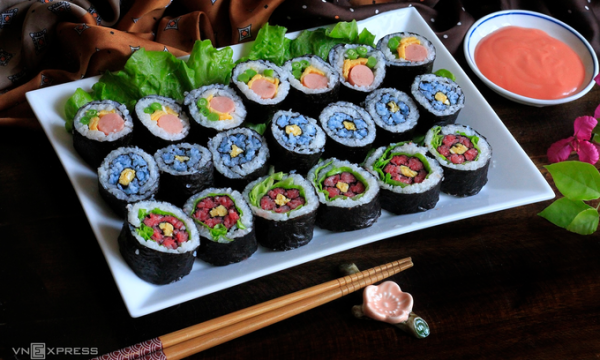
Kimbap features a variety of fillings wrapped in seaweed and seasoned rice. Photo by Read/Bui Thuy |
In Mapo District, Seoul, Jung, 55, is looking for ways to cut costs to save his 17-year-old kimbap shop. After the Covid-19 breakout, he stopped offering dine-in services and switched to takeout only.
He says customer numbers have dropped while fixed costs such as electricity keep rising, making it harder to maintain a dine-in space.
Another shop owner in the area, Choi, 69, let go of his only employee. He installed a self-checkout machine and now himself handles tasks that were once done by his worker.
These changes come as the number of kimbap shops in South Korea continues to decline. According to Yonhap News Agencythe count rose from 41,726 in 2016 to 48,898 in 2021 before falling to 46,211 in 2023.
In Gyeonggi Province too, closures are on the rise. Kyungin Ilbo reported that the number of kimbap shops shutting down there increased from 151 in 2021 to 200 in 2024.
Rising ingredient costs are a primary factor, with the average price in July for 10 sheets of dried seaweed hitting 1,427 won, over 22% higher than the recent average.
Rice prices are up 13%, eggs are up 18%, spinach has doubled in a month, and cucumber is up 71%.
The minimum wage has climbed past 10,000 won per hour and summer electricity rates have surged by over 31% since 2021.
However, the global popularity of kimbap is soaring. Yonhap News Agency noted that processed rice exports jumped by 46% in 2024 to $166 million, boosted by frozen kimbap demand.
In South Korea, convenience stores also pose competition for traditional shops. Korea Economic Daily reported that kimbap sales at GS25 and 7-Eleven surged by 42% and 20% in 2024 as bulk buying allowed both chains to keep prices low.
Caught between surging costs and competition, kimbap shop owners are forced to cut staff, offer takeout only, or close down.
-
Everton and Manchester United confirm starting XIs for Premier League clash

-
Ainsley Maitland-Niles nets stunning late equaliser on debut as Everton deny Manchester United victory

-
‘Every year on May 13, I relive the QPR goal’ - Sergio Aguero looks back on his iconic Manchester City moment

-
Arsenal star Declan Rice honoured before Chelsea clash as new mural is unveiled

-
‘We knew we could get back into the game’: Everton standout delivers blunt post-match verdict on Manchester United after draw