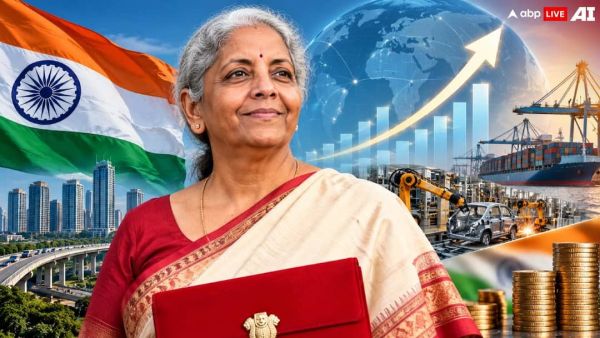
India’s steroid-charged economic growth of 7.8 per cent in the April-June quarter of FY2026-27 underlining a bold defiance of tariffs, turbulence in West Asia and tough conditions, is finding a global resonance with Japan Credit Rating Agency (JCR) upgrading India’s foreign currency long-term issuer rating and local currency long-term issuer rating by one notch ‘BBB+’ to ‘A-’ as a reflection of India’s solid economic growth.
Managing Director of IMF Kristalina Georgieva commenting on “India’s stellar growth performance” in her exchange of views with Finance Minister Nirmala Sitharman in the US.

The upswing and endorsement couldn’t have come more timely for a Government put on the backfoot by electoral losses in bypolls, an aggressive students’ protest and sceptics wary of India’s road ahead given the war and India’s energy dependence. A GDP growth in the range of 6.8 to 7 per cent was a foregone conclusion by experts and even the Reserve Bank of India.
A strong combo of fixed investments, factory boom, private consumption and higher net exports have, however, powered a 7.8 per cent growth much to everyone’s surprise.
Unexpected Outcome
Leading economists dismissive of anything over 7 per cent are trying to decode the turnaround. The figure was higher than the average of 7.5 per cent in the previous 10 quarters, but show slowdown from 8.6 per cent in the preceding quarter, Q4 FY2026, according to Dharmakirti Joshi, Chief Economist, Crisil.
“India’s real GDP growth continued to outperform expectations in the first quarter of this fiscal, expanding 7.8 per cent despite geopolitical headwinds stemming from the West Asia conflict,” Joshi concedes, crediting the resilience of growth to the economy’s robust domestic fundamentals and its ability to navigate an increasingly uncertain global environment.
Sure, key fundamentals have added the fire power. The Government’ fiscal deficit has eased marginally to Rs 4.6 trillion during April-July or FY2027 from Rs. 4.7 trillion in the year ago period driven by a sharp narrowing in the revenue deficit. The Centre’s gross tax revenues is up by a healthy 11 per cent yoy in April-July FY2027, led by a 20 per cent plus growth in direct taxes amid a low base and a 38 per cent growth in customs duty collections aided by the hike in duties on gold and silver.
The GoI’s net tax collection has risen by a much healthier 28 per cent in April-July FY2027. On the expenditure side, the revenue expenditure increased by just 7.8 per cent in these four months of FY2027, despite the 35 per cent expansion in subsidies. On the external front, net FDI inflows (gross inflows less repatriation and outward FDI) contributed swelled to USD 7.8 billion in Q1 FY27, the highest level seen in the same period of the previous three years.
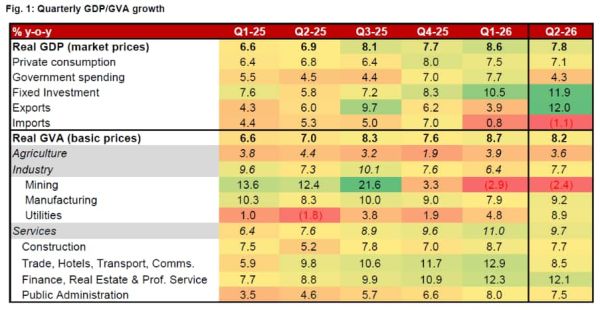
“The GDP growth of 7.8 per cent, supported by 9.2 per cent growth in manufacturing, 10 per cent growth in the tertiary sector, and 7.7 per cent growth in construction is highly inspiring and indicates that the strong growth trajectory of above 7 per cent for the current quarter will continue in whole FY2026-27 too,“ says Nirmal K Minda, President, ASSOCHAM.
Nomura analysts Sonal Varma and Aurodeep Nandi who had, however, estimated GDP growth for the quarter at a robust 7.8 per cent y-o-y, saw it as a likely reflection of factors such as limited pass-through of retail fuel prices and low inflation, the government’s deft supply side management and de-escalation of trade tensions with the US and reduction in the baseline tariffs for India.
Aditi Nayar, Chief Economist, ICRA though agrees that the GDP growth exceeded ICRA’s estimate of 7.0 per cent for the quarter. “Overall, economic activity remained robust during the April-June quarter despite the adverse impact of the West Asia conflict on some sectors as well as the unfolding impact of the uneven monsoon,” says Nayar.
Factory roar and GVA: Expert views narrow down to five triggers. First is the gross value added (GVA) scale up. “A key driver behind the Indian economy remaining resilient in Q1 with 7.8 per cent growth is the GVA growth which in fact was higher than the GDP at 8.2 per cent. In economic measure, GVA calculates the value of goods and services produced in an area, industry, or sector minus the cost of raw materials and other inputs used to make them. “The gap between GDP and GVA can be explained by strong growth in subsides and contraction in indirect tax collections amid past GST rationalisation and recent fuel excise cuts,” adds Sinha.
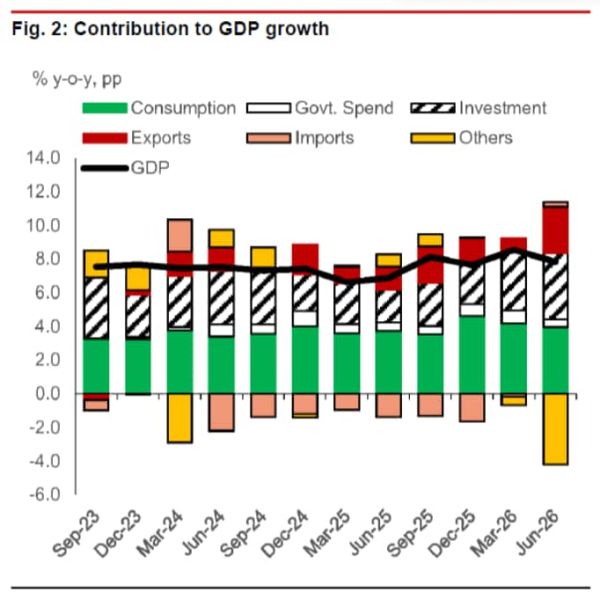
The high GVA was propelled by a boost in capital expenditure (capex) which, points out Nayar, surged by a whopping 30 per cent during April-July months of FY2027, amid a 50 per cent plus growth in June-July 2026. In a multiplier effect, the capital spend pushed up expansion in gross fixed capital formation (GFCF) or investment at 20.4 per cent in Q1 FY2026-27, compared with 5.4 per cent in the same period last year, indicating strong signs of investment and greater employment opportunities in the country.
Strong GCFC demand and growth of 11.9 per cent alongwith exports growth pushed 1QFY27 GDP growth to 7.8 per cent,” confirms Devendra Kumar Pant, Chief Economist, India Ratings & Research (IndRa).
In Q4 FY26, GFCF had grown 0.8 per cent. “Strong investment momentum since 2QFY26 has continued and shown an upward trajectory. The government (both centre and states) along with central public sector enterprises (CPSEs) has continued to undertake capex. Aggregate capex of centre, states and CPSEs grew 16.9 per cent in 1QFY27 as compared to 14.1 per cent in FY26,” says Pant.
According to Joshi, public-sector investment continued to provide a strong impulse. “Centre’s capex rose 23.7 per cent on-year underscoring the continued role of government investment as a cornerstone of growth. States too contributed to the investment momentum, with the combined capex of 17 major states increasing 6.8 per cent on-year,” adds Joshi.
Not surprisingly, among the sectors, growth in the manufacturing GVA exceeded expectations, taking manufacturing growth to 9.2 per cent in Q1 FY2027 from 7.9 per cent in Q4 FY2026. Auto-related industries continued to perform strongly. Motor vehicle output grew 15.3 per cent, while other transport equipment expanded 19.7 per cent, reflecting sustained discretionary demand.
These sectors also benefited from GST rationalisation. Growth in electricity accelerated 8.9 per cent on-year as a delayed monsoon and heatwaves pushed up demand. Volume demand for electricity was up 10.8 per cent on-year.
The uptick in manufacturing has come unexpected as the latest HSBC India Manufacturing PMI® signalled a loss of momentum due to growth of both output, new orders stalling to five-year lows, softer demand conditions in firms as well as a mild decline in employment.
According to Pranjul Bhandari, Chief India Economist at HSBC, "India’s final manufacturing PMI slipped to 52.8 in August, extending its decline for a third consecutive month. The output index fell to its lowest level since August 2021, signalling that production is still expanding but at a markedly slower pace.
On the flip side, the report indicated that despite the softer performance, business expectations strengthened and around 16 per cent of survey participants forecast higher output over the coming 12 months, while the remainder expect no change from present levels.
Consumption Is King: No Letdown In Consumption Boom
Rating agency Crisil’s Joshi outlines the strength of other two engines which underpin this strong performance. First, according to Joshi, domestic consumption remained a powerful growth engine.
“Household spending was supported by the rationalisation of the goods and services tax (GST) regime and income tax relief announced last fiscal. The automobile sector exemplified this strength, with passenger vehicle sales surged 25.6 per cent on-year while two-wheeler sales grew 20.6 per cent, reflecting broad-based demand across income segment,” notes Joshi.
“In addition,” the economist points out, state-level cash transfer programmes, complementing existing food security schemes, provided a further cushion to household consumption and helped sustain spending momentum.”
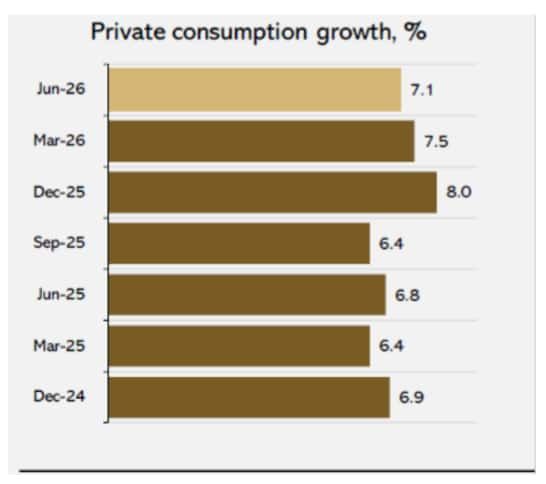
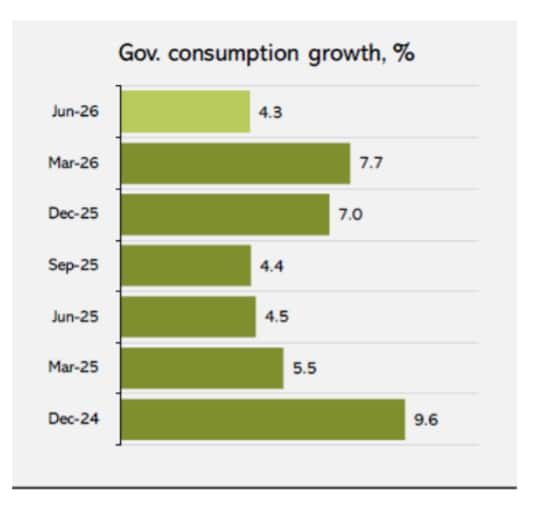
Data shows growth in private final consumption expenditure (PFCE), as a measure of the total money spent by households and non-profit groups on goods and services for daily use, remained strong at 9.9 per cent in Q1 FY2026-27, compared with 8.3 per cent in the same period last year, and Government final consumption expenditure grew by 9.5 per cent compared with 4 per cent in the same period last year.
Both rural and urban demand were strong in the first quarter of this fiscal. Two-wheeler sales grew 20.6 per cent, well above the fiscal 2026 average of 12.3 per cent, while tractor sales growth averaged 19.4 per cent. Retail credit growth remained robust at 15.8 per cent against 16.2 per cent, while other personal loans, a proxy for short-term consumption, grew 14.2 per cent compared with 12.8 per cent.
While El-Nino has cast its shadow over Indian economy in general and rural economy in particular, the vehicle sales in rural area suggests despite hardening of inflation, the impact on rural demand may be lower than envisaged earlier.
Another critical engine of the GDP growth is exports which saw the highest growth in the 2022-23 series (data is available from fiscal 2024). “Exports exceeded expectations despite a challenging global backdrop. Overall exports expanded 12 per cent in real terms demonstrating the agility of Indian exports amid uneven external demand,” says Joshi.
Services sector growth held up well, rising by 10 per cent in Q1 FY27 compared to 9.9 per cent in Q4 FY26 led by financial, real estate, professional services and public administration.
Slowdown Ahead
The honeymoon may however not last long with a wide consensus on paring down of India’s growth in FY27. Nomura’s Varma and Nandi flag the impact of deficient rains and lagging Kharif (summer) crop sowing which increases the probability of lower agricultural GVA growth and a moderation in growth of consumption/services, if rural demand and sentiment are impacted.
India Ratings and Research estimates GDP to grow 6.8 per cent yoy in FY27, attributing the slowdown to higher fuel and food inflation stemming from the West Asia conflict. The view from Crisil too suggests that with the boost from GST rationalisation likely to gradually wane, rainfall remaining 14 per cent below normal as of August 31 posing downside risk to agricultural output and rural demand, growth is likely to moderate in the second half of the fiscal year and India could be looking at a GDP growth 7.0 per cent in FY27.
(Mukherjee is a contributing writer for ABP Live English. A business journalist for more than 15 years, she has written extensively on the economy, policy, and international relations in Indian newspapers and magazines)
-
Atlético Madrid star torments Liverpool again with another Champions League goal

-
Arsenal may have found the missing element and could finally be ready to win the Champions League

-
Manchester United tracking two Club Brugge players, scouts attend Champions League tie this week

-
Fruit flies or vinegar flies in your kitchen? How to tell them apart and keep them out

-
Andrew Garfield plays Sam Altman in ‘Artificial’