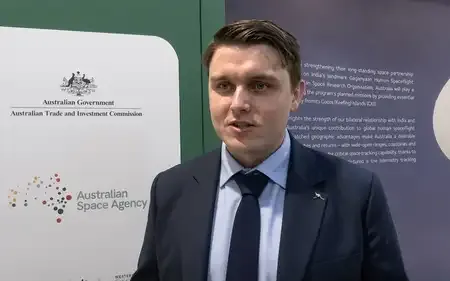
Bengaluru, September 7 (IANS). Australian Trade and Investment Commission Commissioner Nathan Davis has given a big statement regarding space cooperation between India and Australia. He said that after the implementation of the Economic Cooperation and Trade Agreement (ECTA) in 2022, bilateral trade between the two countries has reached a historic figure of 50 billion Australian dollars. This agreement has also given new momentum to the space sector. The official described the MoU between ISRO and Australian Space Agency (ASA) as the highest level among global partnerships.
Question: When the economic cooperation and trade agreement comes into force in the year 2022, how far have India and Australia come in the space sector?
Answer: In comprehensive bilateral relations, we are moving forward as very comprehensive partners and as very old countries. The way economic relations have grown in the last decade, and especially in the last five years, has been very significant. In 2021, we signed a comprehensive strategic partnership to work more closely in many different areas. This is our most highly complementary partnership within the Australian ecosystem. So this has been very important. We are moving forward under our free trade agreement, AI-ECTA. Over the past year, we have finally reached the ambitious target of bilateral trade of AUD 50 billion between our two countries, which is the first time that this feat has been achieved. Such increases have been unprecedented under a free trade agreement. Certainly it has supported the space ecosystem in the same way. We have certainly seen how we have been able to grow trade freely between our two economies, especially over the last few years as our tariffs on imports into India have improved. In this period, we have seen many agreements and certainly the same was the case in India during the time of Prime Minister Narendra Modi, where we signed an agreement, which we call the PAXX agreement, which was focused on cyber technology and space was an important partnership in that.
Question: When Prime Minister Modi visited recently, he had said that India and Australia will work together in the same field. What can the two countries expect from each other?
Answer: Australian ecosystem and Indian ecosystem, we constantly talk about being complementary partners to each other. We are looking at different ways how that ecosystem can complement each other. At the raw material level, we have a lot of resources, which are useful for the supply chain in India's vast manufacturing ecosystem. The technology companies that we have provide a different layer to the tech stack in India. It is also the opposite. India also has a strong tech ecosystem that supports that, and what we are extremely proud of is the large expatriate community of Indians which is over 1 million of our population, which doesn't sound like a lot, but in the context of Australia it is a huge number. We are seeing how it is unfolding with the delegation we have brought. Many of the companies coming here are not looking to compete with what India does, but we have brought 12 companies that are looking at the complementarity aspect, the confluence where their technology supports the broader bilateral ecosystem in very collaborative ways.
Question: What kind of things can India get from Australia?
A: In terms of the 12 companies we have here, we have a reflection of the full spectrum of the Australian space ecosystem. We have everything from early stage intensive research through world-class universities, to upstream technologies like launch and re-entry, to satellite manufacturing and manufacturing. Downstream we are seeing companies that have Earth observation capabilities, in-space manufacturing capabilities, analytics and AI layers. What we're building here is certainly a small mosaic of a much broader fabric of the Australian space ecosystem.
Question: From your point of view, where does ISRO stand in comparison to other space agencies like ASA?
Answer: ASA and ISRO are extremely beneficial partners and we have seen this in many different ways. Their signed commitment on space is the MoU, which is one of the very few bilateral commitments between our space agency and other countries. So, the ASA-ISRO relationship is at the highest level in global partnerships where we see partnership between our two governments.
–IANS
KK/ABM
-
Arsenal close to another Premier League crown as defence once again sets the platform

-
Adidas apologises over Israeli soldier shoe campaign backlash

-
Barcola, Fernandez and Kean headline a weekend of dream debuts

-
Champions League 2026/27 predicted line-ups: Expected starting XIs for Matchday 1

-
Unbeaten even at 40! World Cup hero Vozinha shines on Colo-Colo league debut