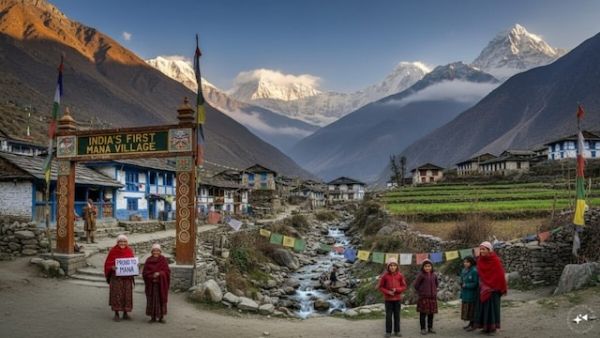
Whenever the snowy valleys and Himalayan mysteries of Uttarakhand are mentioned on the Indian tourism map, the first name that comes to mind is the one that has changed the definition of the geographical identity of the country in recent years. The village which once had the title of being the 'last village' considering it to be the end of the country's border, today after a historic and inspirational call by Prime Minister Narendra Modi, it is proudly called the 'first village' of India. This magical village named Mana, situated at a height of thousands of feet above sea level, very close to the border of China, is now no less than a pilgrimage site for tourists from all over the country and the world. The mysterious caves, age-old mythological tales, gurgling rivers and sky-touching snow-covered mountains attract the tourists so much that everyone who reaches here wants to stay here. If you are also looking for a place this weekend that will give peace to your soul and fill you with adventure, then this first village situated in the lap of Himalayas is going to prove to be the best destination for you. How did this magical village of Chamoli district become the 'first village' of the country from the 'last village'? Mana village, located in Chamoli district of Uttarakhand, is situated near the border of India and China (Tibet), just a few kilometers away from Badrinath Dham. For decades, this village was administratively and geographically known as 'the last village of India', because beyond it the country's border ended and the area beyond was considered a restricted area. But some time ago, during his visit to Badrinath, the Prime Minister of the country Narendra Modi completely changed this thinking and made a historic statement that no end or border village of the country is the 'last', rather it is the first outpost of our country and the 'first village' of the country. This one small ideological change changed the fortunes of this entire region overnight. Government initiatives to develop border villages under the Vibrant Village Program helped in enhancing the image of Mana, after which tourists from all corners of the country started coming here to experience this pride. The village, believed to be the origin place of Saraswati river and the mythological mystery of the sacred cave of Ved Vyas, is not only known for its geographical location, but it also has a deep and unbreakable relationship with Hindu mythology and epic period. It is believed that the epic Mahabharata was composed by Maharishi Ved Vyas while sitting in a natural cave located in this village, which is today known as 'Vyas Cave'. 'Ganesh Cave' is also present near this cave, about which it is believed that sitting here, Lord Ganesha had written down the verses told by Ved Vyas ji. Apart from this, another biggest religious and geographical feature of this village is the origin of the Saraswati river flowing from here. This sacred confluence of Alaknanda and Saraswati rivers is worth seeing. Here the Saraswati river emerges with a thunderous sound from under a huge rock, about which there is a legend that during his exile, Bhima, one of the Pandavas, had paved the way for the flow of this river by removing the huge rocks here. An exciting journey near the Tibet border and a unique confluence of local Bhotiya culture, visiting Mana village is not just about seeing the natural beauty, but it is a cultural experience that takes you closer to the rich heritage of the country. The local residents here mainly belong to the Bhotiya tribe, who are known throughout the region for their unique culture, traditional costumes and hospitality. During the winter season, when there is heavy snowfall, the entire village gets covered with white sheets and the local people move to lower areas, but during summer and monsoon, it is bustling with tourists. The handicraft products, woolen clothes, organic potatoes and Himalayan herbs available in the local markets are quite popular among the tourists. Apart from this, tasting the traditional tea and local mountain cuisine here is an unforgettable experience for every tourist. Despite being so close to the border, due to the alertness of the Indian Army and ITBP personnel, the security environment here remains completely tight, due to which tourists enjoy the valleys here without any fear. Best time and necessary guidelines to visit the first village of the country: If you are also planning to visit this first village of India i.e. Mana, then the time from May to October is considered to be the best time for this. During this time, the weather is pleasant, the roads remain open and due to the doors of Badrinath Dham being open, there is an influx of pilgrims and tourists from all over the country. This beautiful place can be easily reached by road via Delhi or Rishikesh via Chamoli and then Joshimath. During the journey, it is important to keep in mind that since this is a sensitive border area, carry a valid identity card (such as Aadhar Card or Voter ID) with you and completely respect the local rules. It is our collective responsibility to maintain the beauty of this untouched and sacred lap of nature by not spreading plastic waste. So what are you waiting for, plan a trip to this historic and beautiful 'Pehle Village' for your next vacation now and make your trip memorable.
-
Atlético Madrid star torments Liverpool again with another Champions League goal

-
Arsenal may have found the missing element and could finally be ready to win the Champions League

-
Manchester United tracking two Club Brugge players, scouts attend Champions League tie this week

-
Fruit flies or vinegar flies in your kitchen? How to tell them apart and keep them out

-
Andrew Garfield plays Sam Altman in ‘Artificial’