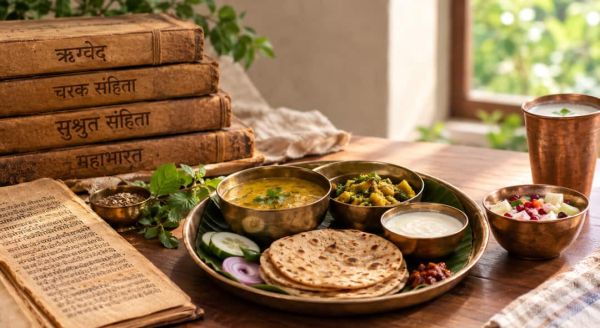
FSSAI CEO Rajit Punhani recently said that eating three fixed meals a day was not traditionally followed in India, with two meals being a more common pattern. But do ancient Indian texts actually support this? Here's what the Vedas, Ayurveda and modern science say.
You wake up, have tea and breakfast, eat dal and roti at lunchtime and sit down for dinner again at night. For most people, three meals a day have become such a routine part of life that questioning the pattern may seem unusual.
But according to Food Safety and Standards Authority of India (FSSAI) CEO Rajit Punhani, the traditional Indian way of eating was different. In a media interaction on September 2, 2026, Punhani said that the Indian tradition did not necessarily revolve around three fixed meals such as breakfast, lunch and dinner. Instead, having two meals was considered a more traditional pattern.
This has raised an interesting question: Was eating twice a day actually recommended in ancient Indian texts, and if so, how did three meals become the norm?
What Did FSSAI CEO Rajit Punhani Say?
Punhani pointed out that packaged and processed food has become increasingly common, including products marketed as convenient breakfast options. He suggested that people should look towards traditional, locally available and home-cooked foods.
FSSAI's 'Eat Right Thali' initiative also promotes healthier traditional eating habits. In 2025, the food regulator released a 424-page book featuring traditional thalis from 29 Indian states. The book highlighted foods such as grains, pulses, spices, seasonal vegetables, fruits and dairy products as important parts of traditional Indian diets.
However, the idea of eating twice a day is not limited to a recent statement by an FSSAI official. Several ancient Indian texts contain references to meal timings and eating patterns.
What Do The Vedas And Ancient Texts Say About Meal Frequency?
The references can broadly be understood through four important examples.
References In Vedic Literature
The Taittiriya Brahmana (1.4.9) has been cited as describing two meals a day. References to the manner and discipline of eating also appear in ancient Indian literature, suggesting that food was viewed as more than simply a routine activity.
An old Ayurvedic saying is often paraphrased as: “One who eats once a day is a yogi, one who eats twice is a bhogi, and one who eats three times is a rogi.” However, such sayings should be understood in their historical and cultural context rather than treated as modern medical advice.
Rules In Dharmashastras And Grihyasutras
Texts including the Gautama Dharmasutra (IX.59), Baudhayana Dharmasutra (II.7.36), Manusmriti (II.56) and Samvarta Smriti (12) contain references to a householder having two meals a day, with food not being consumed between the main meals. The Gobhila Smriti (II.33) also discusses meal timings. The Khadira-Grihyasutra (I.2.23) refers to two meals during the day.
The Apastamba Dharmasutra (II.8.19.10), meanwhile, provides some flexibility by mentioning that roots and fruits could be consumed between the two main meals. This shows that ancient dietary rules were not necessarily identical for every individual or circumstance.
Bhishma's Advice In The Mahabharata
The Shanti Parva of the Mahabharata contains a reference attributed to Bhishma, according to which two eating times were prescribed for humans, one in the morning and another in the evening, with no food in between. Again, these references reflect the dietary and social practices of their time and should not automatically be interpreted as a universal nutritional rule for people today.
What Does The Sushruta Samhita Say?
Ayurvedic text Sushruta Samhita also discusses meal timing. It describes two meals, one in the morning and another later in the day.
According to the text, people accustomed to eating twice a day could have a lighter meal in the morning and another meal later, with specific timings described in terms of traditional periods of the day. There were also exceptions. People who had undertaken certain Vedic practices, including Agnihotra, were not necessarily expected to follow the same eating schedule.
Why Was A Gap Between Meals Considered Important?
Ancient Indian dietary traditions placed importance not only on how much a person ate but also on when they ate. The underlying idea was that the body needed sufficient time to process a meal before another one was consumed. Traditional Ayurvedic and yogic practices therefore often emphasised a gap between meals rather than continuous eating throughout the day.
Some modern proponents of time-restricted eating and intermittent fasting make a similar argument about creating longer periods without food. However, this does not mean that intermittent fasting and ancient Indian dietary practices are exactly the same. Meal timing can also influence factors such as hunger, blood sugar patterns and overall calorie intake, but the ideal schedule varies from person to person.
So Where Did The Three-Meal Pattern Come From?
The three-meal routine of breakfast, lunch and dinner became increasingly established as lifestyles changed.
British And Western Influence
During British rule, Western food habits and social customs became more influential in India. The structured breakfast, lunch and dinner pattern gradually became familiar, particularly among sections of the urban and middle-class population.
Industrialisation And Fixed Working Hours
The growth of factories, offices and fixed working schedules also changed eating habits. A lunch break became a practical part of the working day, while set meal timings fitted better into an increasingly clock-based lifestyle. Earlier, food timings could be more closely linked to agricultural work, household routines and daylight.
The Rise Of Packaged Food
The growth of the packaged food industry further strengthened the idea of breakfast as a distinct meal. Breakfast cereals, snack bars and other convenience foods have increasingly been marketed around the idea of quick and easy morning eating. This is one of the concerns highlighted by FSSAI, which has been encouraging people to choose more traditional, minimally processed and locally available foods.
What Does Modern Science Say About Eating Twice A Day?
Intermittent fasting and time-restricted eating have become increasingly popular in recent years. These approaches involve limiting the time during which a person eats and extending the fasting period. There is some overlap between this concept and traditional eating patterns that involved longer gaps between meals. However, modern scientific research does not establish that everyone should eat exactly twice a day.
Research on meal frequency and fasting suggests that factors such as total calorie intake, food quality, sleep, physical activity and the timing of meals can all influence metabolic health. The effects of fasting also vary depending on the individual and the specific eating pattern.
Therefore, the fact that an eating practice existed in ancient India does not automatically make it healthier for everyone today.
Is Eating Twice A Day Right For Everyone?
There is no single meal schedule that works for every person. Nutritional requirements depend on age, activity level, health conditions and lifestyle. People doing physically demanding work may require more frequent energy intake. Children and teenagers have different nutritional needs, while pregnancy and breastfeeding increase the body's requirement for several nutrients.
People with diabetes or other medical conditions may also need specific meal timings depending on their treatment and medication. Even within Ayurveda, dietary practices are often discussed in relation to an individual's constitution, digestion and circumstances. So while ancient Indian texts contain several references to two meals a day, this should not be interpreted as proof that three meals are inherently unhealthy or that everyone should immediately switch to two meals a day.
The bigger takeaway may be about the quality of food, mindful eating, avoiding unnecessary snacking and choosing a dietary routine that suits an individual's nutritional needs and lifestyle.
-
How to download a Lok Adalat token? Understand the step-by-step process.

-
Railways Liable for Compensation in On-Board Train Robbery; Father-Daughter Duo Win Case After 22 Years

-
IRCTC server crashes at 8 AM; travelers struggle to book tickets for Diwali and Chhath

-
UPSSSC PET 2026 Dates Announced; Check Full Schedule Here
-
Half of India is unaware of the SIP '30-35-40' formula; knowing it could help you amass a corpus of ₹1 crore.