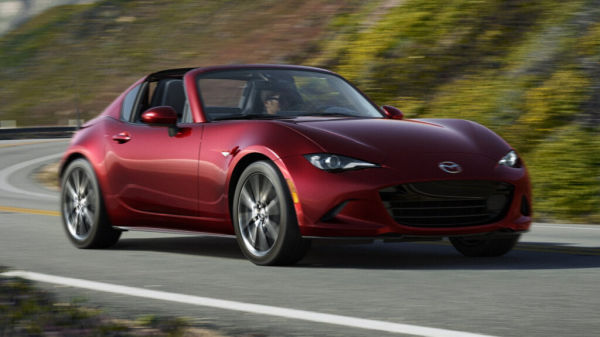
Mazda spent years promoting its cars with the “Zoom-Zoom” tagline, which, according to the brand, is supposed to capture the childlike joy of experiencing motion. Anyone who’s ever stood trackside while a modified RX-7 or even a 787B storms past will certainly know what the manufacturer is getting at, but even the brand’s more down-to-Earth cars can be pretty quick.
From its all-terrain SUVs to its affordably priced hatchbacks, Mazda’s current lineup is filled with cars that prioritize driving fun. Even Mazda’s three-row family hauler is more enjoyable to drive than you might expect.
The brand’s commitment to keeping the original MX-5 Miata formula unchanged over the decades has also earned it plenty of admiration from enthusiasts, especially as so many other simple, lightweight sports cars have been consigned to the archives. Whether you prefer the open-air thrills of a roadster or favor something with more hauling power instead, these fast-accelerating Mazdas all pack plenty of punch when you put your foot to the floor.
Mazda CX-50 Turbo
The Japanese automaker’s current lineup includes SUVs of varying sizes and prices, with both the CX-50 and CX-5 sitting at the smaller, more affordable end of its range. The CX-50 is the more outdoorsy of the pair, with a lower roofline but a slightly higher ride height and plastic cladding on its arches. It’s designed to be more capable across a variety of terrains than the CX-5, with the tradeoff of being slightly less roomy inside.
When Car and Driver tested the CX-50’s straight-line performance on the track in 2024, its reviewers recorded a 0-60 mph time of 6.4 seconds. When we spent time in the SUV, we didn’t put it through its paces on track, but we did take it on a trip down twisting roads that carved through the forests and rivers of Virginia.
We found that the CX-50 held its own both on narrower roads and on the highway, while remaining a practical and comfortable road trip companion. Just like the CX-50 tested by Car and Driver, ours featured the more powerful 2.5-liter turbocharged four-cylinder engine available only on higher trims.
Mazda CX-5 Turbo
The latest generation of the Mazda CX-5 debuted for the 2026 model year, with the previous, second-generation model running from 2017 through 2025. The folks at Car and Driver tested an example of the second-generation CX-5 Turbo and found it could reach 60 mph from a standstill in a respectable 6.2 seconds. According to the outlet, the base-engined car was roughly 2 seconds slower than the turbocharged variant.
The brand has redesigned the CX-5 for the 2026 model year, giving it a fresh interior and updated tech. Unfortunately for keen drivers, it has also removed the optional turbocharged powertrain for 2026, leaving the naturally aspirated 2.5-liter engine from the previous generation as the sole engine option. A 2026 CX-5 therefore has very similar straight-line performance to the previous generation base-spec CX-5, clocking a 0-60 mph time of 8 seconds. That’s still faster than some of its rivals, even if it doesn’t hold a candle to the previous generation.
Mazda 6 Carbon Edition
Mazda has a long history of making sporty sedans, but its current sedan lineup includes only one model: the Mazda 3. It no longer offers the Mazda 6 in America, but until it discontinued it in the early 2020s, Mazda was still updating it. Testing a Mazda 6 Carbon Edition in 2021, MotorTrend said that it was “the quickest current-generation example we’ve ever tested,” clocking a 0-60 mph time of 6.2 seconds.
Under its hood sat the same 2.5-liter turbocharged four-cylinder engine that can be found in many of the brand’s current models, which was mated to a six-speed automatic gearbox. Once, Mazda offered a manual transmission option, but stick shifts have long been considered a dying breed, and the 2021 model no longer offered one. The engine made 250 horsepower on premium 93-octane fuel, the same as Mazda’s top-spec crossovers like the second-generation CX-5 Turbo mentioned earlier.
The most recent generation of the Mazda 6 launched in 2014, and Mazda discontinued it in the U.S. in 2022. At the time of its axing, there were reports that a successor could launch in the future, but no replacement has been announced at the time of writing. That’s despite Mazda’s last remaining sedan seeing a surge in popularity in 2026 as buyers seek alternatives to gas-guzzling SUVs.
Mazda MX-5 Miata NC Club
Its no-frills design and attainable price tag belie the fact that the Mazda Miata is one of the most recognizable sports cars on the market. In 2025, it was officially crowned the world’s best-selling roadster, with over 1.2 million examples produced since it first launched back in 1989. It’s been through four distinct generations over its decades on sale, but the core formula has remained unchanged.
It has always been a lightweight, affordable roadster, designed for maximum handling over all-out power. The point has never been for the Miata to be especially quick in a straight line, but that doesn’t stop it from being one of the fastest-accelerating Mazdas in the brand’s history. The ND Miata holds the distinction of being the fastest Miata to date, but the NC generation isn’t far behind. When MotorTrend tested the Miata NC Club in 2013, the outlet recorded a 0-60 mph time of 6.1 seconds.
Mazda RX-8
While Mazda’s recent patents hint that a new rotary-powered sports car might one day hit dealerships, for now the RX-8 remains the last of its kind. It was built between 2003 and 2012, and featured a 1.3-liter engine making around 230 horsepower. It wasn’t slow, but like most of Mazda’s other sports cars, pure speed was never its main selling point. Instead, the high-pitched soundtrack from its rotary engine set it apart from its competition.
Shortly after receiving its 2004 RX-8, Car and Driver tested it and found that it reached 60 mph from a standstill in 6.6 seconds. Five years later, MotorWeek tested a 2009 example of the car and matched that time exactly. However, after 40,000 miles of driving, Car and Driver’s RX-8 did something that most sports cars don’t — it actually got faster. Retesting it on the track, it returned a 0-60 mph time of just 5.9 seconds, and it was faster over a quarter mile to boot. That puts it on par with many of the fastest accelerating cars in Mazda’s current lineup, despite the two-decade age gap.
Mazda CX-90 Hybrid
Although America misses out on the CX-60 Hybrid, it does receive a similar plug-in hybrid powertrain in the CX-90 Hybrid. It churns out 323 horsepower and propels the three-row SUV from 0-60 mph in a time of 5.9 seconds, according to Car and Driver. The inconvenience of needing to find a charging plug is offset by the addition of up to 26 miles of all-electric driving range. Drivers who don’t always have access to a suitable charging point will still be able to benefit from the SUV’s battery power, since using Charge Mode lets you charge it while driving.
It’s safe to assume that speed is not at the top of the list of priorities for the average CX-90 Hybrid buyer. Unlike the aforementioned RX-8, which will complete the sprint to 60 mph in the same amount of time, the CX-90 Hybrid isn’t aimed at enthusiasts, but rather at buyers who need a practical way to haul around a family and their luggage. Yet, thanks to its electrified powertrain, it’s one of several big Mazda SUVs that are faster than you might assume.
Mazda CX-70 Hybrid
Another SUV that’ll accelerate surprisingly quickly from a stoplight is the Mazda CX-70 Hybrid. Unlike the CX-90, it has no third row of seats, but it shares plenty of other elements with the other SUV. An electrified powertrain, comprising a 2.5-liter four-cylinder engine paired with an electric motor, is one of them. It shouldn’t be unexpected, then, to find out that the CX-70 Hybrid’s 0-60 mph time is identical to the CX-90 Hybrid, sitting at 5.9 seconds, according to Car and Driver.
Just like its larger sibling, buyers of the CX-70 Hybrid won’t be purchasing it primarily for its performance, although it’s certainly a distinguishing feature that helps it stand out from the scores of other large SUVs on the market. Instead, they’ll likely appreciate its plentiful interior space, competitive standard safety tech, and the plush interior that’s available on top-spec trims. On twistier roads, they’ll likely also notice that the CX-70 Hybrid feels more composed than rival SUVs, and that’s no accident. Mazda prides itself on injecting a bit of that “Zoom-Zoom” philosophy into all of its latest cars, both in terms of their handling and their straight-line performance.
Mazda CX-30 Turbo
The smallest car in Mazda’s crossover and SUV lineup is the CX-30. The CX-30 Turbo houses the top-spec engine, offering the same 250 horsepower from its 2.5-liter four-cylinder engine as the brand’s larger models. The shrunken proportions of the CX-30 help nudge it to a faster 0-60 mph time than its showroom siblings, though only by the smallest of margins. According to Car and Driver, the car will pull from 0-60 mph in 5.8 seconds.
It’s not quite the fastest accelerating car in the brand’s lineup, but it’s close. Any small crossover with a sub-six-second 0-60 mph time should feel more than fast enough for everyday driving, and we certainly didn’t have any complaints about its performance after putting the 2025 model to the test. Nonetheless, we thought that the hybrid power available in larger Mazda SUVs would have made the CX-30 even more capable in the city.
Mazda CX-60 Hybrid
There aren’t many Mazda models that U.S. buyers miss out on, but the CX-60 is one of them. In Europe, the CX-60 serves as the brand’s mid-range model, slotting just below the range-topping three-row CX-80. It’s available with a diesel engine or a plug-in hybrid gas-electric powertrain, with the electrified option offering a manufacturer-claimed 0-60 mph time of 5.8 seconds.
The CX-60 Hybrid’s 327 metric horsepower output matches the 323 mechanical horsepower offered in the U.S.-market CX-70 Hybrid and CX-90 Hybrid. Mazda says that’s enough to make the trio its most powerful production cars ever. Adding to its appeal, the CX-60 Hybrid also has up to 39 miles of electric range, according to its manufacturer. It may be the most powerful Mazda on the market, but several Mazda models are even faster off the line. However, none of them are SUVs.
If you’re located in a territory where the CX-60 Hybrid is available, it’s the fastest SUV with a Mazda badge you’ll be able to get. American buyers, meanwhile, aren’t exactly missing out — the CX-70 is only a tenth of a second slower to 60 mph, after all.
MazdaSpeed 6
One of modernity’s more overlooked performance cars is the MazdaSpeed 6. On paper, it has all the ingredients needed for a proper sports sedan, including a six-speed manual transmission, upgraded suspension, and 274 horsepower sent to all four wheels. When MotorWeek got behind the wheel, it hit 60 mph in 5.8 seconds, meaning it could deliver proper sports sedan numbers too. Even so, this mid-’00s Mazda never got the same level of attention as some of its contemporaries.
There’s a chance that will change in the future, as the car gets ever closer to hitting the age where it qualifies as a classic. For now, it’s a cool left-field alternative to sedans from the likes of Subaru and Mitsubishi.
The U.S. market got the best deal with the MazdaSpeed 6. Over in Europe, the car was sold as the Mazda 6 MPS, and it came with fewer ponies under the hood and a less stellar 0-60 mph time of 6.6 seconds. That hasn’t been enough to convince American collectors that it’s worth a premium, with many examples now selling for $10,000 or less.
Mazda MX-5 Miata ND
It might not sound like a compliment to say that the latest Mazda Miata is just like the old model, but it is indeed a compliment. The car’s DNA remains unchanged and is still as appealing as ever, even if it has a bit more tech and driver assists than before. Granted, we thought some of that tech felt pretty old when we spent time with the car in 2023, but that’s hardly a dealbreaker considering what else the car offers. Namely, a back-to-basics feel and a handling profile that encourages you to take the long way home.
The Miata is special because it’s supremely enjoyable to drive without needing to hit illegal speeds, but it’s no slouch either. The latest version of the car offers 181 horsepower, and according to MotorTrend, it takes 5.6 seconds to reach 60 mph. That’s enough to make it one of the fastest-accelerating cars in Mazda’s history, even if it’s still fairly leisurely by modern sports car standards.
Mazda 3 Turbo
At the bottom end of its trim range, the Mazda 3 is an affordable car that looks better than most other vehicles in its price bracket and handles better than many of them, too. At the top end, it’s one of Mazda’s fastest-accelerating cars. Testing by Car and Driver pegged the turbocharged Mazda 3’s 0-60 mph time at 5.6 seconds, making it a couple of tenths of a second quicker than any other five-door car in the brand’s current range. The only model that gets close is the Miata, and that isn’t anywhere near as practical as the Mazda 3.
That 0-60 mph time also puts the turbocharged Mazda 3 at the front of the pack in its segment. Commenting on the result, Car and Driver notes that “No other mainstream compact car’s 60-mph time begins with a five.”
Our reviewer thought that even the entry-level engine still felt more than eager enough to make passing on the highway a breeze. But for maximum performance, the turbocharged version of the car is undoubtedly the winner, not just compared to the non-turbo Mazda 3, but compared to anything else in the brand’s current range.
MazdaSpeed 3
The MazdaSpeed 3 was the last in a line of MazdaSpeed-branded cars, a final hurrah before Mazda discontinued it. The reason? It was, according to one of Mazda’s senior executives Masahiro Moro, too “childish.” Moro told CarSales in 2016 that “As a brand we are trying to elevate again a little bit more, because execution of Mazda MPS or MazdaSpeed 3 or whatever you call it was a little bit – I am not afraid to say it – childish.”
As immature as some of Mazda’s leadership team thought it was, there’s no denying that the car was fast. When MotorWeek tested one, it completed the 0-60 mph sprint in just 5.2 seconds. The outlet’s test car was a 2010 model, although it had previously also tested a 2007 model, which was considerably slower off the mark.
By the time it had reached the 2010 model year, the car made 263 horsepower from its 2.3-liter turbocharged four-cylinder engine, with power being sent through a six-speed stick shift to the front wheels only. It was a recipe for fun, albeit one that, unfortunately for the car’s fans, Mazda has been clear that it isn’t looking to repeat.
Mazda RX-7 FD
Mazda’s fastest-accelerating production car is also one of its most legendary. The FD-generation RX-7 could hit 60 mph from a stop in 5 seconds flat, according to MotorTrend, but like most other performance Mazdas, it wasn’t its acceleration that made it stand out. Instead, the twin-turbocharged 13B rotary engine was primarily what made it special. Mazda’s commitment to rotaries is unique, and the FD RX-7 was proof that its decades of work in refining the rotary engine wasn’t in vain.
The car’s ample power and distinctive soundtrack have turned it into a JDM legend, and it certainly helps that its looks have arguably aged well over the decades too. Reliability might never have been the RX-7’s strongest suit, but that hasn’t dampened its appeal among collectors, nor did it faze the legions of tuners who put their own spin on the car during its heyday.
VeilSide’s kit might be the most famous thanks to its appearance in the Fast and Furious franchise, but there are plenty more. Today, the FD RX-7 is famous for being a whole host of things. It’s a movie star, a sought-after JDM classic, and the bestselling rotary-powered vehicle in history. It’s also still Mazda’s fastest-accelerating car, more than two decades after the last one rolled off the production line.
Our selection methodology
Mazda releases official 0-60 mph times for some, but not all, of its cars. They’re a good indication of what the automaker thinks a model is capable of, but to confirm its claims, independent tests are necessary. Thankfully, reviewers have already tested out the real-world acceleration of the vast majority of Mazda’s cars, and we’ve used results from those tests when compiling this list of fast-accelerating models. Where possible, we prioritized data sourced from third-party testing, but in the few instances where it wasn’t available, we relied on 0-60 mph times provided by Mazda itself.