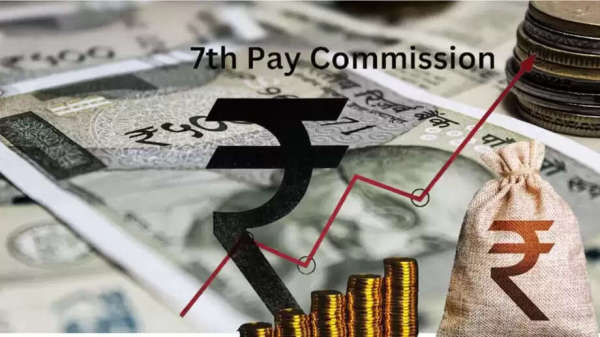
The year 2025 is significant for central government employees, as the 7th Pay Commission completes its 10-year term on December 31st. With this, an entire pay cycle is formally coming to an end. This commission, implemented on January 1, 2016, brought about significant changes in the process of determining employees' salaries, allowances, and pay scales. Today, as discussions about the 8th Pay Commission intensify, it becomes crucial to understand how much salaries have actually increased over the past 10 years.
The biggest distinguishing feature of the 7th Pay Commission was the fitment factor. The government fixed it at 2.57. This meant that the basic salary under the 6th Pay Commission was multiplied by 2.57 to determine the new basic salary. Along with this, another major decision was taken: the grade pay system was completely abolished and replaced with a pay matrix. In the new system, every level and step became clearly visible, making it easier for employees to understand how their salaries would increase.
What was the salary like during the final phase of the 6th Pay Commission?
When the 6th Pay Commission ended on December 31, 2015, inflation was at its peak. This had a direct impact on the Dearness Allowance (DA). The situation for a Level-1 employee at that time was as follows: Basic pay was ₹7,000, and grade pay was ₹1,800. This meant a total basic pay of ₹8,800. The DA had reached 119%, which was approximately ₹10,400. Employees living in major cities received approximately ₹2,600 as House Rent Allowance (HRA). Adding all these components, even excluding transport and other minor allowances, the total salary reached around ₹21,800 to ₹22,000. The impact of inflation was largely covered through the DA even before the new pay commission came into effect.
How did salaries change under the 7th Pay Commission? The 7th Pay Commission, implemented on January 1, 2016, reset the Dearness Allowance (DA) to zero, but in return, there was a significant jump in the basic pay. The basic pay for a Level-1 employee was directly increased to ₹18,000. The complexities of grade pay were eliminated, and the entire salary is now determined according to the pay matrix. At that time, employees felt that the salary hadn't increased as much as expected, because the DA had been reset to zero.
What does today's salary reveal after 10 years?
Now, almost 10 years after the implementation of the 7th Pay Commission, the DA has again increased to approximately 58 percent. On a basic pay of ₹18,000, this DA amounts to about ₹10,400, which is almost the same amount that was being received at the end of the 6th Pay Commission. Meanwhile, a significant change has been seen in the House Rent Allowance (HRA). In X category cities, the HRA has now reached ₹5,400. Thus, the total salary of a Level-1 employee today, even excluding other allowances, has reached approximately ₹33,500 to ₹34,000.
How much has the salary increased in 10 years?
Looking at the overall figures, the picture becomes clear. The basic pay increased from ₹8,800 to ₹18,000, more than double. The DA amount was also around ₹10,400 then and is approximately the same today; the only difference is the percentage. The HRA has almost doubled compared to before, which has provided a good boost to the take-home salary. In total, where the salary was around ₹22,000 ten years ago, today it has increased to approximately ₹34,000. That's a total increase of about 55 percent.
Expectations from the 8th Pay Commission
While salaries have increased over the past 10 years, a large part of this increase has come from the DA. The basic pay has remained unchanged since 2016. Inflation is constantly rising, but the fundamental basis of the salary has not increased. This is why employee organizations are no longer satisfied with just a DA (Dearness Allowance) increase. They are hoping for a higher fitment factor, a higher minimum basic pay, and a new salary structure from the 8th Pay Commission. In the employees' view, the next pay commission is no longer just a matter of relief, but a necessity.
Disclaimer: This content has been sourced and edited from TV9. While we have made modifications for clarity and presentation, the original content belongs to its respective authors and website. We do not claim ownership of the content.
-
PCB chief Mohsin Naqvi hits back at India’s no-handshake policy, says, ‘Pakistan has no…’
-
Abhishek Sharma makes STRONG statement with impressive Vijay Hazare Trophy form, fuels ODI…
-
Yami Gautam reveals she wanted a role in Dhurandhar, says ‘I wished I was a…’

-
Stock Market News: THIS company shares gain nearly 9 percent even as market remains volatile, check full details here

-
Case registered over Instagram reel showing country bomb explosion in Kannur