Highlights
- Voice-first wrist wearables challenge screen-centric design with hands-free, audible interaction.
- Technical hurdles include mic placement, battery demands, and privacy concerns.
- Hybrid models linking wristbands to earbuds/smartphones may be the most practical near-term path.
The concept of a wrist gadget that mainly uses voice for communication instead of a screen changes the traditional notions about wearables: that information must be shown in visual forms, that the main way of interacting is through touch, and that the wrist device has to be equipped with a separate display to be effective.
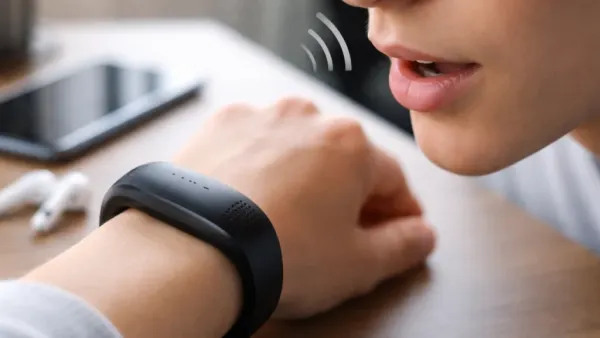
A voice-first wrist wearableno matter if you picture it like a very simple band with a microphone and speaker, a ring that records softly spoken notes, or a module that is attached to your clothes and sends audio to your earbuds, will likely make conversations more immediate, less socially intrusive, and possibly more widely available.
Nevertheless, the technical, social, and commercial hurdles to the establishment of such a category as screenless, voice-led wristwear are formidable. This paper examines the notion, analyzes the available devices that can lead us to that future, and considers the trade-offs that will decide whether voice-first wrist devices are going to be just a rare experiment or a common item in the market.
Why “voice-first” and why the wrist
Over the course of ten years, voice interfaces have grown to be very reliable. The hands-free operation has been made more valuable with the natural language processing, the ability of voice recognition to work well even in crowded places, and the presence of cloud-based AI assistants.
A voice-first gadget minimises the switching between modes: rather than unlocking the phone, going through the menus, and looking at the small text, the user can just give a command or ask a question and get an audible response right away. The form factor, when applied to the wrist, has its pros and cons, though.
The wrist is a socially visible place, which makes it easy to wear a device; it is a good place for holding sensors and mics; and it is also a place that has user habits already established due to watches and bands. Historically, many wrist devices have been visually oriented, smartwatches that mirror a smartphone’s interface. Yet there is a countervailing design logic: some wearables purposefully omit displays to reduce distraction and improve battery life.
Whoop’s band, for example, adopts a screenless, app-centred model that emphasises long-term biometric tracking without pings on the wrist, an approach marketed explicitly as “distraction-free.” This reveals that consumers and designers are already comfortable with non-visual, wrist-worn form factors when the value proposition is clear.
Existing products that suggest the path forward
There are a few mass-market wrist devices today that are truly voice-first; instead, the market shows a patchwork of adjacent solutions. Two product classes are instructive: screenless health bands and miniature voice-enabled wearables that sit off the wrist. Screenless fitness bands such as Whoop or the Oura Ring (the latter being a ring rather than a wristband) demonstrate that users will accept non-visual devices for substantive, continuous functions like sleep and recovery monitoring.
Whoop has explicitly designed its band without a display to encourage focus and deliver analytics through a companion app, illustrating a viable commercial model for screenless, wrist-centred wearables that prioritise background sensing over on-wrist UI. Oura’s ring, while not voice-enabled, similarly shows consumer appetite for subtle, always-on health wearables that avoid screen interruptions.
Complementing these are emergent voice-first micro-wearables that are not wristbound but speak to the same design impulse. Humane’s Ai Pin is a screenless, voice-first wearable clipped to clothing. It foregrounds conversational AI and voice interactions, using voice and gestures instead of a traditional display. Its reception has highlighted both the promise of persistent, screenless assistants and the privacy anxieties they evoke.
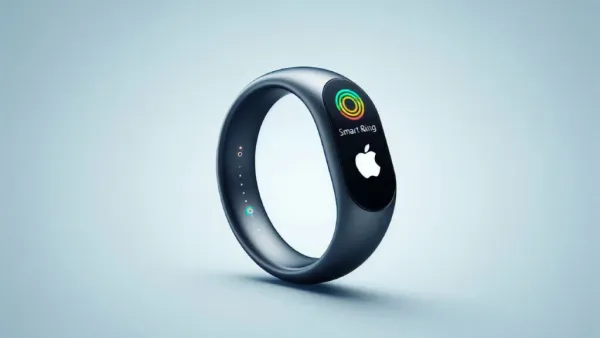
Likewise, recent announcements of smart rings that capture voice notes, for instance, the Stream Ring described in recent coverage, show that voice interaction can be miniaturised into unobtrusive form factors. These devices are important proof-points: voice-first interaction can be compelling in small, intimate wearables, but they are not yet wrist-native.
Technical hurdles for wrist-based voice interfaces
Many engineering issues make the idea of a wrist-mounted, voice-first device challenging. One of the issues is microphone placement and audio quality: the wrist is further from the mouth compared to a collar or a lapel, thus making it likely that the recognition will be affected by noise in the environment, wind, and clothing movements.
To counter this, the design will have to include state-of-the-art beamforming microphones, multi-mic arrays, or alternative bone-conduction sensing methods. However, each option will lead to higher power consumption, increased thermal demands, and greater complexity.
The next limitation is battery power and life. The always-listening wake words and on-device speech processing are power-hungry activities. A wrist device that needs to be always on, always ready to take action, and able to respond without delay cannot be fed by just a small coin-cell battery if it is going to contain mics, DSPs, radios, and speakers.
Designers must choose among larger batteries (which compromise form and comfort), aggressive low-power chips and edge inference, or reliance on paired earphones or smartphones to offload heavy computation. The trade-offs will shape what “always available” means in practice.
Privacy and social acceptability form a third class of obstacles. Voice capture on the wrist feels less private than a whisper into a lapel mic or the direct use of earbuds. Users and bystanders may feel uneasy about a device that appears to be listening in public, especially given recent controversies around voice assistants and camera-equipped wearables. Humane’s AI Pin explicitly sought to mitigate this with visible “trust lights,” but the wrist is a discreet location and thus could generate scepticism if it appears to be recording. Regulatory scrutiny and consumer trust will therefore be decisive factors.
Interaction design: what a wrist voice UI must solve
The voice-first wrist wearable that performs amazingly will not be able to just take the smartphone voice assistant features and put them in a smaller device. It has to come up with new ways of interaction for the brief but rich in context exchanges and for one-handed control. Haptic feedback will hugely contribute to the interaction process being completely constituted, for instance, by indicating a notification, confirming a command, or asking for clarification without resorting to a screen.
Besides, privacy-preserving ambient cues like LEDs or tactile pulses will also be a must to assure the users that the microphone is off. What is more, the device should not be overcompliant: if the voice recognition stops working because of the noise around, it should offer alternative ways (gesture, companion app) instead of leaving the user helpless.
Accessibility is an underappreciated advantage of voice-first wristwear. For visually impaired users, an audible interface combined with haptics could be more natural than tiny visual UIs. Similarly, hands-busy scenarios, such as cooking, exercising, or caregiving, are where voice-first wrist devices could demonstrate clear, practical value.
Commercial prospects and product evaluation
When evaluating the current commercial landscape, it is useful to distinguish between devices that are already succeeding as screenless wearables and those that embody voice-first ambitions. Whoop (and similar health bands) are commercially validated screenless wrist devices that prioritise battery life and continuous sensing via an app, offering a subscription model based on insight delivery rather than on-wrist interaction. Their success suggests a viable market for screenless wristwear where the primary value is background data collection rather than conversational UI.
By contrast, products such as Humane’s Ai Pin and nascent smart rings that record voice notes illustrate the appetite for conversational, screenless wearables, but they also underline the form-factor mismatch when the device is not on the wrist. Humane’s clip-on approach leverages proximity to the mouth and visible indicators to offset privacy concerns; smart rings exploit proximity to the hand for discrete capture. A truly wrist-based voice device would have to reconcile these advantages, proximity, and visible cues with the wrist’s technical limitations.
The hybrid model is the most practical product pathway for the near future: a minimalist, screenless wristband that connects to earphones for sound output and also to a smartphone for heavy processing. The wristband will have microphones, haptics, and contextual sensors, while audio feedback will go to earbuds.
This design keeps the same size and battery life but provides very good voice interaction quality. It also fits in with the current consumer behaviour: many users already use wristbands together with earbuds for working out and talking on the phone. Whether leading companies will go for this approach will rely on their ability to make low-cost, reliable microphone arrays and to convince customers about their privacy.
Conclusion: niche to normative
Voice-first wrist wearables without screens are an intriguing design thesis that addresses distraction, accessibility, and minimal aesthetics. Current market evidence suggests two simultaneous realities: consumers accept screenless wrist devices when the product’s value is clear (health tracking, focus), and voice-first interaction is feasible in miniature wearables when proximity and visible cues are managed carefully (collar clips, rings). The wrist, however, presents distinctive engineering and social challenges that are not yet fully solved.

If manufacturers can deliver reliable on-wrist microphones, efficient on-device or hybrid speech processing, and transparent privacy affordances, while offering compelling utility that is distinct from existing smartwatch ecosystems, voice-first wristwear could move from niche experiment to mainstream option.
Absent those technical and social investments, the market will likely see screenless voice-first features appear first in complementary form factors (clips, rings, earbuds) and in hybrid wrist systems that rely on connected audio devices. The future of minimal wearable design depends less on abandoning screens per se than on rethinking where and how voice becomes the dominant, trusted channel for human-device conversation.
-
Tooth Regrowth Medicine: Why fear tooth loss now? In the next 4 years, teeth will grow again in the mouth; Great miracle of Japan

-
Coldest day of season recorded in Kolkata as cold increases in West Bengal

-
New Year in Ahmedabad: Wildest Dec 31st night with neon raves, horror themes and DJ-led countdowns

-
Make this nutritious millet porridge recipe for morning breakfast in winter, know the easy way to make it.

-
iQOO Z11 Turbo Leaks: 200MP Camera and 7,600mAh Battery… Powerful Smartphone Features Leaked Before Launch