Using the James Webb Space Telescope (JWST), astronomers have spotted unexpected high-energy ultraviolet (UV) radiation around five infant stars, called protostars, in the Ophiuchus star forming area. These findings challenge prevailing models of star formation and could result in fresh insights into the earliest stages of stellar evolution.
Protostars are stars in their initial growth phase, emerging from the collapse of dense pockets of gas and dust within molecular clouds. They remain enveloped in the material from which they arrive, accumulating mass until they are huge enough to ignite hydrogen fusion in their cores, evolving into adult, "main sequence" stars.
The research team determined that ultraviolet radiation must be regarded to completely understand the powerful outflows from these infant stars.
To probe this mystery, the team utilized JWST’s Mid-Infrared Instrument (MIRI) to detect the Ophiuchus molecular cloud, situated about 450 light-years away in the constellation of Ophiuchus, the Serpent-bearer. This area hosts several young, hot B-type stars emitting strong ultraviolet radiation.
Observations confirmed the appearance of UV radiation near protostars, but its source remains uncertain.
"Using these two methods, we showed that ultraviolet radiation, in terms of external conditions, varies significantly between our protostars, and therefore we should see differences in molecular emission," Skretas stated. "As it turns out, we don't see them."
"We can say with certainty that UV radiation is present in the vicinity of the protostar, as it undoubtedly affects the observed molecular lines," Karska cited. "Therefore, its origin has to be internal."
The researchers will continue to study JWST data of the Ophiuchus molecular cloud, that includes gas, dust, and ice, to uncover the mechanisms behind this unexpected ultraviolet radiation.
FAQs;
1. What is a protostar?
A protostar is an extremely young star still forming from a collapsing cloud of gas and dust. It gathers mass until it can initiate nuclear fusion in its core.
2. What is the James Webb Space Telescope?
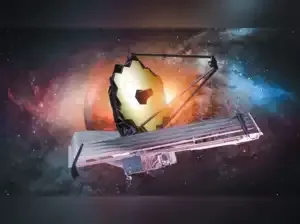
JWST is a powerful space telescope made to observe the universe in infrared light. It studies stars, galaxies, and other cosmic phenomena with unprecedented detail.
Protostars are stars in their initial growth phase, emerging from the collapse of dense pockets of gas and dust within molecular clouds. They remain enveloped in the material from which they arrive, accumulating mass until they are huge enough to ignite hydrogen fusion in their cores, evolving into adult, "main sequence" stars.
Studying Protostars with JWST
"We wanted to take a closer look at protostars, young stars that are still forming deep inside their parent molecular clouds," team member Iason Skretas, researcher from Max Planck Institute for Radio Astronomy, mentioned in a statement. "As protostars accrete mass, they launch part of it outward in the form of jets."The research team determined that ultraviolet radiation must be regarded to completely understand the powerful outflows from these infant stars.
A Surprising Discovery
"This is the first surprise. Young stars are not capable of being a source of radiation; they cannot 'produce' radiation. So we should not expect it. And yet we have shown that UV occurs near protostars," cited Agata Karska, from the Center for Modern Inter-disciplinary Technologies at Nicolaus Copernicus University in Torun, Poland. "Where did it come from? What is its source: internal or external? We decided to investigate."To probe this mystery, the team utilized JWST’s Mid-Infrared Instrument (MIRI) to detect the Ophiuchus molecular cloud, situated about 450 light-years away in the constellation of Ophiuchus, the Serpent-bearer. This area hosts several young, hot B-type stars emitting strong ultraviolet radiation.
Molecular Hydrogen: A Key Clue
The team concentrated on emissions from molecular hydrogen, the universe’s most abundant molecule. While difficult to detect from Earth, shockwaves created when protostellar outflows strike around clouds heat molecular hydrogen, making it emit radiation detectable by JWST. This made JWST and MIRI ideal tools for analyzing protostellar jets.Observations confirmed the appearance of UV radiation near protostars, but its source remains uncertain.
Internal vs. External Sources
Possible origins of the UV radiation included:- Internal processes, like shocks caused by infalling material or jets from the protostar.
- External radiation, arriving from nearby massive stars.
"Using these two methods, we showed that ultraviolet radiation, in terms of external conditions, varies significantly between our protostars, and therefore we should see differences in molecular emission," Skretas stated. "As it turns out, we don't see them."
"We can say with certainty that UV radiation is present in the vicinity of the protostar, as it undoubtedly affects the observed molecular lines," Karska cited. "Therefore, its origin has to be internal."
The researchers will continue to study JWST data of the Ophiuchus molecular cloud, that includes gas, dust, and ice, to uncover the mechanisms behind this unexpected ultraviolet radiation.
FAQs;
1. What is a protostar?A protostar is an extremely young star still forming from a collapsing cloud of gas and dust. It gathers mass until it can initiate nuclear fusion in its core.
2. What is the James Webb Space Telescope?
JWST is a powerful space telescope made to observe the universe in infrared light. It studies stars, galaxies, and other cosmic phenomena with unprecedented detail.