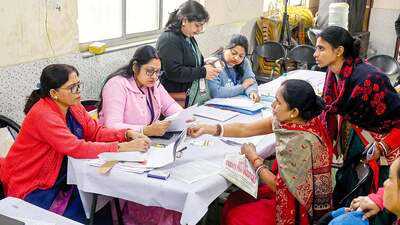
On 27 October 2025, the Election Commission of India (ECI) launched a Special Intensive Revision (SIR) of electoral rolls across nine states and three Union Territories (after a test run in Bihar). By early January 2026, provisional lists revealed an astonishing outcome: nearly 6.5 crore citizens had been removed from the rolls.
India has not witnessed a net decline in registered voters of this magnitude since the introduction of universal adult franchise in 1950 — not during wars, not during famines, not even during the Covid-19 pandemic that claimed millions of lives. The scale of deletion alone rules out benign explanations.
The question before the republic is no longer administrative but existential: if the State can erase 6.5 crore citizens without census data, without parliamentary debate, without transparent criteria and without meaningful due process, does universal adult franchise exist as a right — or merely as a constitutional ornament?
A net decline of such magnitude can be explained by only three phenomena: mass death, mass emigration or mass disenfranchisement.
India has experienced none of these. Even the most expansive estimates of excess Covid-19 deaths — figures the state has resisted acknowledging — fall far short. More tellingly, the pandemic’s peak lies years behind us. If mortality were the cause, deletions would have peaked then, not now.
Internal migration offers no escape from this arithmetic. Migrants do not lose citizenship by moving; they merely change location. Migration complicates voter registration, but it cannot shrink the electorate by tens of millions unless the system is designed to exclude itinerants rather than accommodate them.
SIR 2.0, the new chapter of disenfranchisementOnly one explanation remains: this is political engineering of the electorate. The central question is therefore not how the Election Commission executed the deletions, but who decided that these 6.5 crore people no longer count as voters — and by what authority.
Electoral roll revision is a routine democratic exercise. It adds new voters, removes the deceased based on records and corrects errors. It is incremental, cautious and overwhelmingly additive. Democracies assume that electorates grow.
The SIR departs radically from this logic. It is subtractive. Most critically, it reverses the constitutional burden of proof. Instead of the State establishing grounds for deletion, citizens are required to prove their continued eligibility.
This inversion is not procedural trivia — it is constitutional sabotage. Universal adult franchise rests on the presumption of inclusion. The State must prove death, duplication or loss of citizenship.
The SIR replaces this presumption with suspicion. Voting ceases to be a right flowing from citizenship and becomes an administrative privilege, contingent on documentation, deadlines and bureaucratic discretion.
A right that must be periodically re-earned is no longer a right.
****
The decade-long absence of a national census is not incidental to this mass deletion — it is its enabling condition. A census is the epistemic foundation of democracy. It establishes demographic facts against which representation, welfare and electoral rolls are verified. By refusing to conduct a census for over a decade, the State has dismantled this foundation. There is now no authoritative benchmark against which the EC’s claims can be tested.
In this vacuum, numbers acquire an oracular status: asserted, not validated.
The irony is brutal. A State that demands documents to prove citizenship refuses to document its own population. Papers are demanded selectively and weaponised against the vulnerable. Conducted without census data, the SIR process expresses sovereign power unmoored from empirical accountability.
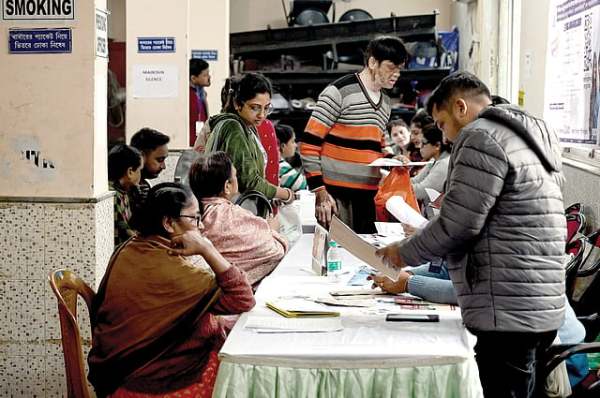 When crores lose voting rights due to administrative actions, India’s foundation is breached Wonders of SIR: Hindu votes in Muslim homes! BLO says “we’d have fixed it”
When the State can remove 6.5 crore people from the electoral rolls without proving that they have died, emigrated or lost citizenship, it is no longer administering democracy. It is editing it.
Administrative exercises never operate on neutral social terrain. They carry a sociology. Who survives them depends on who has documents, stable addresses, literacy to navigate forms, time to contest errors and lives that leave paper trails that the State recognises as legitimate.
Those most vulnerable to deletion are entirely predictable: migrant workers with shifting addresses; the urban and rural poor living in informal housing; Dalits and Adivasis whose historical exclusion translates into thin documentary records; Muslims whose citizenship has been rendered perpetually suspect through NRC–CAA discourse; informal-sector workers whose labour leaves no bureaucratic trace; and citizens whose precarious lives do not generate the paperwork modern governance demands.
These are precisely the populations Indian democracy has struggled to include and that are electorally inconvenient to the ruling powers. They vote disproportionately against incumbents, resist nationalist mobilisations and benefit least from welfare regimes. That they are also the first to disappear from electoral rolls is neither coincidence nor accident.
****
The quiet rewriting of citizenship
Voting rights now hinge on citizenship being demonstrated to administrative satisfaction. This shift has occurred without parliamentary debate, without legislation, without constitutional amendment. Universal adult franchise remains intact on paper while being hollowed out in practice through circulars, verification protocols and any administrative fiat.
The deeper crisis is institutional. The Election Commission was conceived as a counter-majoritarian authority, tasked with protecting electoral integrity from executive interference. Its authority rested on public trust earned through restraint and impartiality.
That authority is now gravely compromised. By presiding over mass deletions without census data, transparent criteria or credible public justification — with effects that fall overwhelmingly on marginalised populations — the Commission has ceased to function as neutral referee. Institutional capture through manipulated appointments and an internal culture of deference has made it a participant in a project to reengineer the electorate.
The pattern is visible well beyond the SIR: asymmetric enforcement of the Model Code of Conduct, indulgence toward ruling-party violations, silence on inflammatory rhetoric and compliance in matters such as electoral bonds.
Defenders argue that deletions can be corrected through objections and re-verifications. This misses the point. The problem is not error but design. The scale ensures mass exclusion; the speed precludes verification; the opacity blocks scrutiny; and the burden is placed on those least equipped to bear it.
Asking 6.5 crore citizens to ‘reapply’ for their vote converts a constitutional right into a renewable permit.
These ‘remedies’ themselves reproduce inequality. They require literacy, time, money, access and persistence — resources the excluded do not possess.
What is being revised, finally, is not the electoral roll but the meaning of who belongs. The political logic is plain. Large segments of the population are ‘managed’ through welfare. Food rations, cash transfers, housing schemes, fuel subsidies — all delivered as favours.
In such a regime, voting is expendable — and sometimes inconvenient. A population ‘disciplined’ through welfare dependency may vote on grievance rather than gratitude, demand more than survival schemes offer or support forces that challenge the distributional and ideological order. For a regime that governs through calculated ‘generosity’, electoral agency becomes a liability.
Mass deletion from electoral rolls is therefore not a contradiction of welfare politics but its logical complement. Those who cannot vote can still be governed; those without electoral power can still receive benefits.
Indeed, benefits become easier to manage when they are detached from political bargaining and delivered administratively. The ideal subject of this order is not the citizen but the beneficiary — compliant, grateful and silent. What emerges is a decisive shift. Democracy presumes that power flows upwards from citizens to the State.
What makes this moment especially dangerous is its procedural camouflage. There are no emergency proclamations, no suspended constitutions, no tanks on the streets. Instead, it’s a silent attack through databases, verification protocols and administrative circulars.
The fabric of democracy painstakingly woven over seven decades is frayed through acts presented as technical necessity. This is authoritarianism without the spectacle.
The technocratic framing isn’t incidental. When disenfranchisement is presented as electoral ‘clean-up’ rather than political exclusion, resistance dissipates. Citizens are more likely to accept loss of rights described as clerical error. Administrative language anesthetises deliberate democratic damage. Overt repression and declared emergencies provoke opposition; procedural normalisation does not.
When millions vanish from electoral rolls through spreadsheets, transformation occurs below the threshold of outrage, accumulating until reversal becomes politically unthinkable.
Universal franchise was our republic’s founding rupture with colonial rule — the principle that transformed subjects into citizens and made the people’s vote the source of legitimacy.
When tens of millions lose voting rights through administrative action, that foundation is breached. The crucial question is no longer who will win elections, but who will be allowed to participate in them.
Democracies that begin by excluding inconvenient voters rarely stop there. They proceed, step by procedural step.
The deletion of 6.5 crore voters is a constitutional crisis. When voters become editable, citizenship provisional and rights revocable by procedure, democracy survives only as shell — its language intact, its substance gone.
Anand Teltumbde is a writer and civil rights activist. Republished with permission from The Wire
-
How to Turn Off Time Limit on Instagram: Step-by-Step Guide for Unlimited Usage

-
SIP Calculation: How long will it take to build a fund of Rs. 10 lakh with a monthly SIP of Rs. 4000? Read the calculation..

-
Instagram Quick Share Feature Explained: How to Instantly Send Posts to Frequent Contacts

-
How to Use WhatsApp’s New Voice Message Player on iPhone: Step-by-Step Guide

-
How to Change or Remove a Bank Account in WhatsApp Payments: Step-by-Step Guide