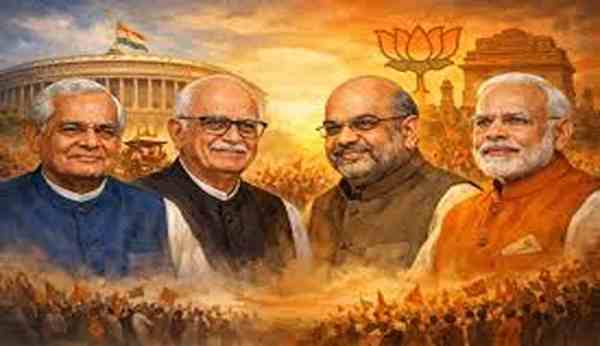
Indian Politics: Prime Minister Narendra Modi recently offered high praise for Nitin Nabin, who has taken charge as the youngest national president of the Bharatiya Janata Party. Addressing party workers, the Prime Minister highlighted not only Nabin’s organisational discipline but also his ability to represent a generational shift in Indian politics. Modi described him as a leader who understands both the legacy of the party and the expectations of a rapidly changing nation. The remarks reflected a broader narrative of continuity combined with renewal within the BJP’s leadership framework.
A Leader Shaped by Transition and Technology
Speaking about Nitin Nabin’s background, the Prime Minister focused on the generational experience that defines his leadership style. According to Modi, Nabin belongs to a cohort that grew up listening to news on the radio and has now adapted comfortably to advanced digital tools. This journey, from analog communication to modern technological platforms, mirrors India’s own transformation over the past few decades. Such exposure has helped Nabin develop a balanced outlook, blending traditional political values with a modern, technology-aware mindset that resonates with younger party workers and voters alike.
Youthful Energy Backed by Organisational Experience
One of the most notable aspects of Nitin Nabin’s rise is the combination of youth and experience. Despite being relatively young in national leadership terms, he has already handled multiple responsibilities within the party and government. Modi emphasized that Nabin has consistently completed every assignment entrusted to him with seriousness and accountability. This track record, according to the Prime Minister, gives confidence that the party’s organisational machinery will benefit from his leadership, especially at a time when political communication, outreach, and strategy are evolving rapidly.
Political Lineage and Electoral Strength
Nitin Nabin’s political journey is also shaped by his family background. He is the son of late BJP leader and former MLA Nabin Kishore Prasad Sinha, a fact that has influenced his early exposure to public service. However, his own electoral success stands independently. He has remained an undefeated five-time MLA from the Bankipur Assembly Constituency, establishing himself as a reliable and popular representative in Bihar. This consistent performance at the grassroots level strengthens his credibility as a national leader who understands local issues.
Understanding the Millennial Perspective
The Prime Minister’s reference to Nabin as a millennial carried symbolic significance. While the technical definition of a millennial often includes those born between 1981 and 1996, Nabin’s birth year places him on the threshold of that generation. Modi used the term more in spirit than in strict demographic terms, emphasizing mindset over age. The idea was to underline Nabin’s adaptability, openness to change, and ability to communicate with younger citizens who form a growing segment of the electorate.
Beyond the Party: Coordination Within the NDA
Modi also made it clear that the responsibility of the BJP national president extends beyond internal party affairs. A key part of the role involves maintaining effective coordination within the National Democratic Alliance. In a coalition environment, leadership requires dialogue, balance, and strategic clarity. The Prime Minister expressed confidence that Nabin’s organisational experience would help strengthen cooperation among alliance partners, ensuring political stability and unified direction.
The BJP as a Culture and a Family
During his address, Modi described the BJP not merely as a political organisation but as a culture rooted in shared values. He spoke of the party as a family where relationships go beyond formal membership. According to him, leadership positions may change over time, but the party’s ideals and long-term vision remain constant. This philosophy, he noted, allows the BJP to nurture new leaders, provide opportunities to first-time entrants, and connect regional aspirations with national goals.
An Unopposed Rise to National Leadership
Nitin Nabin’s elevation to the post of BJP national president was marked by unanimity. He was elected unopposed after emerging as the sole candidate in the organisational election. He succeeded JP Nadda, who currently serves as a Union Minister. Prior to his nomination, Nabin held key portfolios such as road construction and urban development in the Government of Bihar led by Nitish Kumar. He later resigned from these responsibilities to fully focus on his new national role.
A Signal of Continuity and Change
Nitin Nabin’s appointment sends a clear signal about the BJP’s approach to leadership. It reflects continuity in ideology while embracing generational change in style and execution. With strong grassroots roots, administrative experience, and an understanding of modern political dynamics, his leadership is expected to influence the party’s organisational strategy in the years ahead.
-
Tiranga Dhokla: The best and easiest way to make Tiranga Dhokla, know here...
-
Akhilesh blames surge in gold, silver prices on BJP's 'corruption-driven' economics
-
'Newspaper cannot be stopped': SC grants interim relief to media outlet
-
Businessman saves 25 million Lego bricks from landfill - this is how he does it

-
Helmut Marko names two favourites for 2026 F1 title as Max Verstappen snubbed