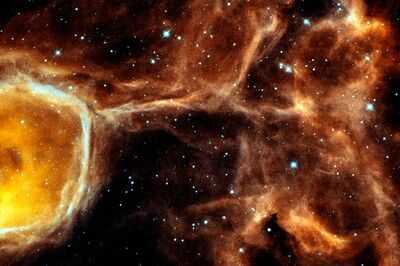
Hard science and theology rarely have much common ground, but one former Harvard physics professor has claimed that he has worked out the exact location of Heaven.
Dr. Michael Guillen, who has a PhD in physics, math and astronomy and taught physics at Harvard, explains that not only is the universe expanding, but the more distant an object is, the faster it’s receding from us. This is a widely-accepted view, based on observations made by celebrated American astronomer Edwin Hubble.
Based on Hubble’s work, Dr Guillen says: “Theoretically, a galaxy that’s 273 billion trillion (273,000,000,000,000,000,000,000) miles away from Earth would move at 186,000 miles per second, which is the speed of light.”
- Theory predicts exact date Earth will 'lose gravity leaving millions dead' as NASA responds
- Baba Vanga's chilling 2026 prediction for WW3 as global tensions boil over
Dr Guillen adds that the location of those impossibly distant, unbelievably fast-moving objects is called the Cosmic Horizon. Beyond this boundary lie more galaxies, but their light hasn't reached Earth yet, and due to accelerating cosmic expansion, some regions are receding so fast they will never be observable. It means there is an absolute limit to what astronomers can observe, no matter what new telescopes we may build in the future.
Most mainstream astronomers believe that there’s nothing unique about any potential objects beyond this limit, other than the fact that we can’t directly observe them. But Dr Guillen has a rather different take.
In an opinion piece for Fox News, Dr Guillen wrote: “Our best astronomical observations — and Einstein’s theories of special and general relativity — indicate that time stops at the Cosmic Horizon. At that special distance, way up there in deep, deep, deep space, there is no past, present or future. There’s only timelessness.”
For Dr Guillen, this “timeless” realm beyond the limits of the observable universe is where Heaven is located. He explains: “As a scientist, I understand the importance of definitions. According to the Bible, the lowest level of Heaven is Earth’s atmosphere. The mid-level heaven is outer space. The highest-level heaven is what we’re talking about: It’s where God dwells.”
He claims that any matter beyond the Cosmic Horizon has some unique properties, existing outside space-time as we know it. He believes its properties match exactly with the ancient descriptions of Heaven in the Bible.
Not only is it, no matter where you stand on Earth “up” above our heads, it’s also inaccessible to us mortals. It is also, according to Dr Guillen, inhabited by “nonmaterial, timeless beings,” or the spirits of the dead.
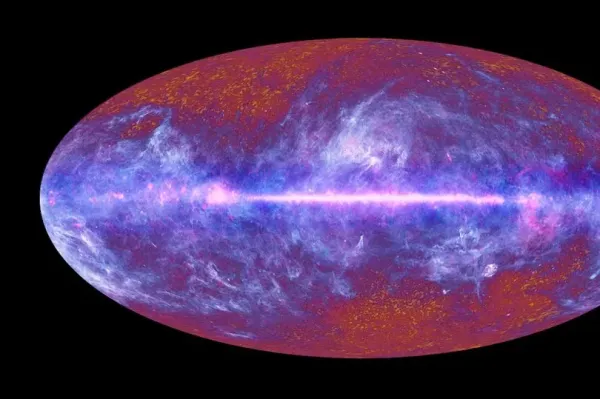
For most other scientists, the cosmic horizon is simply the limit of how far we can see in the universe. Because light travels at a finite speed and the universe has a finite age, distant regions have not had time to send us signals. Beyond this horizon, the universe may exist, but remains unobservable today.
The oldest “light” that we can detect, the very faintest afterglow of the Big Bang, is now the Cosmic Microwave Background – the massively red-shifted light from the earliest epoch of the Universe.
This ancient light is important because it is considered a kind of “afterglow” from the Big Bang.
According to the Big Bang Theory, the universe began about 13.8 billion years ago in an extremely hot, dense state and has been expanding ever since. In the early moments, the universe was so hot that light could not travel freely; it was constantly scattered by charged particles. As the universe expanded and cooled, atoms formed and light was finally able to move through space. That light is what we now observe as the cosmic background radiation.

Over billions of years, the expansion of the universe stretched this light, lowering its energy until it became microwave radiation. Today, it appears almost perfectly uniform in all directions, showing that the early universe was very smooth, with only tiny variations.
These small variations are especially important because they later grew into galaxies and clusters of galaxies. The discovery of the cosmic background radiation in 1965 provided strong evidence for the Big Bang Theory and remains one of its most important confirmations.
In the far future, more and more distant galaxies will begin to disappear beyond our view. The universe is expanding at an accelerating rate, driven by dark energy, causing far-off galaxies to move away faster and faster. Eventually their light will no longer reach Earth, leaving our local group of galaxies isolated in an otherwise dark sky.
Or, from Dr Guillen’s point of view, that could represent Heaven expanding as its population grows.
-
BBC Traitors fans furious as they 'turn off for first time ever' just days before final

-
Manchester crash: Police rush to city centre after car nearly crashes into bar

-
Five biggest bombshells from Prince Harry's emotional testimony in court

-
How my MP voted over removing protections for veterans

-
Chelsea set up thrilling Champions League finale after Moises Caicedo heroics