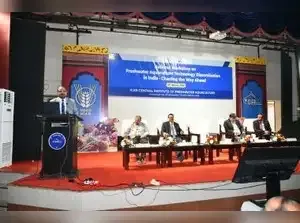
M L Jat, Secretary (DARE) & DG (ICAR), on Tuesday, underscored the critical role of freshwater aquaculture in enhancing farmers’ income, ensuring nutritional security, and strengthening rural livelihoods. Jat, while addressing a one-day National Workshop on “Freshwater Aquaculture Technology Dissemination in India – Charting the Way Ahead” organized by Indian Council of Agricultural Research – Central Institute of Freshwater Aquaculture (ICAR-CIFA), Bhubaneswar, emphasised the need for coordinated national efforts to ensure effective dissemination of technologies, highlighting the importance of leadership and teamwork in realizing the vision of Viksit Bharat.
Stressing the imperative of linking science with society, Jat noted that the Agricultural Technology Application Research Institutes and Krishi Vigyan Kendras play a pivotal role in translating research into field-level impact. He further called for a focused, accountable five-year action plan emerging from the workshop. From the perspective of agricultural development and farmers’ prosperity, he emphasised that a shared vision and collective understanding of priorities—along with convergence and synergy among stakeholders are essential to achieving meaningful and sustainable outcomes.
Jat appreciated the work of ICAR–CIFA and underscored the critical role of freshwater aquaculture in enhancing farmers’ income, ensuring nutritional security, and strengthening rural livelihoods. He emphasised the need for coordinated national efforts to ensure effective dissemination of technologies, highlighting the importance of leadership and teamwork in realizing the vision of Viksit Bharat.
Meanwhile, J K Jena, Deputy Director General (Fisheries Science), ICAR, highlighted the contributions of ICAR–CIFA and emphasised the critical role of freshwater aquaculture technologies in enhancing national aquaculture production.
Jena stated that the primary objective of the workshop was to sensitise Subject Matter Specialists (SMSs) of Krishi Vigyan Kendras (KVKs) about proven freshwater aquaculture technologies for wider dissemination. Sagar Mehra, Joint Secretary (Inland Fisheries), Ministry of Fisheries, Animal Husbandry and Dairying, informed the participants about the establishment of 34 fisheries clusters across the country. He stressed the need for a practical convergence roadmap for high-impact freshwater aquaculture technologies tailored to the requirements of different zones.
Rajbir Singh, Deputy Director General (Agricultural Extension), ICAR, appreciated the innovative and farmer-centric technologies developed by ICAR-CIFA and emphasised their potential for scaling up through extension networks.
B K Behera, Chief Executive, NFDB, underscored the importance of institutional convergence, large-scale demonstrations, scientific validation, and effective last-mile extension for accelerating the adoption of freshwater aquaculture technologies.
Earlier, P K Sahoo, Director, ICAR-CIFA, emphasised the need for concerted effort for dissemination of freshwater aquaculture technologies across the country to enhance farmers’ income, nutritional security, and sustainable livelihoods.
Stressing the imperative of linking science with society, Jat noted that the Agricultural Technology Application Research Institutes and Krishi Vigyan Kendras play a pivotal role in translating research into field-level impact. He further called for a focused, accountable five-year action plan emerging from the workshop. From the perspective of agricultural development and farmers’ prosperity, he emphasised that a shared vision and collective understanding of priorities—along with convergence and synergy among stakeholders are essential to achieving meaningful and sustainable outcomes.
Jat appreciated the work of ICAR–CIFA and underscored the critical role of freshwater aquaculture in enhancing farmers’ income, ensuring nutritional security, and strengthening rural livelihoods. He emphasised the need for coordinated national efforts to ensure effective dissemination of technologies, highlighting the importance of leadership and teamwork in realizing the vision of Viksit Bharat.
Meanwhile, J K Jena, Deputy Director General (Fisheries Science), ICAR, highlighted the contributions of ICAR–CIFA and emphasised the critical role of freshwater aquaculture technologies in enhancing national aquaculture production.
Jena stated that the primary objective of the workshop was to sensitise Subject Matter Specialists (SMSs) of Krishi Vigyan Kendras (KVKs) about proven freshwater aquaculture technologies for wider dissemination. Sagar Mehra, Joint Secretary (Inland Fisheries), Ministry of Fisheries, Animal Husbandry and Dairying, informed the participants about the establishment of 34 fisheries clusters across the country. He stressed the need for a practical convergence roadmap for high-impact freshwater aquaculture technologies tailored to the requirements of different zones.
Rajbir Singh, Deputy Director General (Agricultural Extension), ICAR, appreciated the innovative and farmer-centric technologies developed by ICAR-CIFA and emphasised their potential for scaling up through extension networks.
B K Behera, Chief Executive, NFDB, underscored the importance of institutional convergence, large-scale demonstrations, scientific validation, and effective last-mile extension for accelerating the adoption of freshwater aquaculture technologies.
Earlier, P K Sahoo, Director, ICAR-CIFA, emphasised the need for concerted effort for dissemination of freshwater aquaculture technologies across the country to enhance farmers’ income, nutritional security, and sustainable livelihoods.