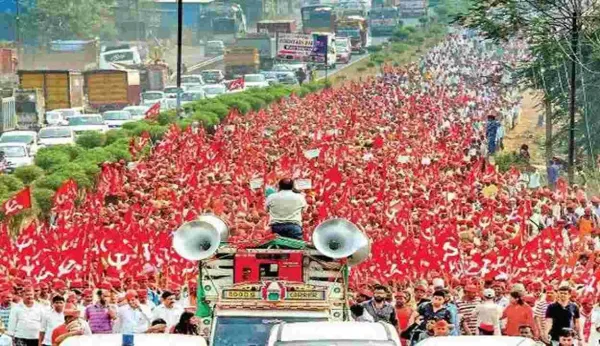
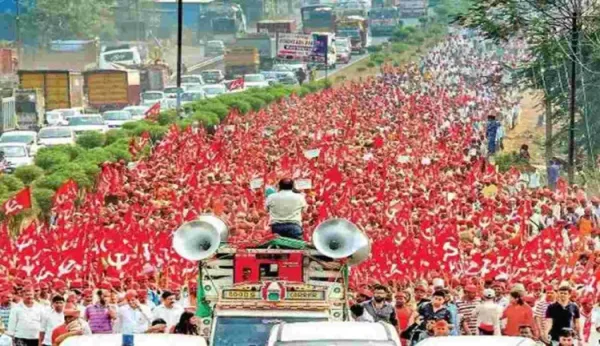
Farmer: Thousands of farmers and members of tribal communities continued their march toward Mumbai on Tuesday, seeking action on long-pending land and agriculture-related demands. The protest, which began in Nashik district, entered neighbouring Thane after covering a substantial distance on foot. Even as the march progressed, the Maharashtra government extended an invitation to protest leaders for discussions at the state secretariat later in the day.
Origins of the March
The march was launched on Sunday following a protest outside the Dindori tehsil office in Nashik district that failed to yield firm commitments from the authorities. Organisers said the absence of clear assurances on key issues prompted them to escalate the agitation by taking their demands directly to the state government in Mumbai. The decision marked a shift from local demonstrations to a coordinated statewide appeal.
Leadership and Organisation
The march is being led by the All India Kisan Sabha, affiliated with the Communist Party of India (Marxist), with participants carrying red flags as they advance. According to organisers, careful logistical planning has been put in place to sustain the protesters over several days. Arrangements for food, grain, firewood and other essentials have been made to ensure that the march can continue without interruption.
Distance Covered and Route Taken
Over the first two days, the marchers covered close to 60 kilometres, moving steadily from Nashik toward Mumbai. On Tuesday morning, the group began its descent through the Kasara Ghat, a key mountain pass connecting the region to the Mumbai metropolitan area. By later in the day, the protesters had crossed into Thane district, signalling that the march was approaching its final destination.
Government Response and Proposed Talks
Protest leaders said sustained mobilisation and widespread media coverage drew the attention of the state administration, resulting in an invitation for talks. A delegation representing the protesters is scheduled to meet the chief minister and other senior ministers at Mantralaya in Mumbai. The delegation includes senior leaders of the farmers’ organisation and elected representatives associated with the movement.
Participation from Tribal Regions
A significant number of participants are tribal farmers from talukas such as Peth, Surgana, Kalwan and Trimbakeshwar. These areas are known to be drought-prone, and residents have repeatedly raised concerns about the lack of reliable irrigation and secure land ownership. Organisers said the march aims to highlight unresolved issues affecting livelihoods in these regions.
Key Demands Raised by Protesters
Among the central demands are the recognition and regularisation of cultivation on encroached land up to four hectares, issuance of proper land records, and a fresh review of forest rights claims that were previously rejected. Farmers are also seeking assured procurement of agricultural produce grown on forest land at minimum support prices. In addition, there is a strong demand for the construction of large check dams on west-flowing rivers and their tributaries to improve water availability for farming.
Impact on Local Transport
The agitation has had noticeable effects on traffic in parts of Nashik district. Over the past two days, vehicles were diverted in the Dindori area after protesters staged a sit-in, leading to congestion on alternative routes. Local authorities worked to manage the situation while ensuring the safety of both residents and march participants.
District-Level Engagement
Before the march moved out of Nashik, protest representatives met with the district collector to discuss local concerns. It was agreed during this meeting that issues specific to the district would be addressed locally, while broader policy-related demands would be taken up with the state government in Mumbai. Protest leaders said this two-tier approach was necessary to ensure that immediate as well as long-term concerns receive attention.
As the march advances and talks are expected to take place, both protesters and officials are watching closely to see whether the discussions lead to concrete outcomes.
-
Domestic stock market regained momentum amidst lot of ups and downs, Sensex rose by 320 points, Nifty stopped at 25175.

-
Apple launches second generation AirTag in India, know the price and powerful features

-
‘Rahul Gandhi insulted Assam,’ Why is BJP cornering Congress for Gamcha?
-
Zelensky hopes for agreement on security guarantees with America

-
India-Europe trade agreement: Tariffs on 99% goods will be reduced or removed