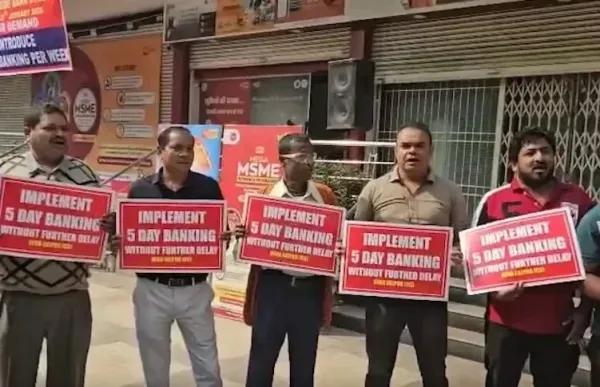
Nationwide: Banking services at public sector lenders across India faced widespread disruption on Tuesday following a nationwide strike by the United Forum of Bank Unions (UFBU). The protest was called to press for the immediate rollout of a five-day workweek, a long-standing demand of bank employees and officers.
The strike action affected routine banking operations in many regions, leading to partial or complete closure of several branches. Customers visiting public sector banks encountered delays or unavailability of counter-based services as staff participation in the strike remained high throughout the day.
Strike Follows Unsuccessful Conciliation Talks
The decision to proceed with industrial action came after a conciliation meeting held on January 23 with the Chief Labour Commissioner ended without consensus. Union representatives stated that the talks failed to produce assurances from the government regarding their primary demand.
According to union leaders, repeated attempts to resolve the issue through dialogue have not resulted in concrete steps. They argue that bank employees are being unfairly treated compared to workers in other sectors who already follow a five-day work schedule.
Union Leaders Express Discontent
The All India Bank Employees Association (AIBEA), a key member of the UFBU, voiced strong dissatisfaction over the outcome of negotiations. Its general secretary, C H Venkatachalam, said employees and officers felt compelled to strike after the government declined to move forward on the agreed terms.
Union representatives maintain that the demand is neither new nor unreasonable, emphasizing that it was part of prior discussions with banking authorities and requires only formal government notification to be implemented.
Branch Operations and Customer Services Affected
Most public sector bank branches reported reduced functionality as both officers and clerical staff joined the strike. Essential services such as cash deposits and withdrawals, cheque processing, loan-related work, and internal administrative tasks were among those impacted.
In addition to public sector banks, a few old-generation private banks also experienced disruptions due to union participation. Customers were advised to expect delays, particularly for services that require in-branch assistance.
Private Sector Banks Largely Unaffected
Major private lenders, including HDFC Bank, ICICI Bank, and Axis Bank, continued operations with minimal disruption. Employees at these institutions are not affiliated with the unions participating in the strike, allowing normal branch activity to continue.
As a result, customers of private banks were largely insulated from the effects seen at public sector lenders, though interbank processes involving public sector institutions faced some delays.
Digital Banking Continues, ATM Issues Possible
Despite the strike, digital banking platforms such as UPI transactions, mobile applications, and internet banking services remained operational. However, ATM cash availability in certain locations could be affected due to delays in cash replenishment caused by reduced staff movement.
Banks advised customers to rely on online channels where possible and plan branch visits accordingly once normal operations resume.
Banks Alert Markets on Potential Impact
Several public sector banks, including the State Bank of India, had earlier informed stock exchanges about the possibility of operational disruption. In a regulatory filing, SBI stated that while arrangements were made to maintain essential services, some impact on branch operations was expected due to the strike.
The disclosure was intended to keep investors informed about potential short-term service interruptions without indicating any long-term financial implications.
Demand Linked to Pending Policy Notification
At the center of the dispute is the unions’ call for all Saturdays to be declared bank holidays. Union officials point out that this provision was part of the 12th Bipartite Settlement signed with the Indian Banks’ Association in March 2024.
Currently, banks operate on the first, third, and fifth Saturdays of each month. The unions argue that formal government approval is the only remaining step needed to implement the agreed five-day workweek.
-
Domestic stock market regained momentum amidst lot of ups and downs, Sensex rose by 320 points, Nifty stopped at 25175.

-
Apple launches second generation AirTag in India, know the price and powerful features

-
‘Rahul Gandhi insulted Assam,’ Why is BJP cornering Congress for Gamcha?
-
Zelensky hopes for agreement on security guarantees with America

-
India-Europe trade agreement: Tariffs on 99% goods will be reduced or removed