New Delhi: Import duty concessions granted by the EU under the free trade agreement with India will help boost the country’s exports to the 27-nation bloc and promote domestic manufacturing, according to exporters.
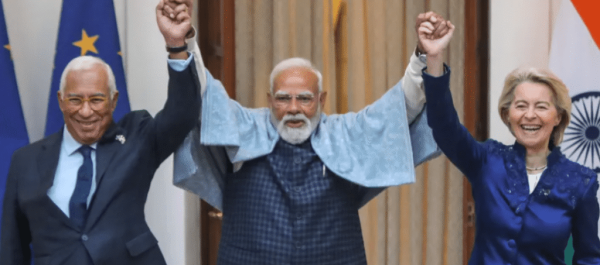
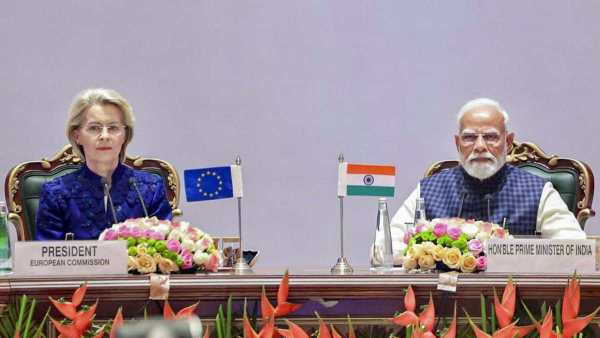
The European Union and India on Tuesday, January 27, announced the conclusion of negotiations for the free trade agreement (FTA) here.
India’s bilateral trade in goods with the EU was USD 136.53 billion in 2024-25 (exports worth USD 75.85 billion and imports at USD 60.68 billion), making the EU India’s largest goods trading partner.

The EU market accounts for about 17 per cent of India’s total exports, and the bloc’s exports to India constitute 9 per cent of its total overseas shipments.
The pact is expected to come into force early next year.
Hailing the pact, Aqeel Panaruna, Chairman, Florence Shoe Company and Director, Grand Atlantia Panapakkam SEZ PvT Ltd, said the European Union remains the largest market for India’s footwear and leather industry, accounting for 44.64 per cent of exports in 2024.
“With exports to the EU at USD 2.25 billion and the total sector exports at USD 5.04 billion, the agreement has the potential to significantly accelerate growth,” Aqeel said.
He added that the shipments to the EU are projected to reach USD 6 billion by 2030, while overall exports could touch USD 14 billion, strengthening India’s position as a globally competitive manufacturing partner.
Gulzar Didwania, Partner, Deloitte India, said tariff concessions in wines, spirits and automobiles under the trade deal are best seen as a bid for reciprocal market access.
“In alcohol, carefully phased liberalisation can help formalise imports. In automobiles, selective opening, particularly for components and EVs, can be leveraged to attract investment, embed technology transfer and strengthen domestic manufacturing ecosystems,” he said.
Apparel Export Promotion Council (AEPC) Chairman A Sakthivel said this deal will provide a significant boost to apparel exports, which are expected to double over the next three years.
“The zero-duty access of Indian garments and clothing to the EU market will decisively turn the tables in India’s favour, enhancing our competitiveness in the European market,” Sakthivel said.
He added that Industry projections estimate that Indian apparel exports could grow by 20–25 per cent year-on-year after the operationalisation of the FTA, against the current growth rate of 3.01 per cent in the EU market.
The FTA eliminates tariffs on 100 per cent of apparel tariff lines, which will enhance market access to all member countries of the EU.
The EU is the world’s largest apparel importer with total apparel imports worth USD 202.8 billion in 2024-25.
Some of the major garment importing countries of the EU, like Germany, France, Spain and Italy, source substantially from India and this deal will further boost our apparel exports to these economies, he added.
While the EU accounts for roughly 28 per cent of India’s apparel exports, the country’s share is only 2.9 per cent in the EU’s apparel market.
“With the elimination of tariffs on Indian apparel products, the Indian apparel industry gains immensely as it will get a level playing field vis-à-vis its competing countries like Bangladesh, Turkey and Vietnam, which enjoy duty-free/ preferential duty access in the EU’s market,” Sakthivel added.
Sharing similar views, international trade expert and Hi-Tech Gears Chairman Deep Kapuria said this is truly the mother of all trade deals.
“For India, this is by far the most comprehensive trade deal ever signed. This will not only restore India’s tariff benefits, which it had enjoyed in the large EU market for years through GSP, but open new avenues for exports and investment flow, particularly in the areas of services, student mobility, and digital trade,” Kapuria said.
Federation of Indian Export Organisations (FIEO) President SC Ralhan said that by unlocking preferential market access across one of the world’s largest consumer markets, the FTA will catalyse exports in key sectors like textiles, gems and jewellery, engineering goods, and leather products.
“The pact will boost export competitiveness by reducing tariff barriers and providing Indian exporters duty-advantaged access, especially in labour-intensive and high-value sectors,” Ralhan said.
He appealed to the exporters community to prepare themselves to leverage the FTA’s full potential by enhancing product quality, meeting stringent regulatory standards, and scaling up capacity to serve large, discerning markets across Europe.
-
Domestic stock market regained momentum amidst lot of ups and downs, Sensex rose by 320 points, Nifty stopped at 25175.

-
Apple launches second generation AirTag in India, know the price and powerful features

-
‘Rahul Gandhi insulted Assam,’ Why is BJP cornering Congress for Gamcha?
-
Zelensky hopes for agreement on security guarantees with America
-
India-Europe trade agreement: Tariffs on 99% goods will be reduced or removed