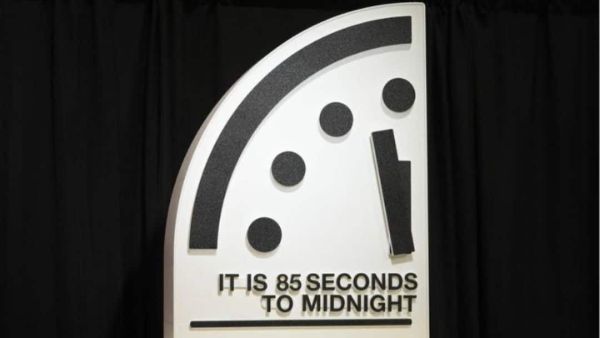
Doomsday Clock: The world is now closer to catastrophe than at any point in history as the Doomsday clock advanced to just 85 seconds to midnight, warned a leading science-based advocacy group on Tuesday. The reduction in time reflects growing alarm over rising global aggression, deepening geopolitical rivalries and the failure of nations to work together on shared existential threats.
The Bulletin of the Atomic Scientists said the world has entered a more dangerous phase, driven by increasingly adversarial and nationalistic behaviour among major powers, including Russia, China and the United States. The group had offered an initial demonstration on Friday before formally announcing its decision on Tuesday.
The Doomsday Clock is a symbolic measure of how close humanity is to self-destruction. Last year, it stood at 89 seconds to midnight, meaning the latest adjustment signals a further deterioration in global stability.
Nuclear, Climate And Technology Risks Drive Alarm
Explaining the decision, the scientists pointed to an expanding set of risks, including the threat of nuclear war, the accelerating climate crisis, the potential misuse of biotechnology and the rapid deployment of artificial intelligence without sufficient safeguards. Together, these dangers are compounding at a time when international cooperation is weakening.
“Hard-won global understandings are collapsing,” the group said, warning that intensifying great-power competition is undermining the collaboration needed to reduce existential risks. The Bulletin expressed particular concern about conflicts involving nuclear-armed states, citing the ongoing Russia-Ukraine war, May’s confrontation between India and Pakistan, and questions over Iran’s nuclear capabilities following US and Israeli strikes last summer.
Daniel Holz, chair of the group’s science and security board, stressed that rebuilding trust is critical. If the world fractures into an “us-versus-them” mindset, he warned, “it increases the likelihood that we all lose.”
Climate Crisis And Global Inaction In Focus
The Bulletin also highlighted the worsening impacts of global warming, including droughts, heatwaves and floods, alongside what it described as a lack of meaningful international agreements to curb emissions. It singled out former US President Donald Trump’s efforts to expand fossil fuel production and weaken renewable energy initiatives as contributing to the problem.
First introduced in 1947, the Doomsday Clock was created to illustrate the likelihood of human actions leading to global catastrophe. At the end of the Cold War, it stood at 17 minutes to midnight. In recent years, however, the pace of global change has prompted the group to shift from counting minutes to seconds.
Despite the grim assessment, the scientists said the clock is not fixed. It could be turned back, they argued, if world leaders and nations choose cooperation over confrontation and take decisive action to confront the risks threatening humanity’s future.
-
Start Hakini Yoga posture from today itself, you will get the benefit of sharpening memory and reducing stress.

-
How to do darshan in budget

-
Bank Holidays 2026: Complete all work soon, banks will remain closed for so many days in February, banking related work may be affected.
-
Don’t get time between work? This ‘Yoga Flow’ of just 10 minutes will melt the stubborn fat of the body:

-
Phulera Dooj 2026: 18 or 19 February, which day is Phulera Dooj? Know why it is considered to be Abuj Muhurat