The conclusion of the India-EU FTA during India’s Pre-Budget period presents a significant opportunity for India to sustain high growth at a challenging juncture. Enhanced trade, technology collaboration, innovation, and investment could present a timely boost as the country grapples with 50 percent tariffs in its largest export market - the United States - along with historically weak net foreign inflows, and a depreciating rupee.
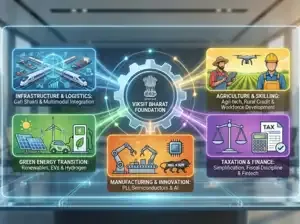
Building on the slew of reforms undertaken in the last year, and against a background of expanding opportunities for trade and investment, Union Budget 2026 can be expected to deliver well-calibrated fiscal interventions for the Indian economy. Leveraging on the country’s robust underlying growth potential, the Budget can be an opportunity to announce policy rationalisation for a more competitive India, to attract investments, integrate more deeply with value chains, and create quality employment. Some of these opportunities are discussed in this write-up, as outlined below.
Rural transformation: Immense potential exists in agriculture, and higher investments could shift the focus to exports and innovation in the rural ecosystem. Last year’s GST 2.0 reforms have positively altered the scenario for consumption and investments in food processing. It is important to deepen reforms and incentivise investment in agricultural technologies, warehouses, cold storages, testing and packaging.
Driving skilling and technology at scale, India’s rural workforce – a large part of which is women – could be proactive participants in an agri-marketing ecosystem for frozen food, ready-to-eat and packaged organic foods for export to affluent markets. Agri-start-ups could be incentivised to aggregate farm surpluses, link products to both domestic and international markets, even as logistics related to supply chains is prioritised. Higher incomes for farmers that so accrue, will act as further impetus to domestic consumption levels and the economy.
A manufacturing powerhouse: In manufacturing, it is imperative to attract greater foreign and domestic investment under the Make in India initiative. Policies and allocations that unlock access to land, labour, logistics, reliable power and other utilities, a skilled workforce, and streamlined customs procedures would accelerate investment in domestic manufacturing and exports. Complemented by support for design, quality testing, branding and consistent marketing outreach, Indian products can not only dominate global markets but also successfully penetrate new ones.
Allocations that strengthen infrastructure and connectivity in industrial corridors, with clarity on establishing large industrial townships - that are country-specific or product-specific with respect to investments - would go a long way in building an ecosystem around supply-chains. The India-EU FTA can open a world of possibilities in this regard for renewable energy, electric mobility, other high-tech areas of innovation and manufacturing.
At the same time, mandating single window clearances, time-bound and deemed approvals, longer validity for licences, along with auto-renewal process, would greatly add to Ease of Doing Business. A new industrial policy - clearly delineating role for centre and states - would bring more accountability and facilitate investments.
Services as growth-enablers: Applications built on the foundation of Digital Public Infrastructure (DPI) - such as UPI, Aadhar and Digilock - have demonstrated what a growth-enabler it can be. Increased capital allocation and support for DPI and its integration with healthcare and education systems, MSME formalisation and logistics-related services would catalyse technical collaborations and economic growth.
Continued policy and fiscal support for digital services - such as fintech, SAAS and AI - would help scale up innovation and value addition in a sector that is already contributing significantly to India’s GDP and exports.
Hi-tech skilling: There is little option but to incentivise rapid upskilling in AI, machine learning, data engineering and other high technology sectors. Expanding industry-linked training programmes - particularly for services, technology and tourism - will rapidly create employment, aligning supply of skilled workforce to demand of growing sectors.
Availability of a strong pool of skilled manpower will attract greater integration of global supply chains, including continued expansion of Global Capability Centres (GCCs), while contributing to international mobility of skilled labour force.
Infrastructure and logistics: Efficient logistics remains an area critical for building global competitiveness for our products. A high priority for infrastructure and services related to transport, urban living, agriculture requirements, high-quality power and fibre corridors, will have a multiplier impact on growth, jobs, consumption.
At the same time, financially empowering the newly formed Gati Shakti Integrated Transport Planning and Research Organisation (GTPRO) to deliver on infrastructure connectivity of economic clusters to EXIM gateways, with a mandate to monitor the progress of investments in Maritime Development Fund and National Infrastructure Pipeline, will propel faster project execution.
Outcomes-based approach: In the last one year, Union Cabinet has approved major policy packages to support trade, industry, infrastructure connectivity, innovation ecosystems - paving the way for the Union Budget to make multi-year allocations to transform these big-ticket initiatives into outcomes.
A shift to outcomes-based budgeting for schemes such as Export Promotion Mission, Electronics Component Manufacturing Scheme, major infrastructure projects for connectivity, the Agricultural Infrastructure Fund, Research Development and Innovation (RDI) Scheme, would give impetus to output delivery.
Delivering Viksit Bharat: Equally important are allocations to implementing institutions such as the National Shipbuilding Mission, SPVs of Industrial Corridors, various Councils and Missions aligned to national priorities of skilling, exports, health, education, and social security, that would expedite deliverables for a Viksit Bharat.
The contributor is former Union Labour Secretary; views are personal.
Building on the slew of reforms undertaken in the last year, and against a background of expanding opportunities for trade and investment, Union Budget 2026 can be expected to deliver well-calibrated fiscal interventions for the Indian economy. Leveraging on the country’s robust underlying growth potential, the Budget can be an opportunity to announce policy rationalisation for a more competitive India, to attract investments, integrate more deeply with value chains, and create quality employment. Some of these opportunities are discussed in this write-up, as outlined below.
Rural transformation: Immense potential exists in agriculture, and higher investments could shift the focus to exports and innovation in the rural ecosystem. Last year’s GST 2.0 reforms have positively altered the scenario for consumption and investments in food processing. It is important to deepen reforms and incentivise investment in agricultural technologies, warehouses, cold storages, testing and packaging.
Driving skilling and technology at scale, India’s rural workforce – a large part of which is women – could be proactive participants in an agri-marketing ecosystem for frozen food, ready-to-eat and packaged organic foods for export to affluent markets. Agri-start-ups could be incentivised to aggregate farm surpluses, link products to both domestic and international markets, even as logistics related to supply chains is prioritised. Higher incomes for farmers that so accrue, will act as further impetus to domestic consumption levels and the economy.
A manufacturing powerhouse: In manufacturing, it is imperative to attract greater foreign and domestic investment under the Make in India initiative. Policies and allocations that unlock access to land, labour, logistics, reliable power and other utilities, a skilled workforce, and streamlined customs procedures would accelerate investment in domestic manufacturing and exports. Complemented by support for design, quality testing, branding and consistent marketing outreach, Indian products can not only dominate global markets but also successfully penetrate new ones.
Allocations that strengthen infrastructure and connectivity in industrial corridors, with clarity on establishing large industrial townships - that are country-specific or product-specific with respect to investments - would go a long way in building an ecosystem around supply-chains. The India-EU FTA can open a world of possibilities in this regard for renewable energy, electric mobility, other high-tech areas of innovation and manufacturing.
At the same time, mandating single window clearances, time-bound and deemed approvals, longer validity for licences, along with auto-renewal process, would greatly add to Ease of Doing Business. A new industrial policy - clearly delineating role for centre and states - would bring more accountability and facilitate investments.
Services as growth-enablers: Applications built on the foundation of Digital Public Infrastructure (DPI) - such as UPI, Aadhar and Digilock - have demonstrated what a growth-enabler it can be. Increased capital allocation and support for DPI and its integration with healthcare and education systems, MSME formalisation and logistics-related services would catalyse technical collaborations and economic growth.
Continued policy and fiscal support for digital services - such as fintech, SAAS and AI - would help scale up innovation and value addition in a sector that is already contributing significantly to India’s GDP and exports.
Hi-tech skilling: There is little option but to incentivise rapid upskilling in AI, machine learning, data engineering and other high technology sectors. Expanding industry-linked training programmes - particularly for services, technology and tourism - will rapidly create employment, aligning supply of skilled workforce to demand of growing sectors.
Availability of a strong pool of skilled manpower will attract greater integration of global supply chains, including continued expansion of Global Capability Centres (GCCs), while contributing to international mobility of skilled labour force.
Infrastructure and logistics: Efficient logistics remains an area critical for building global competitiveness for our products. A high priority for infrastructure and services related to transport, urban living, agriculture requirements, high-quality power and fibre corridors, will have a multiplier impact on growth, jobs, consumption.
At the same time, financially empowering the newly formed Gati Shakti Integrated Transport Planning and Research Organisation (GTPRO) to deliver on infrastructure connectivity of economic clusters to EXIM gateways, with a mandate to monitor the progress of investments in Maritime Development Fund and National Infrastructure Pipeline, will propel faster project execution.
Outcomes-based approach: In the last one year, Union Cabinet has approved major policy packages to support trade, industry, infrastructure connectivity, innovation ecosystems - paving the way for the Union Budget to make multi-year allocations to transform these big-ticket initiatives into outcomes.
A shift to outcomes-based budgeting for schemes such as Export Promotion Mission, Electronics Component Manufacturing Scheme, major infrastructure projects for connectivity, the Agricultural Infrastructure Fund, Research Development and Innovation (RDI) Scheme, would give impetus to output delivery.
Delivering Viksit Bharat: Equally important are allocations to implementing institutions such as the National Shipbuilding Mission, SPVs of Industrial Corridors, various Councils and Missions aligned to national priorities of skilling, exports, health, education, and social security, that would expedite deliverables for a Viksit Bharat.
The contributor is former Union Labour Secretary; views are personal.
(Disclaimer: The opinions expressed in this column are that of the writer. The facts and opinions expressed here do not reflect the views of www.economictimes.com.)