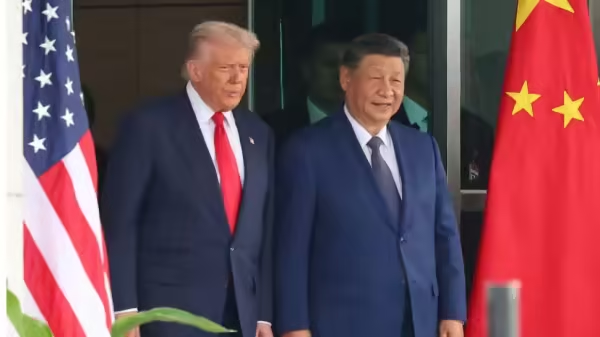
The world grapples with sweeping geopolitical shifts under US President Donald Trump. US-Iran tensions simmer, Trump’s pursuit of Greenland continues, and new cracks are widening inside China.
Beijing faces deepening internal divisions. Elite purges accelerate ahead of the 2027 Party Congress, with leadership shakeups in the People’s Liberation Army (PLA). Economic woes, skyrocketing debt, persistent deflation, and soaring youth unemployment further erode Xi Jinping’s authority, hampering China’s response to external threats.
Reports of a foiled military coup in Beijing have sparked speculation: Are these rifts US-fueled?
Add Zee News as a Preferred Source
Trump’s Anti-China Policies
US president Donald Trump continues his Greenland bid, imposing tariffs, escalating military presence around Iran with an armada of warships around Iran. Trump’s policies are mostly directed toward choking China, whether directly or indirectly.
With the revival of ‘Monroe doctrine’, gripping for hemispheric dominance. The Middle East US-Iran conflict and Trump’s eye on Greenland collectively impact Beijing.
The US president has on multiple occasions targeted Beijing’s growing influence around the globe. “China’s ripping us off for decades, 60% tariffs if they don’t play fair on fentanyl and rare earths,” he warned, reigniting the trade war to slash Beijing’s export edge.
“No more China owning our chips or minerals, we’re building factories at home and blocking their AI takeover,” he added, prioritizing US control of semiconductors.
After the US carried out ‘Operation Absolute Resolve’ earlier this month, US presidnet trump directly lashed out at China, saying, “Took down Maduro, cut off China’s cheap crude, they pay full price now, no more funding Beijing’s military!”
The Iran Nexus
US President Trump’s multi-front offensive against Iran exploits Beijing’s deep economic reliance on Tehran, pressuring China by targeting its critical oil lifeline amid broader efforts to choke its global influence through tariffs, resource grabs, and trade disruptions.
China maintains close ties with Iran, relying heavily on its discounted oil to fuel its economy despite US sanctions. China buys 1.2 to 1.4 million barrels of Iranian crude daily, about 10-13% of its total seaborne oil imports. This represents 80-90% of Iran’s entire oil exports, shipped secretly to small “teapot” refineries in China that process the cheap, sanctioned crude.
Bilateral trade reached $32.9 billion in 2025, making China Iran’s largest partner with 25% of Tehran’s total trade. A 2021 25-year deal promises $400 billion in Chinese investments for guaranteed Iranian oil supplies and infrastructure linking Beijing’s Belt and Road routes through Iran to Europe.
US president’s January 28 warning of a “massive armada” against Iran, plus new 25% tariffs on countries buying its oil, strikes at China’s vital imports from Tehran. Beijing promises to protect its energy needs but condemns US “bullying.”
Venezuela Oil Seizure and Panama Canal Dominance
US policies in Venezuela and the Panama Canal reinforce a broader “Trump Corollary to the Monroe Doctrine,” reasserting dominance over the Western Hemisphere to exclude Chinese influence from critical resources and routes.
The 2026 US National Defense Strategy prioritizes “restoring American military dominance in the Western Hemisphere,” surging troops to the Caribbean post-Venezuela operation, and eyeing permanent bases in Panama, Greenland, and the Gulf of America to deny Beijing “strategic footholds.” This shifts forces from Europe/Middle East, framing China as a hemispheric intruder.
With Maduro’s capture and US seizing Venezuelan oil fields not only cuts China’s 80% export share but blocks Beijing’s debt-trap diplomacy in Latin America.
Trump prioritizes US ships and pressures Panama on fees to counter Chinese influence at canal ports, securing vital access for trade and military needs. The canal handles 40% of US-China trade; delays or hikes add 15-20% shipping costs for Beijing, protecting key US strategic routes.
Arctic Trade Route and Greenland Cutoff
US efforts to control chokepoints like the Panama Canal extend to a wider strategy, severing Beijing from Arctic routes, Greenland minerals, and even Suez leverage, creating a global noose around China’s trade lifelines.
Trump aggressively targets Greenland’s Pituffik base expansion and mineral wealth to block China’s ‘Polar Silk Road’, denying Beijing access to 25+ critical rare earths and uranium.
It also eyes dominating melting Arctic routes 30% faster for European trade. Trump’s troop surges and (North American Aerospace Defense Command (NORAD) radars deter Chinese icebreakers, forcing reliance on costlier Panama and Suez paths already pressured by US fees and ship priorities.
US allies like Israel and Gulf states fuel Red Sea Houthi chaos, making the Suez unpredictable with US naval patrols choking China’s Mideast oil exports via Suez.
Combined with Venezuela and Iran oil cuts, Panama trade friction, and Arctic and Greenland denial slashes China’s efficiencies.
Internal Rifts and Elite Purges within Beijing
Beijing currently battles internal divisions ahead of the 2027 Party Congress, driven by Xi Jinping’s aggressive purges of top elites and military leaders.
Trusted allies like CMC Vice Chairman Zhang Youxia and Joint Staff chief Liu Zhenli face investigations for disloyalty, while dozens of generals across the Army, Navy, and Rocket Force have been removed, leaving key posts vacant and the Central Military Commission effectively down to Xi’s core loyalists, according to Reuters.
These internal shakeups, accompanied by external pressures and exploding local debt, erode Xi’s grip, hobbling China’s ability to counter US pressures like oil cuts from Venezuela and Iran, Panama trade fees, and Arctic and Greenland denial.
-
Shamed Andrew just reached disgusting new low - now King Charles must make 1 move

-
Assam Government to Revise High School History Textbooks

-
Drivers warned of 'rotten egg' smell in February

-
Petrol costs drop to lowest rate for years after 3p fall

-
Panic in Spain as British expats snub country for 7 others - full list