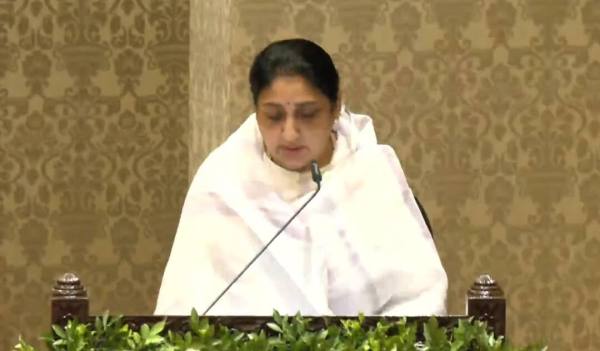
Guwahati, Jan 31: The Chief Minister of Assam, Himanta Biswa Sarma, has directed the Education Department to begin a review of high school history textbooks. This announcement was made during the closing ceremony of the 10th Mising Youth Festival held at Kareng Chapori, where he raised questions about the established narratives surrounding the Ahom-era warrior Bagh Hazarika's involvement in the 1671 Battle of Saraighat.
While addressing the audience, Sarma mentioned that he had already communicated this decision to the Education Department, although he did not provide further details on the reasoning behind this initiative.
The Chief Minister pointed out that current educational materials inaccurately depict Bagh Hazarika as a combatant alongside Ahom general Lachit Borphukan against Mughal forces during the significant battle.
“Bagh Hazarika was not present with Lachit Borphukan at the Battle of Saraighat. It was Miri Handique, a leader from the Mising community, who fought against the Mughals in Kamrup,” Sarma stated, while Union Home Minister Amit Shah was in attendance.
Traditionally, historical accounts have recognized Ismail Siddique, known as Bagh Hazarika, as a 17th-century warrior who allied with Lachit Borphukan in the fight against the Mughals. Siddique is believed to have originated from an Assamese Muslim family in Dhekerigaon village, located near Garhgaon in the current Sivasagar district.
Reaffirming the government's stance, Sarma declared, “We are committed to rewriting history for high school students, and I have informed Education Minister Ranoj Pegu about this.”
This initiative by the Assam government has sparked a contrast with the perspective of renowned historian Romila Thapar, who recently expressed concerns regarding the removal or selective modification of historical content in educational curricula.
During her address at the Kerala Literature Festival (KLF) 2026, Thapar emphasized that history should not be taught in isolation or in fragmented pieces.
“History is a continuous narrative, reflecting the evolution of societies and cultures, as well as behavioral and cognitive patterns. This continuity cannot be disrupted by arbitrarily omitting dynasties or historical periods,” she remarked.
Thapar further contended that excluding entire epochs, such as the Mughal era, skews students' comprehension of societal development and interactions.
“Eliminating the Mughals or any other dynasty fractures history into disjointed segments. Such an approach lacks intellectual validity,” Thapar asserted.
-
RCB Sale: Full List Of Interested Buyers Revealed
-
Pakistan's T20 WC 2026 Hopes Suffer Big Blow As Babar Azam Issue Emerges

-
Budget 2026: Rs 12.4 Lakh Crore Capex Likely, Focus On Defence, Roads, Railways

-
Zero Duty In EU Market: India’s Leather, Footwear Exports Set For Big Push Under FTA
-
From Jayalalithaa To Mamata: Sunetra Pawar Joins Line Of Women Who Rose In Political Turning Points