On Jan. 14 the Louvre Museum in Paris increased ticket prices for visitors from outside the European Economic Area from 22 euros to 32 euros ($26 to $37), a 45% rise, while prices for locals remain unchanged under a so-called “differentiated pricing” model.
|
People wait for the Louvre Museum to open as its employees vote to extend a strike that has disrupted operations at the world’s most visited museum, Dec. 18, 2025 in Paris, France. Photo by AP |
Governments justify the policy by saying it is “fair to taxpayers,” as heritage sites in countries such as France and Italy are funded through national budgets, CNN reported.
France plans to extend this double-pricing to other places like the Palace of Versailles, Sainte-Chapelle and the Paris Opera.
In the U.S., national parks will begin charging foreign visitors an additional $100 from 2026, according to Condé Nast Traveler.
In Japan, Himeji Castle plans to triple entry fees ($30) for foreigners from March 2026, while in Italy, Venice has introduced an entry fee of up to 10 euros ($12) on peak days.
Venice budget councillor Michele Zuin said the fee is meant to manage visitor flows, support local services and discourage low-spending visits, InTrieste reported.
 |
|
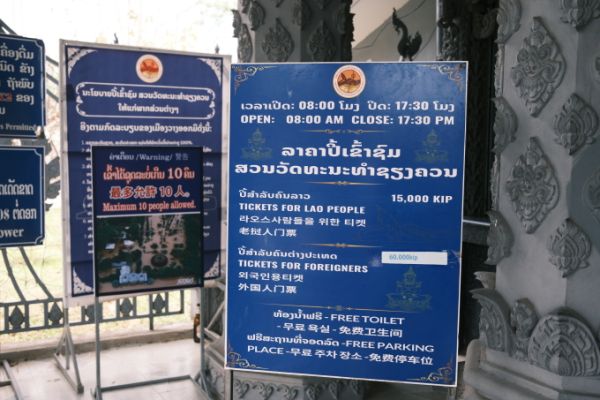
The entrance fee for foreigners at Buddha Park (Wat Xieng Khouane Luang) in Laos is four times that of locals. Photo by Read/Bich Phuong |
Some destinations use higher fees to protect the environment and influence tourist behavior.
In Ecuador’s Galápagos Islands, the entrance fee for international visitors was raised to $200 in 2024, seven times the rate for locals.
Jordan uses pricing to encourage longer stays, charging day-trippers to Petra 90 dinars ($127), while overnight visitors pay a lower standard fee.
Bhutan has the “high-value, low-volume” tourism strategy, requiring international visitors to pay a $100-per-night fee.
In Japan, restaurants have drawn criticism for charging foreign customers more, citing higher labor costs linked to language barriers.
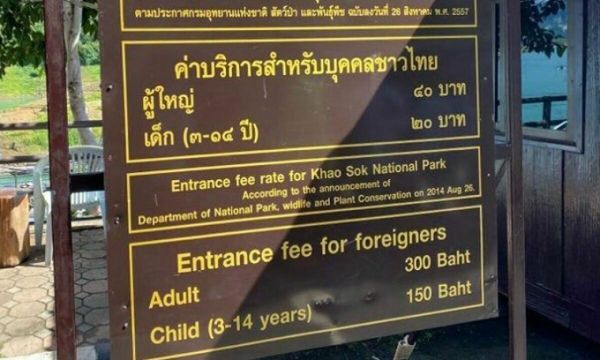
In Thailand, dual pricing at attractions often favors locals. At some places, signs list entry fees of 200 baht ($6) for foreigners in English, while lower fees are displayed only in Thai.
Thai authorities say the system reflects income gaps and that locals contribute through taxes.
|
Entrance fees for Khao Sok National Park for foreigners in English and locals in Thai. Photo courtesy of ASEANNOW |
-
Shamed Andrew just reached disgusting new low - now King Charles must make 1 move

-
Assam Government to Revise High School History Textbooks

-
Drivers warned of 'rotten egg' smell in February

-
Petrol costs drop to lowest rate for years after 3p fall

-
Panic in Spain as British expats snub country for 7 others - full list